
ASTANA – Central Asia was placed at the center of discussions at the Bled Strategic Forum (BSF) in Slovenia for the first time, as the influential international platform dedicated a special panel to the region during its 20th edition on Sept. 1–2.
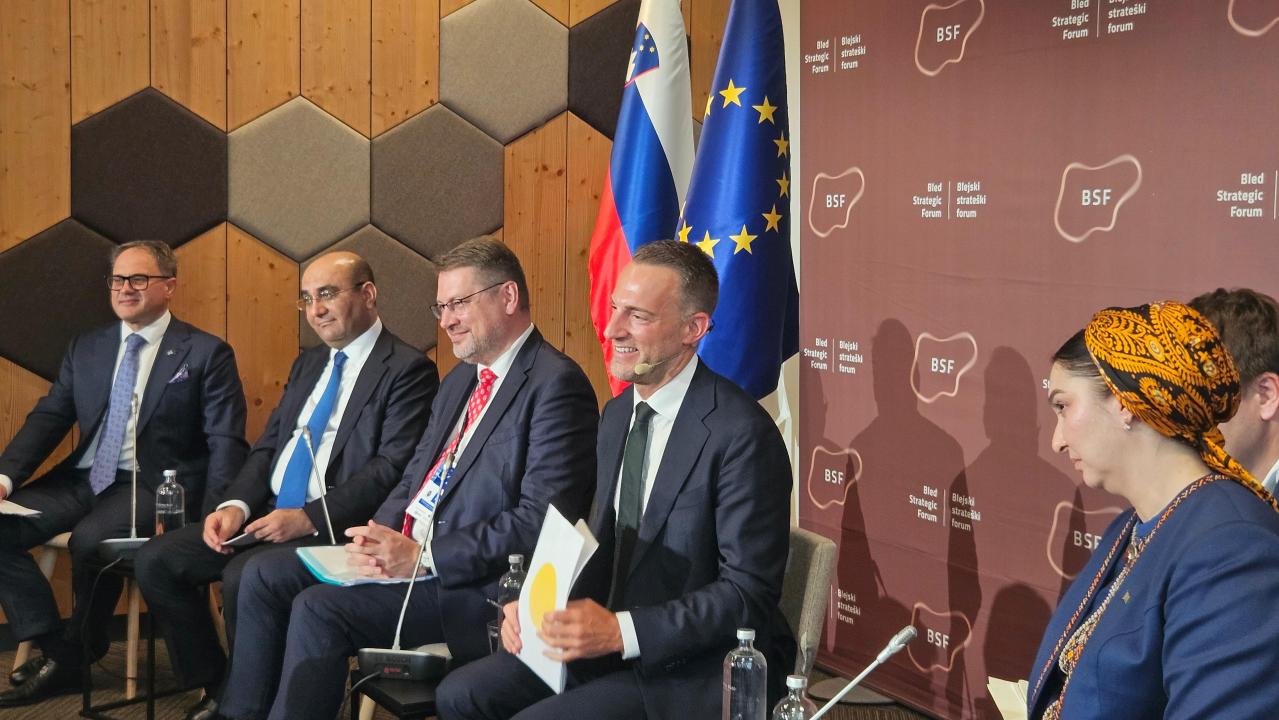
Photo credit: gov.kz
Established in 2006, the BSF has become a key venue for addressing global challenges with the participation of world leaders, politicians, academics, and business innovators in Central and Southeast Europe. The main theme of BSF 2025, A Runaway World, reflected the multiple crises of our time, including geopolitical tensions, economic upheavals, social inequality, and the weakening of international institutions, reported Kazakhstan’s Embassy in Belgium’s press service on Sept. 3.
The panel The New Centrality of Central Asia featured Ambassador of Kazakhstan to the European Union and NATO Roman Vassilenko, EU Special Representative for Central Asia Eduards Stiprais, senior EU officials, and deputy foreign ministers from Uzbekistan and Turkmenistan. The session highlighted the region’s growing importance and its strategic significance in strengthening global dialogue and building a more resilient world order.
In his remarks, Vassilenko presented a vision of Central Asia as a region that is transforming from a passive transit zone into an active and constructive player on the world stage.
“Central Asia is evolving from a landlocked region, from a ‘crossroads’ of other countries’ ambitions — into a hub that connects Eurasia and jointly builds its own future. The five countries – Kazakhstan, the Kyrgyz Republic, Tajikistan, Turkmenistan, and Uzbekistan – speak with a single, confident, and constructive voice. As the global chessboard continues to evolve, one thing is clear: the center of Eurasia is no longer a passive arena – it is an independent player,” Vassilenko said.
Quoting President Kassym-Jomart Tokayev, he stressed that Central Asia should be positioned “not only as a link between Asia and Europe, but also as a separate regional actor in international relations, capable of becoming a new center of global gravity.”
“Europe is not discovering Central Asia – it is remembering why this region is so important. At this stage, Central Asia and Europe, having elevated their relations to the level of a strategic partnership, can deepen practical cooperation in the interests of our peoples, the real effect of which will be felt for many years to come,” Vassilenko said.
Stiprais underscored the EU’s commitment to deeper cooperation, recalling its updated Central Asia Strategy and noting the region’s growing importance for diplomacy, security, and sustainable development.
Experts said Central Asia’s inclusion in the BSF agenda reflects Europe’s recognition of the region as a rising strategic partner, following the EU–Central Asia Summit in Samarkand earlier this year.
As part of the forum, the Kazakh delegation held a series of bilateral meetings with forum participants aimed at strengthening bilateral and multilateral cooperation.
