
ASTANA – Wiebke Schloemer, a regional director for Türkiye and Central Asia at the International Finance Corporation (IFC), explores key milestones in more than 30 years of partnership with Kazakhstan and what comes next in an interview with The Astana Times YouTube channel.
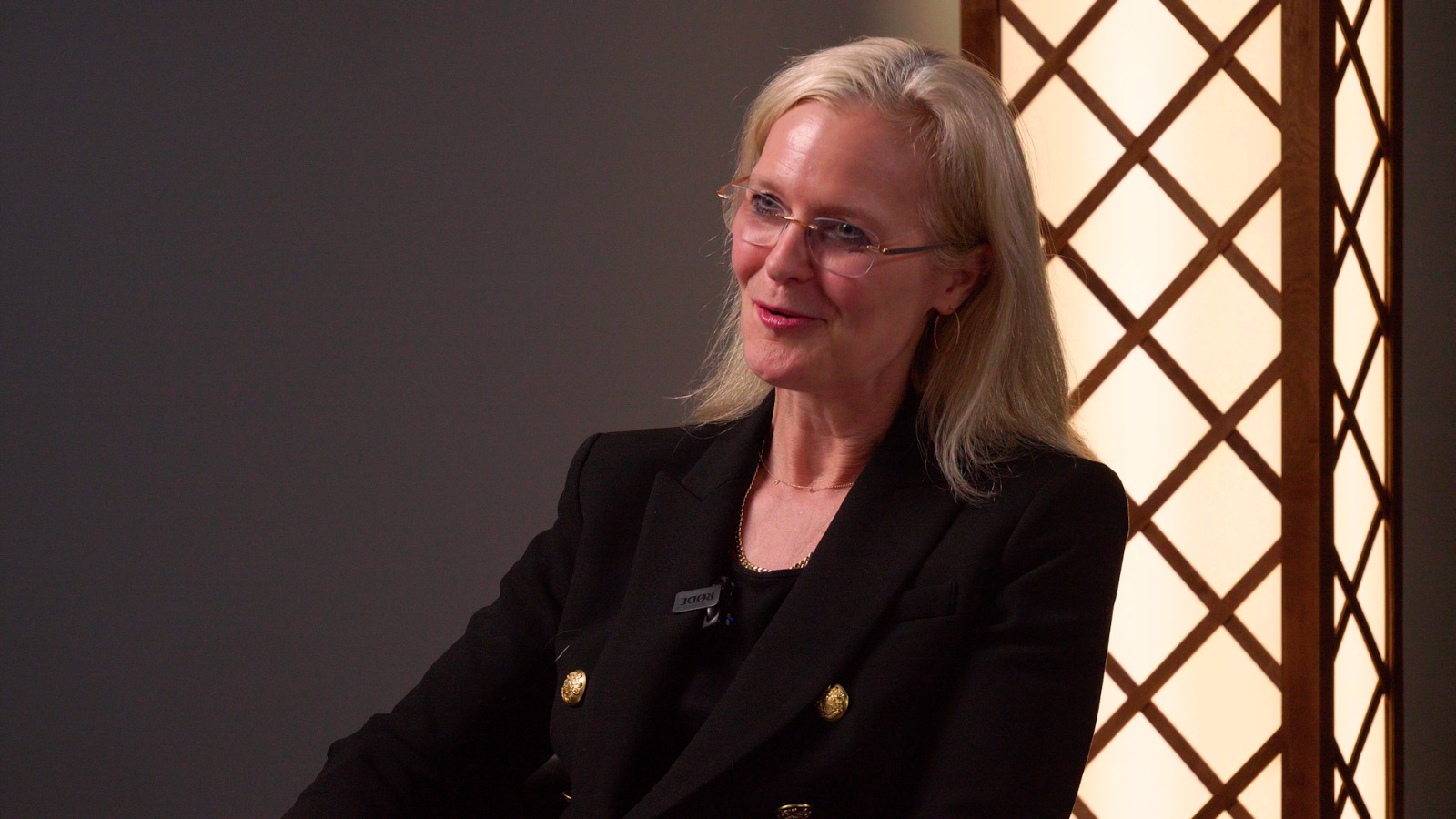
Wiebke Schlomer spoke to The Astana Times YouTube channel ahead of the Astana International Forum on May 29-30. Photo credit: The Astana Times
IFC is a private sector arm of the World Bank Group, and it is the largest global development institution focused on the private sector in emerging markets. The organization’s work spans more than 100 countries, including Kazakhstan.
In fiscal year 2024, IFC committed an all-time high $56 billion to support private sector development in developing countries. Of that, $1.04 billion was allocated to Central Asia. It included more than $400 million in long-term financing from IFC’s own funds, $600 million in mobilization, and $35 million in short-term trade and supply chain financing to support cross-border trade.
“First of all, IFC and the whole World Bank Group have a long-standing partnership with Kazakhstan, and perhaps to put some numbers to it, since we are a financial institution, over the more than two decades of working together, we have invested over $2.6 billion in the country, so a sizable amount and over 60 projects, both financing and advisory projects,” said Schlomer, who visited Kazakhstan to take part in the Astana International Forum on May 29-30.
Support for diversification

Assel Satubaldina and Wiebke Schlomer during an interview. Photo credit: The Astana Times
While hydrocarbons have supported Kazakhstan’s rapid economic growth, the nation also looks to the future with a strong commitment to diversification. This is where IFC’s support came in. It backed two flagship infrastructure projects: the modernization of Almaty International Airport and the landmark Big Almaty Ring Road (BAKAD), which remains the country’s largest public-private partnership (PPP) to date.
IFC provided $222.2 million in financing to the airport’s owners, a consortium led by Turkiye’s TAV Airports. It consisted of a $150 million loan from IFC’s account and $72.2 million from IFC’s Managed Co-Lending Portfolio Program.
The European Bank for Reconstruction and Development (EBRD) also lent $150 million, while the Eurasian Development Bank (EDB) and DEG, a German development finance organization, jointly mobilized $77.8 million in parallel loans.
“It [Almaty airport project] is important for me, because it is really the largest private sector infrastructure financing outside natural resources. Of course, natural resources attract a lot of capital to the country, but as we look into diversifying, the Almaty airport is critical. We are seeing how the expansion and the modernization are leading to increased traffic and better services,” Schlomer explained.
PPPs as a key investment opportunity
BAKAD, she noted, shows how a well-structured, internationally tendered PPP could be delivered ahead of schedule. BAKAD is a 66-kilometer highway around Almaty, Kazakhstan’s largest city, which was built to clear Almaty’s city roads from transportation traffic, improve road safety, and enhance transport services.
“It is still the largest and most complex public-private partnership project in the country, and it was actually one that has been paving the way for more PPPs in the country. I think it shows how a well-structured project within an international, competitive tender process, a very transparent process, can attract a lot of interest from companies all over the world. That’s something where IFC was the lead advisor,” said Schlomer.
She expressed strong optimism about the potential of PPPs to drive sustainable development, an area she has spent over two decades specializing in.
“We see that public-private partnerships play such a vital role, and they can really help tackle key challenges and unlock opportunities across sectors,” she said, highlighting energy and water as sectors where PPP proved to be efficient in Kazakhstan.
“That’s where we see they can really help deliver services in an efficient way, and bring knowledge. Because, often, it is international companies that are being brought in to operate some of the services. It is state-of-the-art knowledge. It is international best practice. Private companies also bring financing. It actually has a positive impact on the government’s budget. From a fiscal perspective, there is a big positive impact,” she explained.
Schlomer emphasized that well-structured projects, particularly in the form of PPPs, are essential to attracting both foreign and domestic investors.
“I always say, for private companies, both foreign and local, what is key for an investor is clarity and predictability,” she said. When thoughtfully designed, PPPs offer exactly that: a clear contractual framework, funding flows, and transparent risk allocation.
Private sector engagement
When discussing further opportunities to engage the private sector in the country’s development goals, Schlomer sounded optimistic.
“We are just discussing together with the government our strategy looking ahead for the next few years, and perhaps as a basis, the country’s national development plan and the diversification strategy really offer a very good basis for a variety of investment opportunities,” she said.
She highlighted the substantial potential that Kazakhstan has in the transport and transit sector, one that she had a chance to notice during her trip to Aktau in the country’s west.
“My trip to Aktau really gave me a very good sense of the transit and transport potential that Kazakhstan has. It is very critical. It is important for infrastructure, transportation, logistics, bringing goods ultimately from Europe, from China to you, Europe, and anywhere in between,” she said.
That opportunity is increasingly relevant as supply chains diversify and the Trans-Caspian International Transport Route, also known as the Middle Corridor, gains traction as an alternative to traditional trade routes.
According to Schlomer, another promising area is agriculture. The sector accounts for 3.9% of the nation’s GDP. Latest figures show that 2024 was a record year for the past decade, with the industry’s gross output increasing by 13.7% to reach 8.3 trillion tenge (US$16 billion).
“Agriculture is always a vital sector in Kazakhstan, because it really provides a livelihood for the population in rural areas. It creates jobs in rural areas. I believe that Kazakhstan is still by far the largest grain producer in the region. That’s very significant,” she said.
Beyond infrastructure and transit, Schlomer emphasized job creation as a broader development challenge facing Kazakhstan and many countries worldwide.
“As the World Bank Group, we have a very big focus on employment opportunities, creating jobs in Kazakhstan, and actually globally. What we see, over the next years, is that there will be hundreds of millions of young people coming to the job market. It is important that they find good jobs and it helps the economic welfare. It is key for stability. That’s where we have a very big focus,” she said.
Globally, IFC sees five sectors as crucial for job creation. It includes infrastructure and energy, agribusiness, healthcare, tourism, and value-added manufacturing. Schlomer said in Kazakhstan, all five are directly relevant.
“All of these are important for economic diversification and economic growth, but ultimately, economic growth is meant for providing welfare, better livelihood for the people of the country,” she added.
Equally important is accelerating the green transition.
“I have a lot of respect for that. The country has already started the green transition, as we name it. What we would like to see and what we stand ready to support is accelerating renewable energy,” she said, stressing the need to foster work on improving water management and energy efficiency.
Watch the full interview on The Astana Times YouTube channel
