
ASTANA – Two Amur tigers released into Kazakhstan’s Ile-Balkhash Nature Reserve are adapting well to their new environment and have begun hunting wildlife, marking an encouraging start to the country’s efforts to restore the tiger population, said Sergey Aramilev, director general of the Amur Tiger Center.
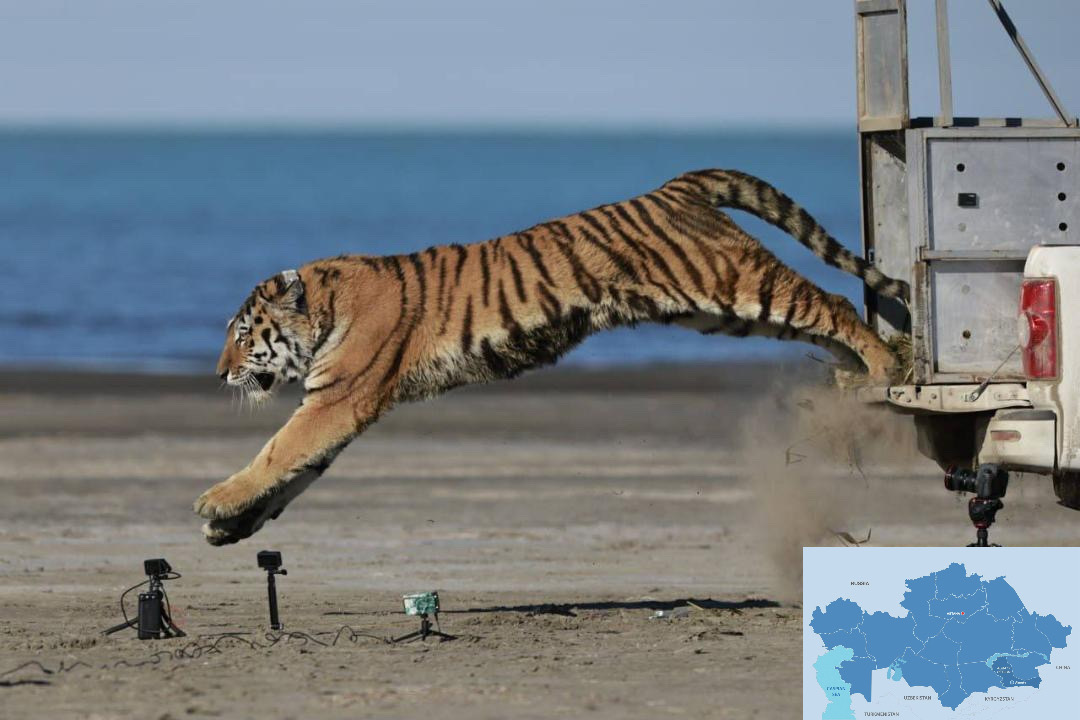
Kazakhstan released a second Amur tiger, named Amur, into the wild on Oct. 31. Photo credit: Ministry of Ecology and Natural Resources. Click to see the map in full size. The map is designed by The Astana Times.
Speaking at a TASS press conference in Khabarovsk on Nov. 18, Aramilev said both animals were healthy and remained within the reserve’s designated area.
“Both are doing well, hunting and staying within the area designated by specialists. The tigress hunts regularly. Her prey has included wild boar, Bukhara deer and a wolf,” he said.
The male tiger, named Amur, has also made a kill, although specialists will identify its prey only after the animal moves far enough away.
First steps toward restoring the tiger population
In May, Russia transferred four Amur tigers to Kazakhstan as part of a program to restore the predator in its historical range. The animals were brought to the Ile-Balkhash Nature Reserve, where the first tigress, named Umit, was released into the wild in late July. Amur followed in late October.
More than 300 deer and kulans were introduced into the reserve to provide food for the predators.
Specialists hope the two released tigers will form a breeding pair, although Aramilev cautioned that their compatibility cannot be guaranteed.
“The female was released earlier and has already established her own temporary territory. The male should be able to detect her presence,” he said, adding that both animals were released as adults because they had reached reproductive maturity.
However, he noted that animal behavior is not governed by instinct alone and the two tigers might simply not accept each other.
The project will be considered successful if the female produces offspring.
GPS tracking monitors adaptation
Both tigers wear GPS collars that transmit location data via satellite, allowing specialists to monitor their movements and adaptation.
According to Aramilev, the tigress travels between seven and 15 kilometers per day. So far, her movement patterns, activity and resting periods resemble those of Amur tigers living in Russia’s Khabarovsk and Primorye territories.
The monitoring data will help researchers assess how the animals use the landscape and determine whether additional releases are possible.
Kazakhstan plans to release two more tigers next year, which will have reached adulthood by then.
Kazakh specialists estimate that the territory could support up to 50 tigers, while their Russian counterparts are more cautious. According to Aramilev, a sustainable population could be established with 10 to 15 animals.
The Amur tiger is the closest genetic relative of the extinct Caspian, or Turan, tiger, which once inhabited Kazakhstan and other parts of Central Asia. The restoration program aims to bring the big cat back to its historical habitat.
