
ASTANA – Kazakhstan aims to attract 100,000 international students by 2029 and strengthen its position as Central Asia’s academic hub through international research partnerships, artificial intelligence development and university modernization, President Kassym-Jomart Tokayev said at the third Strategic Partners Forum on Nov. 19.
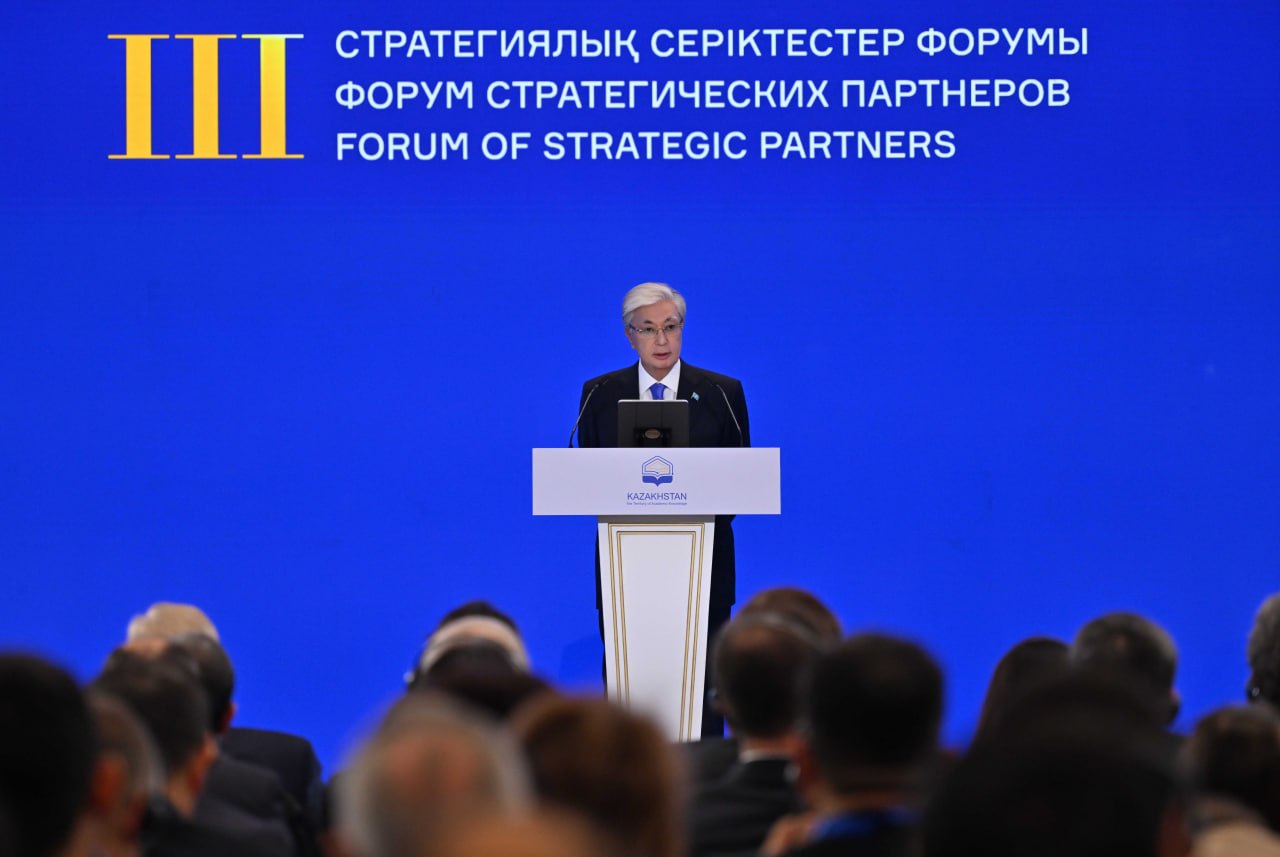
President Kassym-Jomart Tokayev addresses participants of the third Strategic Partners Forum in Astana. Photo credit: Akorda.
Addressing international university leaders, scientists and education experts, Tokayev said the country must move beyond hosting foreign university branches and focus on research, technological innovation and retaining world-class expertise, Akorda reported.
“Our strategic goal is to transform Kazakhstan into an academic hub of Central Asia and become part of the global market for knowledge, particularly relevant and high-quality knowledge,” he said.
From international campuses to joint research
Tokayev described international academic partnerships as the first stage of Kazakhstan’s ambitions. Universities from 11 countries have established branches in the country, enrolling more than 12,000 students and employing nearly 1,500 lecturers, including more than 600 foreign professors.
Kazakhstan currently has 132 universities with more than 800,000 students. The number of international students has increased from 31,000 last year to 41,000, with more than 8,000 receiving financial support from Kazakhstan. The country plans to raise this figure to 100,000 by 2029 through the national Study in Kazakhstan initiative.
Kazakhstan has also become the first country in the region to join the Lisbon Recognition Convention, covering Europe, and the Tokyo Convention, covering the Asia-Pacific region. The move strengthens international recognition of Kazakh university qualifications.
The next stage, Tokayev said, will focus on scientific cooperation, joint research laboratories and breakthrough technological projects.
“Now I have set the task of retaining world-class knowledge in Kazakhstan in the form of qualified personnel, scientific achievements and innovations,” he said.
The forum also featured an exchange ceremony for a signed agreement between Kazakhstan’s Ministry of Science and Higher Education and the United Nations University on establishing a regional research hub in Almaty.
AI and research partnerships
Tokayev highlighted the role of artificial intelligence in transforming higher education and research, noting that Kazakhstan’s universities should focus on developing practical solutions and technological innovations. He cited the development of the national language models KazLLM and AlemLLM, as well as the launch of Qazaq AI Research University, as examples of progress.
“Strong universities are the foundation of the future,” he said.
Shymkent to become a regional education hub
Astana and Almaty have traditionally served as Kazakhstan’s main centers of science, culture and intellectual development, hosting the country’s leading national universities. Tokayev said Shymkent should now become a major scientific and educational hub for southern Kazakhstan.
The city has launched an educational program with Arizona State University and opened a branch of Türkiye’s Gazi University.
Tokayev also announced his decision to grant national university status to South Kazakhstan University named after Mukhtar Auezov, saying it should become a center of high-quality education, advanced research and intellectual development for the region.
Education to support economic transformation
Tokayev linked higher education development to the nationwide People’s Construction program, which will include social, transport and energy infrastructure projects across Kazakhstan.
He stressed that universities must prepare specialists capable of supporting infrastructure development, digital transformation and the expansion of AI across industries.
“Building a knowledge-based economy has become a long-term constitutional commitment that both the current government and all subsequent governments will have to fulfil,” he said.
Tokayev also emphasized that the rule of law and anti-corruption efforts are essential to creating a stable and predictable environment for international academic partnerships.
Concluding his address, he called for deeper cooperation with international universities and researchers.
“Science is an invaluable asset intended to serve the progress of all humanity, which means that knowledge has no borders and should have none,” he said.
