
ASTANA – Kazakhstan has called for stronger international cooperation to counter evolving terrorist threats, emphasizing the need to combine security measures with humanitarian assistance, political engagement and sustainable development. Foreign Minister Mukhtar Tileuberdi presented the country’s priorities at the third Schuman Security and Defense Forum in Brussels on Nov. 18.
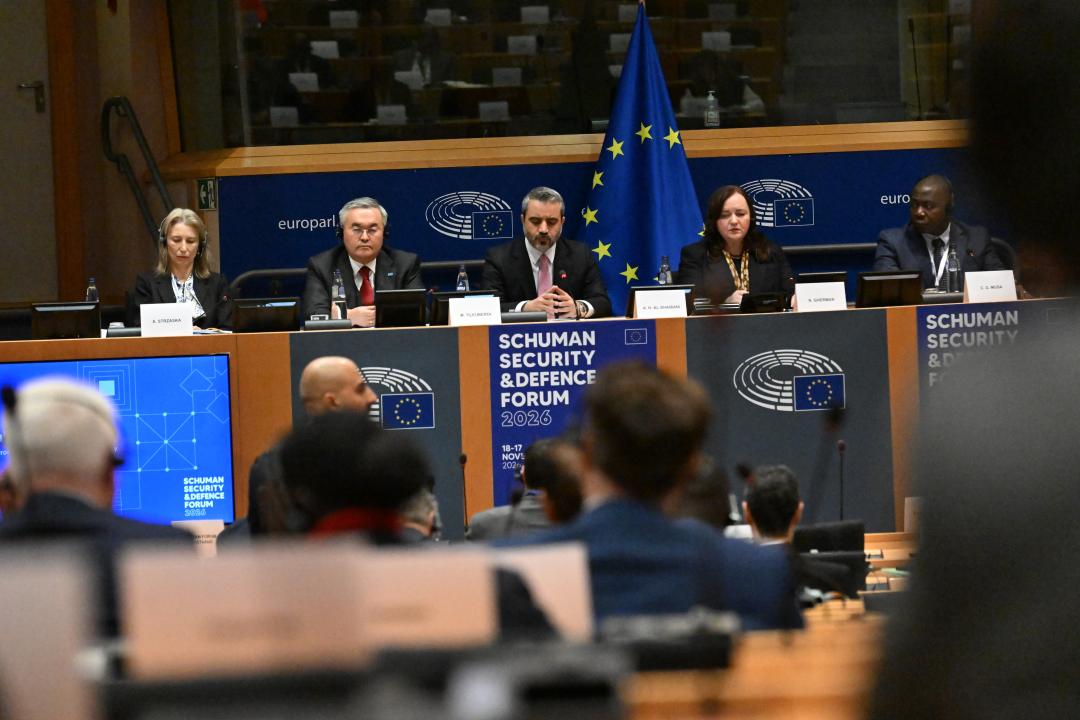
Kazakhstan’s Foreign Minister Mukhtar Tileuberdi with other participants of the third Schuman Security and Defense Forum in Brussels on Nov. 18. Photo credit: Foreign Ministry
Tileuberdi addressed a thematic roundtable titled From Conflict to Terror: Understanding the Evolving Security Nexus, which examined the growing links between armed conflicts, terrorism and regional instability.
The forum brought together delegations from Australia, Azerbaijan, Canada, Brazil, the United States, the United Kingdom and other countries, as well as senior representatives of the United Nations, European Union, Organization for Security and Co-operation in Europe (OSCE), ASEAN and the League of Arab States. Think tanks and academic institutions also participated, the ministry reported.
In his remarks, Tileuberdi outlined the changing nature of terrorist and extremist threats, identifying the spread of radical ideologies through digital platforms, cross-border activities of extremist groups, and risks to critical infrastructure and international transport and energy corridors among the key security challenges.
He stressed that addressing these threats requires coordinated international efforts, including timely intelligence sharing, exchanging best practices, stronger prevention mechanisms and effective rehabilitation and reintegration programs for individuals involved in extremist activities.
Afghanistan and regional stability
Developments in Afghanistan and their implications for Central Asian security were another focus of the discussion. Tileuberdi noted that terrorist networks, illicit trafficking and the spread of radical ideologies continue to threaten regional stability.
Against this backdrop, Kazakhstan reaffirmed its support for pragmatic engagement with Afghanistan, alongside expanded humanitarian assistance and economic cooperation. Education, healthcare, transport connectivity and institutional capacity-building were identified as essential areas for supporting the country’s long-term stability.
To strengthen regional and international cooperation, Tileuberdi proposed making greater use of the United Nations Regional Center for the Sustainable Development Goals for Central Asia and Afghanistan, based in Almaty. He also highlighted opportunities to expand educational programs for Afghan women in partnership with international organizations and donor countries.
Kazakhstan’s participation in the forum provided an opportunity to present its approach to emerging security challenges and engage with European and international partners. Tileuberdi emphasized that lasting security cannot be achieved through military and law-enforcement measures alone, but also requires political dialogue, humanitarian support and sustainable economic and social development.
