
ASTANA – Investment stock from Gulf Cooperation Council (GCC) countries in Central Asia increased 3.4-fold to $31.1 billion by mid-2026. In comparison, trade between the two regions nearly quadrupled over five years to reach $3.9 billion in 2025, reflecting growing economic ties and the Gulf’s expanding role in the region, according to a report by the Eurasian Development Bank (EDB) released on Nov. 10.

Photo credit: Shutterstock
The report, titled Trade and Investment Cooperation Between Central Asia and the GCC Countries, identifies the United Arab Emirates (UAE) as the leading trade and investment partner, accounting for approximately 94% of trade between the two regions and 66% of their total investment stock.
Trade expands nearly fourfold
Trade between Central Asia and the GCC countries increased from $1 billion in 2020 to $3.9 billion in 2025. The Gulf countries’ share of Central Asia’s foreign trade also grew from 0.7% to 1.7%.
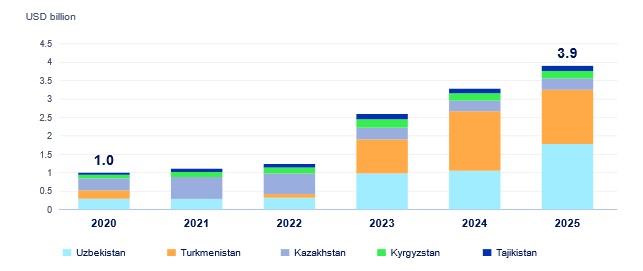
Trade in goods between Central Asia and the GCC countries. Photo credit: EDB
Uzbekistan and Turkmenistan accounted for approximately 85% of the total trade in 2025. Uzbekistan became the largest trading partner, with trade reaching $1.75 billion, or around 45% of the regional total. Turkmenistan followed with $1.6 billion.
Kazakhstan’s trade with the GCC countries exceeded $300 million in 2025. Its exports have become more diversified, extending beyond metallurgical products to include agricultural goods, meat and other food products, chemicals and certain types of equipment. Imports are dominated by pharmaceutical and chemical products, as well as machinery and equipment for the oil and gas industry.
The EDB estimates additional trade potential between Central Asia and the GCC countries at $4.9 billion by 2030. High transportation and logistics costs, limited access to trade finance and shortcomings in the mutual recognition of standards remain among the main barriers to expanding trade.
The Economic Partnership Agreement between the Eurasian Economic Union (EAEU) and the UAE, which entered into force on Oct. 6, is expected to create additional opportunities by eliminating or reducing tariffs on more than 85% of the product range.
Gulf investment shifts toward energy
According to the EDB’s Monitoring of Mutual Investment, investment stock from GCC countries in Central Asia increased from $9.1 billion in 2020 to $31.1 billion by mid-2026.
Turkmenistan remains the largest recipient, with investment stock reaching $14.4 billion. Uzbekistan recorded the fastest growth, with investments increasing more than 25-fold to $11.3 billion. Kazakhstan’s investment stock reached $5.3 billion.
The UAE leads among Gulf investors with a portfolio of $20.6 billion, accounting for 66% of the total. Saudi Arabia and Qatar are also expanding their presence, with investment stock reaching $6.5 billion and $3.1 billion, respectively.
The sectoral structure of investment is also changing. The electric power sector’s share rose from 2% in 2020 to 34%, with investment stock reaching $10.5 billion. Meanwhile, the commodities sector, although still accounting for the largest share at 49%, declined from 82% in 2020.
The expansion of renewable energy projects, notably solar and wind power plants in Uzbekistan, is a major driver of this shift.
Emirati company Masdar is a key investor in the region’s renewable energy sector. Its projects include a 500-megawatt wind power plant in Zarafshan and a solar power plant in the Surkhandarya Region. In Kazakhstan, construction began in June on a 1-gigawatt wind power plant in the Zhambyl Region, with Masdar participating in the $1.4 billion project.
Saudi Arabia’s investment presence is largely driven by ACWA Power, which accounts for more than 95% of the country’s investment portfolio in Uzbekistan. Its projects include wind and solar power plants across several regions.
Qatar’s investment portfolio is more diversified, covering telecommunications, finance, manufacturing, electric power, transportation and logistics. In Kazakhstan, major projects include Power International Holding’s acquisition of Mobile Telecom-Service, operating under the Tele2 and Altel brands, for approximately $1.1 billion, and Lesha Bank’s purchase of Bereke Bank.
The EDB expects trade and investment ties between Central Asia and the GCC countries to continue expanding, supported by economic growth in Central Asia, the international expansion of Gulf businesses and stronger economic cooperation within the Islamic world.
