
ASTANA – Kazakhstan’s snow leopard population has grown from an estimated 80 to 90 animals in the 1990s to between 190 and 200 today, according to the Forestry and Wildlife Committee of the Ministry of Ecology and Natural Resources.

Photo credit: Ministry of Ecology and Natural Resources. Click to see the map in full size. The map is designed by The Astana Times.
The milestone coincides with a first for the country’s eastern mountains: in October, scientists fitted a snow leopard in Southern Altai with a satellite collar, giving researchers a new window into the lives of one of the world’s most elusive predators.
The first for Southern Altai
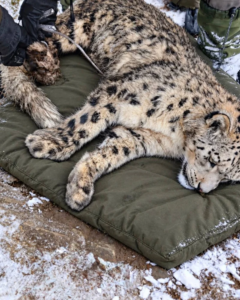
Photo credit: Ministry of Ecology and Natural Resources
The collar was installed on Oct. 19 in Katon-Karagai State National Nature Park in the East Kazakhstan Region, the first time such work has been carried out in Southern Altai. The animal was named Altai.
Satellite data will allow researchers to follow Altai’s movements, map the routes he takes and define the boundaries of his home range. According to the committee, this information is essential both for studying the species and for planning conservation measures. As snow leopards inhabit remote, high-altitude areas that are difficult to access, GPS collars allow scientists to monitor their movements and collect data while minimizing human presence near the animals.
Katon-Karagai is part of a transboundary reserve, and its snow leopards belong to a population that crosses national borders, which makes the new data relevant to conservation efforts beyond Kazakhstan.
The Altai region has long been considered the periphery of the species’ range in Kazakhstan, and evidence of snow leopards there has accumulated slowly, largely through camera traps. In August, cameras in Katon-Karagai captured rare footage of a snow leopard family.
Sixteen collars since 2021
Altai is the latest of 16 snow leopards fitted with satellite collars in Kazakhstan since 2021. Another animal, collared in Ile-Alatau State National Nature Park in February, is still being monitored.
The tracking program is already shaping policy on the ground. Officials say satellite data are used to define and justify the boundaries of protected areas, and several territories have already been expanded on that basis, with further development of the protected area network planned. Today, snow leopards in Kazakhstan live in nine specially protected natural areas, including national parks and nature reserves, and about 70% of the species’ range in the country lies within protected territory.
Recognition at COP17
Kazakhstan’s results drew international attention at the 17th Conference of the Parties (COP17) to the Convention on Biological Diversity in Yerevan, Armenia. Speaking at the summit on Oct. 16, President Kassym-Jomart Tokayev said the population had recovered from a critically low level in the 1990s to about 190 animals.
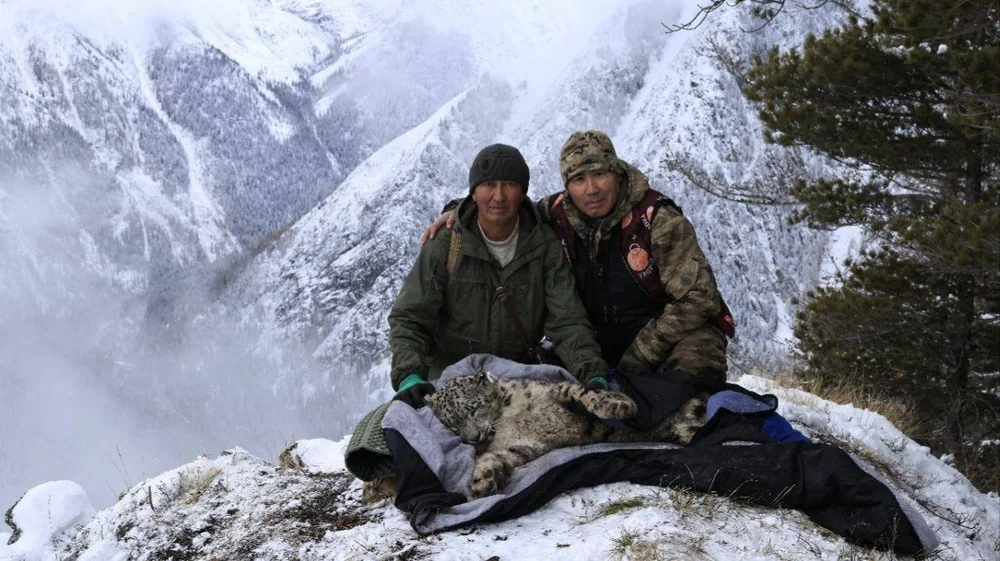
Photo credit:
“There are encouraging signs of recovery in the snow leopard population,” Tokayev said, crediting long-term work by government agencies, scientists and international partners.
At a COP17 side event on using animal movement data to reduce the impact of linear infrastructure on biodiversity, Forestry and Wildlife Committee Chairman Daniyar Turgambayev presented Kazakhstan’s experience with satellite tracking.
Turgambayev also highlighted the country’s work with saiga antelope, whose population exceeded 4.6 million in a spring 2026 aerial survey. Saiga have been tagged with satellite transmitters since 2009, and over the past two years specialists have fitted about 50 animals in the Ustyurt population with ear tags carrying built-in GPS sensors. The data help track migration routes and show how roads, railways, pipelines and other linear structures affect animal movement.
Kazakhstan proposed that animal movement data be considered at the earliest stages of infrastructure planning, including environmental impact assessments, and called for wider access to such data and stronger international and regional cooperation.
International snow leopard day
The news arrived ahead of International Snow Leopard Day, observed annually on Oct. 23. The date was established in 2013 at the initiative of WWF and marks the adoption of the Bishkek Declaration at the first Global Snow Leopard Conservation Forum in Kyrgyzstan. The declaration was signed by representatives of all 12 range countries: Afghanistan, Bhutan, China, India, Kazakhstan, Kyrgyzstan, Mongolia, Nepal, Pakistan, Russia, Tajikistan and Uzbekistan.
According to the Global Snow Leopard and Ecosystem Protection Program (GSLEP), the species inhabits the high mountains of Central and South Asia, including the Himalayas, Pamir, Tian Shan, Karakoram, Kunlun and Altai, at elevations from a few hundred meters to more than 5,000 meters above sea level. The cats are largely solitary and roam vast territories.
The snow leopard is listed in Kazakhstan’s Red Book of endangered species, and international trade in the animal is regulated by the Convention on International Trade in Endangered Species of Wild Fauna and Flora (CITES). Despite the recovery, conservationists stress that the species still depends on habitat protection, anti-poaching efforts and continuous scientific monitoring, work that collars like Altai’s are designed to support.
