
ASTANA – Kazakhstan has proposed establishing a network of artificial intelligence centers under the Shanghai Cooperation Organization (SCO) and integrating regional transport corridors under a unified strategy through 2035, Prime Minister Olzhas Bektenov said at an Oct. 20 meeting of SCO heads of government in Dushanbe.
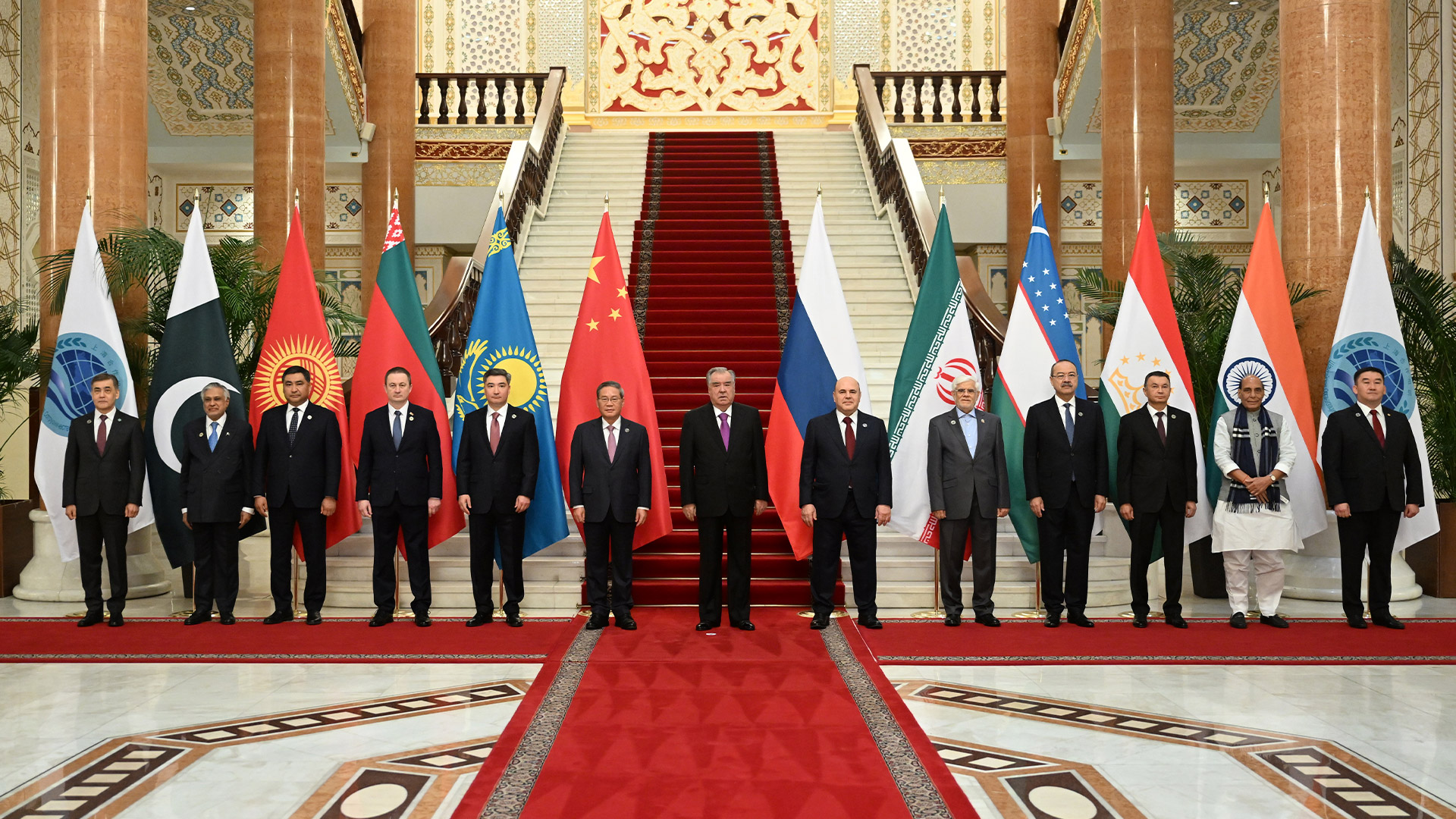
Tajik President Emomali Rahmon and heads of delegations from SCO member states attend a collective meeting in Dushanbe. Photo credit: Kazakh Prime Minister’s press service.
Bektenov attended a collective meeting hosted by Tajik President Emomali Rahmon and SCO Council of Heads of Government sessions in narrow and expanded formats, bringing together representatives of member states and partner countries, the Prime Minister’s press service reported.
Welcoming the participants, Rahmon highlighted the SCO’s role as a platform for constructive dialogue, peace and stability amid changing global conditions. He called for expanding trade and investment, strengthening transport links, deepening industrial and agricultural cooperation, advancing digitalization and green technologies, and reinforcing energy and food security.
Rahmon also emphasized joint efforts to combat terrorism, extremism, cyber threats, drug trafficking and transnational organized crime. He highlighted the importance of establishing an SCO Anti-Drug Center in Dushanbe and called for greater cooperation in artificial intelligence, innovation and workforce development, reported Kazinform.
He also noted Tajikistan’s initiative, supported by the UN General Assembly, to declare 2027-2036 the International Decade for Strengthening Peace for Future Generations. Other priorities included climate change adaptation, environmental protection, glacier preservation and the sustainable use of water resources.
Addressing the expanded session, Bektenov outlined Kazakhstan’s priorities for strengthening trade, transport connectivity, digital cooperation and regional energy and water security.
Trade and transport connectivity
Kazakhstan called for removing trade barriers, simplifying customs procedures and expanding the use of national currencies in cross-border settlements. National currencies already account for nearly 70% of Kazakhstan’s cross-border payments with SCO member states, according to Bektenov.
To improve regional connectivity, Kazakhstan proposed integrating China’s Belt and Road Initiative with existing and planned transport corridors and incorporating common priorities into an SCO Transport Connectivity Strategy through 2035.
Bektenov also called for accelerating the modernization of maritime and dry ports under the SCO Action Plan for the Development of Ports and Logistics Centers through 2030.
The Trans-Caspian International Transport Route was identified as a platform for practical cooperation, with annual freight volumes targeted at 10 million tons.
AI and digital cooperation
Kazakhstan proposed establishing an SCO network of artificial intelligence centers to pool technological expertise and support member states in exchanging and scaling AI solutions.
Bektenov also highlighted the potential of the UN Economic and Social Commission for Asia and the Pacific’s Asia-Pacific Center for Digital Solutions in Almaty to facilitate technology transfer and cooperation.
“Only over the past five years, our IT services exports have grown 34-fold, reaching $1.1 billion,” Bektenov said, adding that Kazakhstan aims to strengthen its position as a regional digital hub under its Digital Qazaqstan strategy.
Energy and water security
Kazakhstan raised energy and water security as priorities for regional cooperation, including implementing the SCO Strategy for Energy Cooperation through 2030 and establishing an SCO Center for Water Issues Analysis.
Bektenov said the economic scale, geographic proximity and complementary production capacities of SCO member states created opportunities for more ambitious joint initiatives, including stronger production chains and industrial projects.
The meeting also reviewed reports on the activities of the SCO Business Council and Interbank Consortium for 2025-2026.
Following the sessions, participants signed documents covering multilateral trade and economic cooperation, transport connectivity and investment projects in industrial cooperation. Among them was a decision to establish an SCO digital platform to facilitate international multimodal freight transportation.
