
ASTANA – President Kassym-Jomart Tokayev proposed a new development strategy for the Commonwealth of Independent States (CIS) through 2035, calling for closer industrial and technological cooperation as traditional trade relationships come under strain.
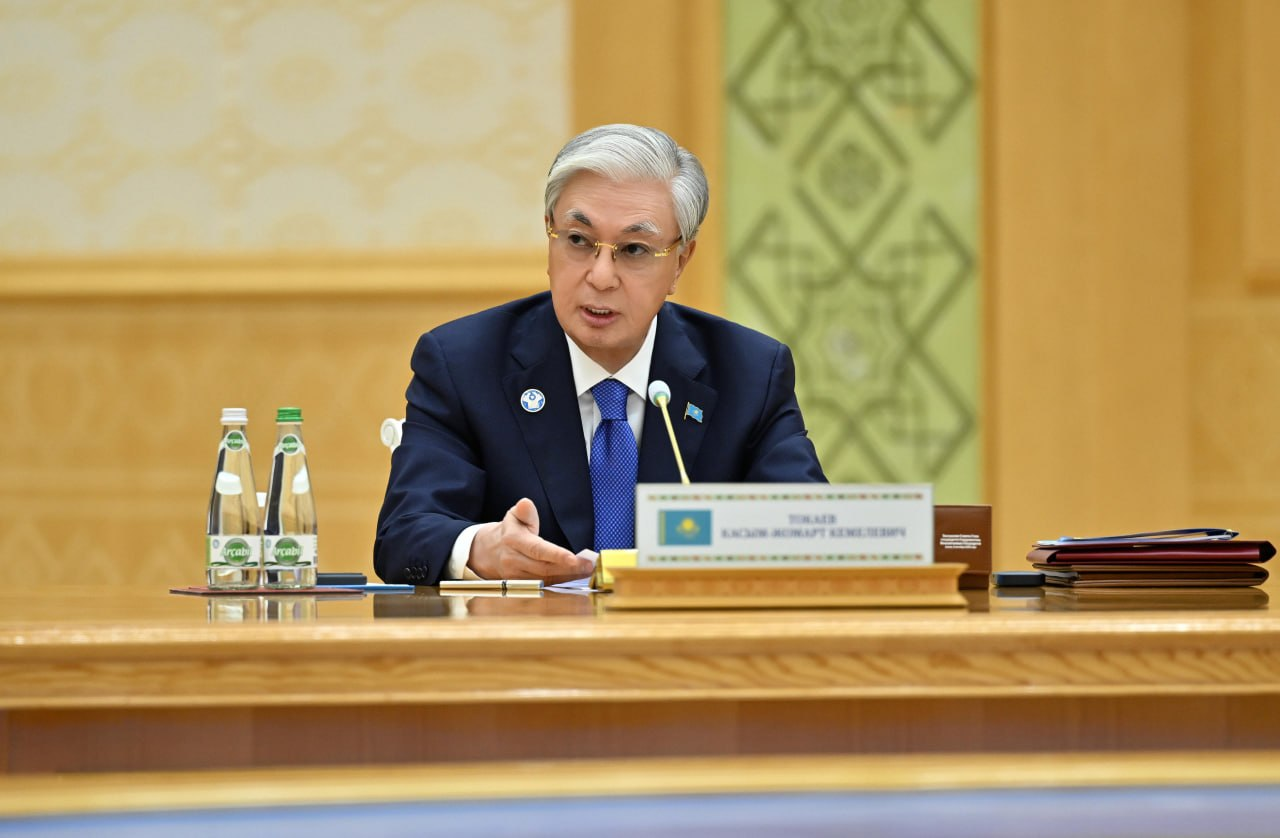
President Kassym-Jomart Tokayev speaks at a meeting of the Council of Heads of State of the Commonwealth of Independent States (CIS). Photo credit: Akorda.
Tokayev suggested creating a portfolio of joint industrial and technological projects until 2030 during his remarks to the Oct. 9 meeting of the CIS Council of Heads of State in Avaza.
He also proposed holding a CIS-sponsored artificial intelligence forum in Astana next year and establishing a mechanism to exchange experience in AI strategies, legislation and government support.
He said a new architecture of international relations is taking shape, the system of global economic ties is breaking down, technological competition is intensifying, and uncertainty and unpredictability are increasing.
“Against this backdrop, direct and trusting dialogue, which makes it possible to find coordinated solutions that take into account the interests of every state, is becoming critically important,” Tokayev said.
CIS development strategy through 2035
The CIS, a regional grouping established in 1991 following the collapse of the Soviet Union, had played an important role in maintaining stability and preserving ties among its members, according to Tokayev.
“The creation of the CIS made it possible to avoid a total conflict in the so-called post-Soviet space. It would not be an exaggeration to say that the consolidating mission of the CIS was particularly evident during the period when our countries gained independence,” he said, highlighting that the countries preserved historical ties and built a fundamentally new format of interstate cooperation.
Tokayev called on member states to define the organization’s long-term priorities and its place in Eurasia’s changing geopolitical landscape.
“We, the CIS member states, must answer the question of what we want the Commonwealth to look like in the long term and what place it should occupy in the rapidly changing geopolitical architecture of Eurasia,” Tokayev said.
He noted that CIS markets remained important for Kazakhstan, accounting for more than a quarter of the country’s foreign trade turnover. Bilateral and regional trade with CIS partners reached nearly $40 billion last year and increased 10% in the first seven months of 2026.
Joint industrial projects and trade barriers
Tokayev proposed creating a portfolio of flagship CIS industrial and technological projects with a focus on products with higher added value.
He said modern infrastructure for business cooperation and new production facilities was emerging across much of the organization, but countries needed to make fuller use of this potential.
Tokayev also highlighted Kazakhstan’s efforts to establish a network of cross-border industrial and trade centers along its borders with Russia, Uzbekistan and the Kyrgyz Republic. The proposed joint project portfolio would complement these initiatives by encouraging industrial cooperation and investment across the region.
Russian language and cultural cooperation
Tokayev also urged CIS leaders to support the International Organization for the Russian Language, emphasizing the language’s role in education, science and cultural exchanges across the region.
“This organization has favorable prospects. I am confident of this, given that around 300 million people around the world have varying degrees of proficiency in the language,” he said.
He also stressed the importance of preserving and respecting the linguistic and cultural diversity of member states.
“Meanwhile, it is extremely important to maintain a careful attitude toward the linguistic and cultural diversity of CIS states, show due respect for the history, traditions and culture of all peoples, and seek more effective forms of cooperation in the humanitarian sphere to bring our peoples closer together,” Tokayev said.
Tokayev invited scholars, legal experts and historians from CIS countries to participate in an international conference in Almaty in November marking the 35th anniversary of the historical document establishing the organization. The conference will be organized by the Kazakhstan Institute for Strategic Studies.
Tokayev also welcomed Uzbekistan’s upcoming chairmanship of the CIS in 2027.
