
ASTANA – President Kassym-Jomart Tokayev held a series of meetings with executives of major German companies during his official visit to Germany, discussing cooperation in transport and logistics, industrial localization, engineering, metallurgy and waste processing.
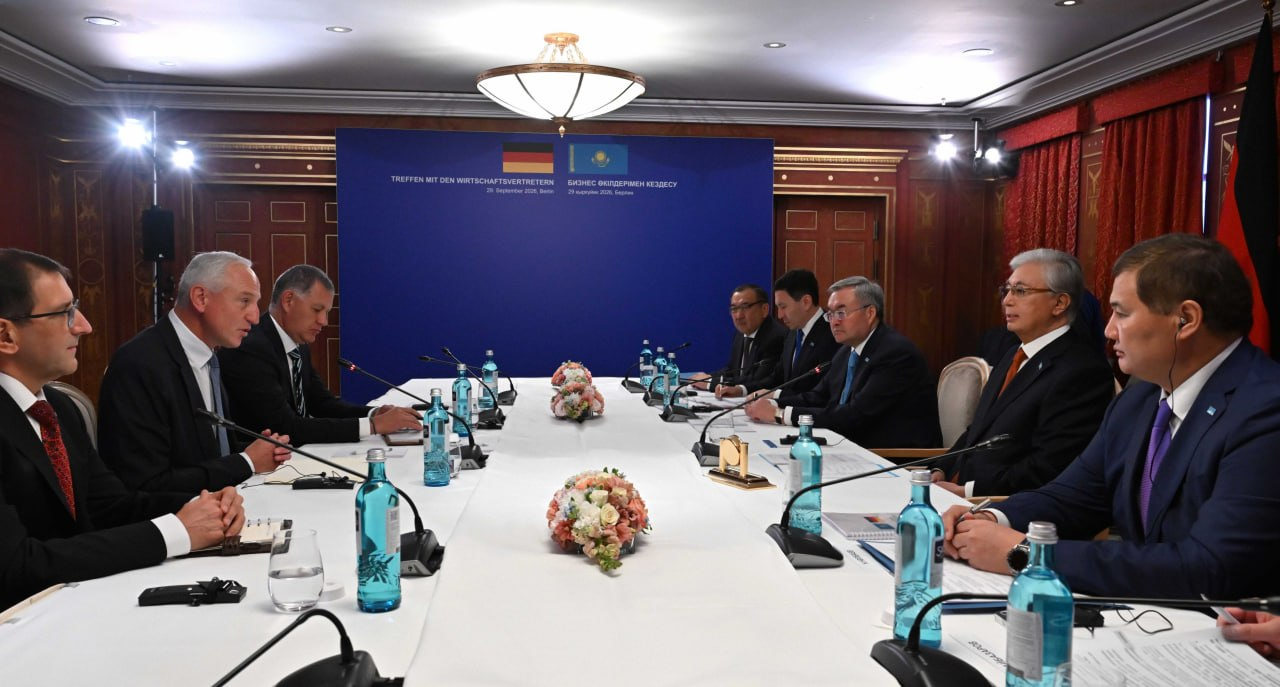
President Kassym-Jomart Tokayev meets with representatives of German companies during his official visit to Germany. Photo credit: Akorda.
Speaking with Chairman of the Executive Board of Rhenus Group Tobias Bartz, Tokayev discussed the development of the Trans-Caspian International Transport Route (TITR), also known as the Middle Corridor. Tokayev called for joint efforts to develop a competitive route supported by modern ports, terminals, railways and digital services.
In a separate meeting, Tokayev highlighted the contribution of Deutsche Bahn to Kazakhstan’s railway development, including the joint project between DB Engineering & Consulting and Kazakhstan Temir Zholy to develop passenger rail services. He also stressed the importance of integrating Kazakh manufacturers into Deutsche Bahn’s supply chain, including through the necessary certification procedures.
Tokayev separately met Oliver Hermes, Chairman of the Executive Board of Wilo Group, a German technology company specializing in pumps and energy-efficient solutions for residential, public and industrial buildings. He called for deeper localization, including increasing the share of locally produced components, developing engineering and service capabilities, and expanding Kazakh suppliers’ participation. He also welcomed plans to establish a regional service and engineering center for pumping equipment in Alatau City.
President Tokayev also emphasized the metallurgical sector’s importance to Kazakhstan’s economy, discussing the reconstruction of Qarmet, one of the country’s major metallurgical enterprises, with Chairman of the Executive Board of D.A.R. Metall AG Christian Artner. They paid particular attention to a potential joint project for metal processing in Kazakhstan.
The meetings underscored Kazakhstan’s efforts to attract German expertise and investment across several sectors, while expanding local production, technology transfer and integration of Kazakh companies into international supply chains.
Commenting on the visit, experts highlight that the next stage of Kazakhstan-Germany economic cooperation will depend on whether high-level political commitments can translate into commercially viable projects. Stephan Meister, a German expert on Central Asia, pointed to the size of Kazakhstan’s domestic market as one consideration facing German companies, speaking with The Astana Times.
This means the visit’s significance may ultimately extend beyond the number of agreements announced. A stronger indication of deeper economic ties would be whether the existing framework leads to projects that create more value in Kazakhstan while giving German companies stronger commercial incentives to expand their presence.
Earlier on Sept. 29, Tokayev also met with heads of leading German business associations and financial institutions, where he proposed creating a Kazakhstan-Germany Investment and Financial Platform to facilitate investment and joint projects.
