
ASTANA — President Kassym-Jomart Tokayev will visit Germany from Sept. 29-Oct. 1, with meetings in Berlin and Munich coming at a time when Kazakh-German relations have grown significantly in both political and economic terms, but are also entering a more demanding stage.
Photo credit: shutterstock.com
Germany is one of Kazakhstan’s key European partners for investment, technology and industrial cooperation. For Berlin, Kazakhstan has become increasingly important as a source of energy and critical raw materials and as part of efforts to diversify supply chains. The question now is whether those complementary interests can translate into deeper industrial ties, particularly in processing, manufacturing and technology.
Munich is more than a stop on Tokayev’s German visit
The Munich part of the visit deserves particular attention because Bavaria is significant in Kazakhstan’s economic engagement with Germany. Bilateral trade between Kazakhstan and Bavaria reached 3.4 billion euros in 2025, putting Bavaria first among Germany’s federal states by trade with Kazakhstan, according to Kazakhstan’s Prime Minister’s Office. The two sides have expanded cooperation in industry, agriculture, technology and raw materials, with German companies including Horsch, Linde Gas and Rhenus already operating in Kazakhstan.
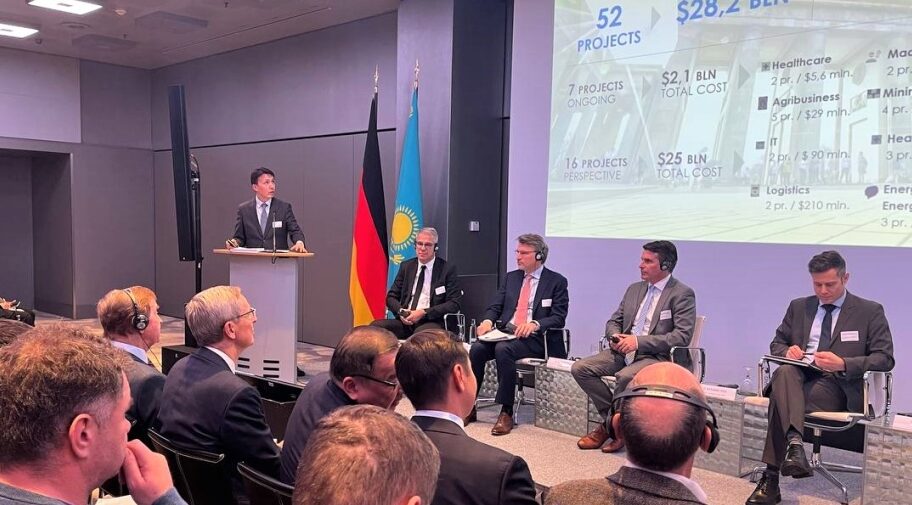
Kazakhstan-Bavarian Investment Roundtable in Munich in January 2023. Photo credit: Kazakh Invest
The significance of Bavaria is not only the size of its trade with Kazakhstan. It also lies in the structure of its economy, with strong positions in manufacturing, engineering and technology. For Kazakhstan, closer ties with such a region fit its broader effort to attract German companies into local production rather than rely mainly on imports of finished equipment.
That makes Munich a useful lens through which to view the wider relationship. It offers a closer look at whether the strategic agenda discussed between governments in Berlin will translate into decisions by companies.
Kazakhstan seeks to change its role in the relationship
The push for a more advanced economic relationship has been building since Tokayev’s visit to Berlin in September 2023. At the time, Kazakhstan and Germany were discussing critical raw materials, green energy, transport and logistics and greater German investment in non-resource sectors. Tokayev proposed a consortium for joint raw-materials projects and invited German companies to help develop production in Kazakhstan. Bilateral trade rose 25% to $2.8 billion in 2022, while German businesses invested almost $6 billion in Kazakhstan, nearly 90% of it outside the resource sector.
A year later, when German Chancellor Olaf Scholz made his first visit to Kazakhstan in 14 years, the agenda had expanded to energy, green transformation, mining, transport and logistics, agriculture and climate cooperation. A business forum in Astana produced 36 documents worth $6.3 billion covering mechanical engineering, innovation, logistics, petrochemicals, information technology and industrial automation.
The relationship continued to grow in 2025. Bilateral trade reached $4.4 billion, up 9.5% from the previous year. German investment rose 28.5% to $700 million, bringing cumulative German investment since 2005 to about $7.8 billion. More than 1,100 companies with German capital operate in Kazakhstan.
But Kazakhstan’s ambition is increasingly about changing the structure of the relationship, not only expanding its volume. Prime Minister Olzhas Bektenov said in June that Kazakhstan wants to transform traditional trade and investment ties into deeper industrial and technological cooperation through production localization, technology transfer and training. The government pointed to CLAAS and Horsch as examples of phased localization that could be extended to other sectors.
Valeriy Sitenko, senior expert at the Institute of Foreign Policy Studies under Kazakhstan’s Ministry of Foreign Affairs, puts that shift in broader terms. He highlights that Kazakhstan’s role should evolve from transit to production.
“If previously the emphasis was mainly on transport connectivity and Kazakhstan’s transit function, today there is a transition toward deeper integration: the inclusion of Kazakhstan and Central Asia in global value chains. In the new model, Kazakhstan acts not only as a transit space, but as a production and technology hub,” Sitenko told The Astana Times.
That would change the logic of cooperation. Instead of simply connecting Kazakh resources with European markets, Kazakhstan would seek to retain more of the value created from those resources through processing and manufacturing.
Sitenko identifies machinery, chemicals, electrical engineering, critical minerals processing, IT and renewable energy as potential areas. He also points to Germany’s dual vocational education system, where companies are directly involved in training workers and aligning skills with production needs. The latter is particularly relevant to Kazakhstan’s industrial ambitions. German expertise could shape not only what is produced, but also the skills base built around new production.
Germany’s strategic interest is growing, but business is moving carefully
Germany has its own reasons to deepen the relationship. The German Federal Foreign Office describes Kazakhstan as Germany’s largest trading partner in Central Asia and an important supplier of energy and raw materials, noting that shifting global trade and energy flows have increased the region’s strategic importance.
Energy remains part of that relationship. By Scholz’s September 2024 visit, Kazakhstan was already supplying crude oil to Germany’s Schwedt refinery, and the bilateral agenda included energy, critical raw materials, mining and technological cooperation.
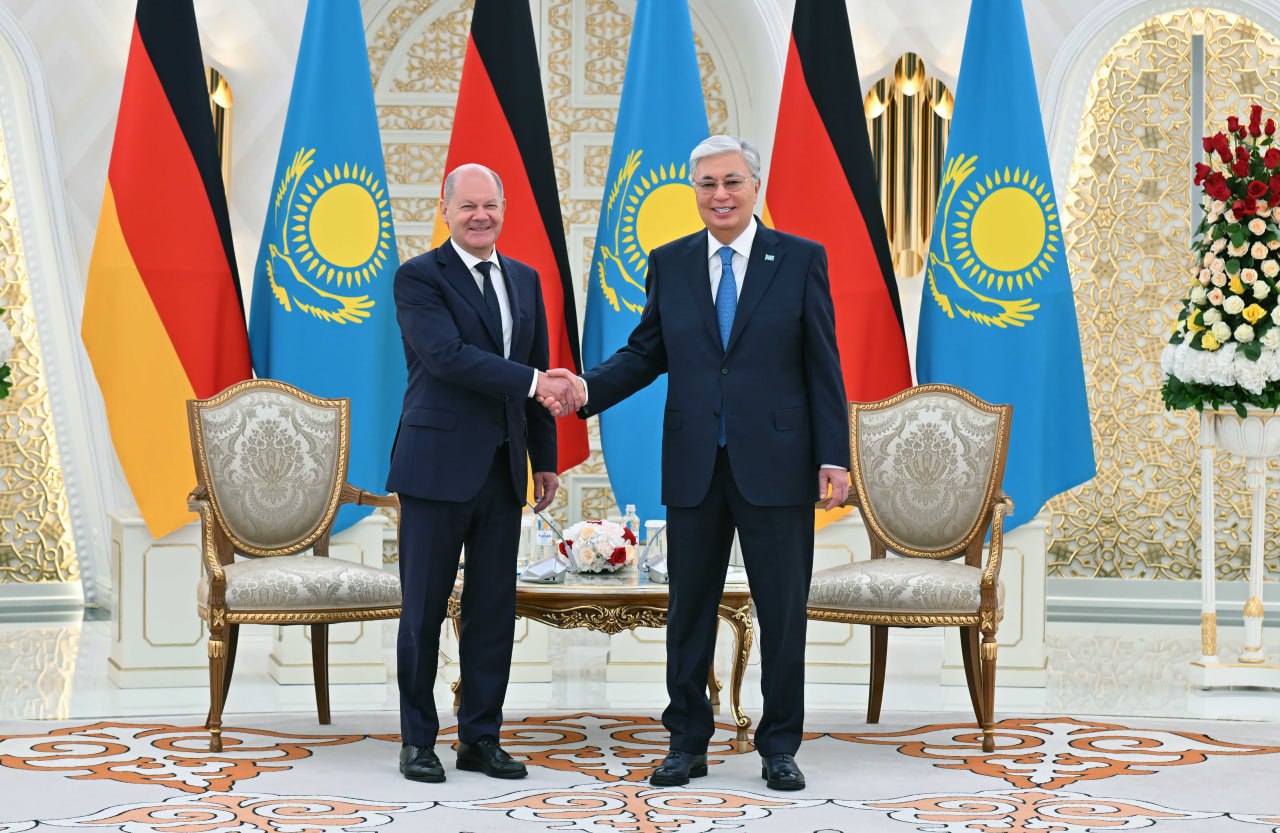
Olaf Scholz and President Kassym-Jomart Tokayev at Akorda in September 2024. Photo credit: Akorda
The economic relationship has also become more concrete this year. A Kazakhstan Investment Day in Frankfurt in February brought together around 200 representatives of German companies, financial institutions and industry associations. KfW IPEX-Bank and Solidcore Resources also signed a $100 million term sheet linked to the Ertis hydrometallurgical plant.
Yet strategic interest does not automatically mean that German companies will make large, long-term investments. Stephan Meister, a German expert on Central Asia, points to a basic commercial consideration that is less visible in government-level discussions: the size of Kazakhstan’s domestic market.
“It’s a difficult question, since Kazakhstan is in terms of population a small market, so there is a question about how much it makes sense to invest in bigger industrial production and for which markets,” he said to The Astana Times.
He also questions whether Kazakhstan’s investment environment has changed enough to encourage more German capital.
“German business is more cautious before they invest, and in terms of rule of law, transparency and business climate, not much has changed in the last years in Kazakhstan which has improved the investment conditions,” Meister said.
For Kazakhstan, that raises a practical question about the markets new production would serve. If large projects are not aimed primarily at domestic demand, they need to be competitive in wider regional and international supply chains. Market access, predictable business conditions and financing therefore matter alongside the availability of raw materials.
The constraints are not only on Kazakhstan’s side
Meister also points to a factor that complicates the usual discussion of why German investment may be slow: Germany itself is going through a difficult economic period. German companies, he argues, are becoming more cautious about where they commit capital, making the search for new markets more difficult even when the strategic case is strong.
This creates a gap between Germany’s growing political interest in Central Asia and the risk appetite of its private sector. Germany may see Kazakhstan as useful for diversifying energy and raw-material supply chains while companies continue to ask whether individual projects are commercially compelling enough to justify the risks. Meister sees another issue on the German side: political engagement.
“My impression is the main limitation on the German side is the lack of a political vision for relations with Central Asian countries, more investment on the leadership level into the countries of the region, including Kazakhstan, and a lack of understanding about the importance of the region,” he said.
According to him, German companies are slower and more risk-averse than some competitors and often lack sufficient political support when entering Central Asian markets. That leaves both sides with something to prove. Kazakhstan needs to make the country more attractive for long-term industrial investment and demonstrate that production can serve markets beyond Kazakhstan. Germany, meanwhile, faces the question of whether its growing strategic interest in Central Asia is strong enough to translate into more active support for German companies entering the region.
What the visit could clarify
The two governments already have a broad network of mechanisms for cooperation, from the Central Asia-Germany format launched in Berlin in 2023 to bilateral platforms bringing together ministries, businesses and financial institutions. Sitenko notes that the institutional tools for a strategic partnership are already in place and need to be used more effectively. Meister, however, points to Germany’s lack of a clear political vision and its companies’ cautious approach as factors that could slow new investment.
The difference between these two views is useful in understanding what will be at stake during the visit. Kazakhstan is looking to use German technology and capital to retain more value from its own resources and move further into production and processing. German companies, for their part, need projects with sufficient scale, predictable conditions and access to wider markets.
The Munich leg is therefore particularly relevant. Bavaria’s growing trade and business ties with Kazakhstan offer one of the clearest examples of where the broader relationship could go, especially in manufacturing, technology and industrial cooperation.
Sitenko also points to the less visible side of economic ties: education, skills and movement between the two countries. He notes that scaling German-style dual education and easing visa procedures could strengthen business, professional and academic links alongside larger industrial projects.
What emerges from the visit may therefore be more important than the number of new agreements announced. The stronger signal would be whether the existing framework produces projects that create more value in Kazakhstan and give German companies a stronger commercial reason to deepen their presence.
