
ALMATY – Kazakhstan is moving ahead with a $1.4 billion renewable energy project with Masdar, a leading renewable energy company based in the United Arab Emirates (UAE), as the country seeks to expand wind generation while addressing electricity shortages and building a more flexible power system. The development was discussed Sept. 8 during a meeting between Energy Minister Yerlan Akkenzhenov, Masdar’s Deputy Chairman for Business and Projects Abdullah Zayed and UAE Ambassador to Kazakhstan Mohamed Saeed Mohamed Al-Ariki.
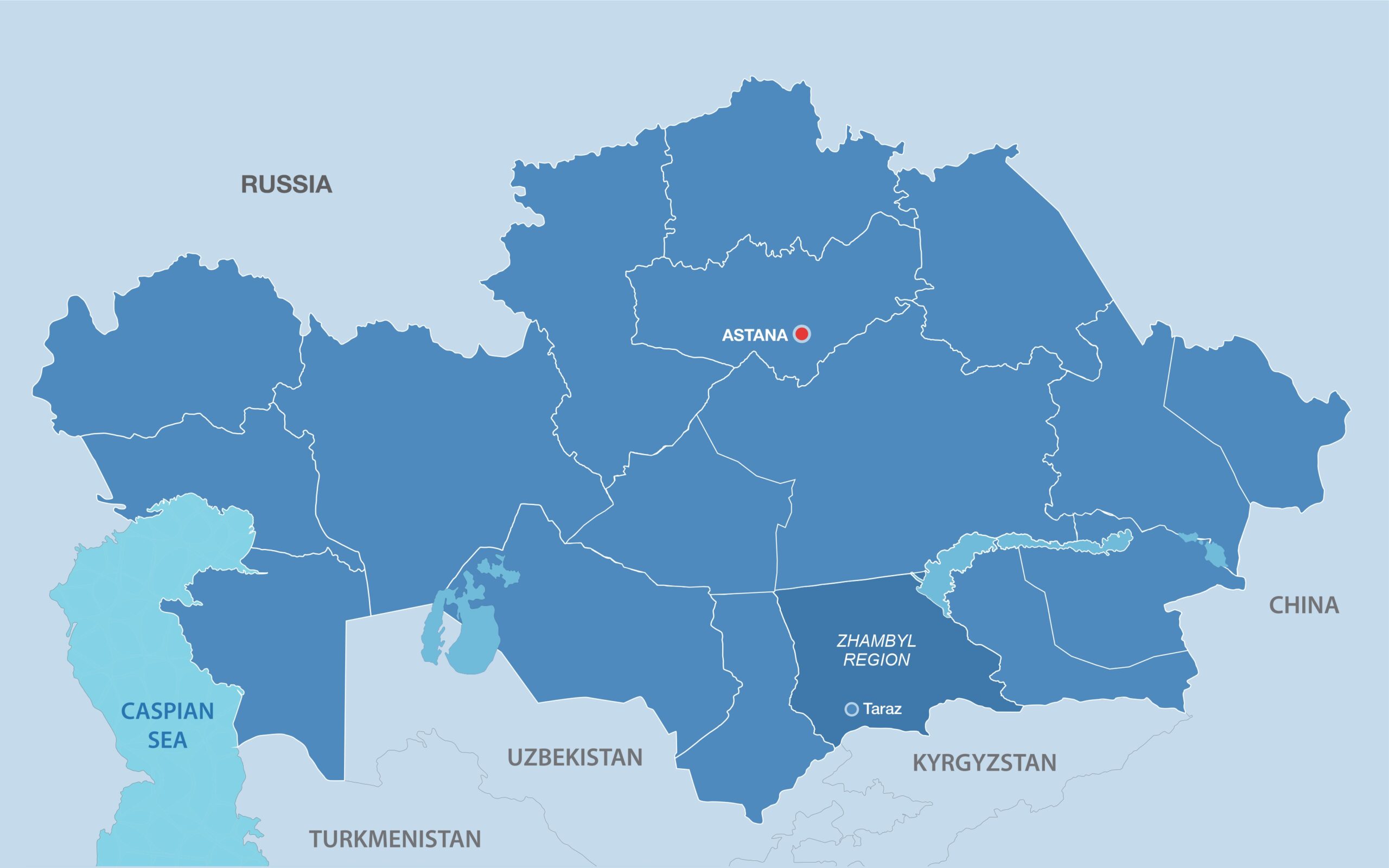
Photo credit: samruk-green.kz Click to see the map in full size. The map is designed by The Astana Times.
The meeting focused on the implementation of a 1-gigawatt wind power plant with an integrated energy storage system in the Zhambyl Region, as well as prospects for expanding cooperation in renewable energy.
The project, being developed within the strategic partnership between Kazakhstan and Masdar, is expected to attract approximately $1.4 billion in investment. It will include a 1,000-megawatt wind farm and a 300-megawatt battery storage system with a capacity of 600 megawatt-hours. Full commissioning is scheduled for the third quarter of 2029.
From a wind project to a test of Kazakhstan’s energy transition
The Zhambyl project comes as Kazakhstan moves toward a more complex phase of renewable-energy development. Increasing installed capacity is only one part of the transition. The country also needs storage, modern transmission networks and regulatory mechanisms capable of balancing electricity generated from weather-dependent sources.
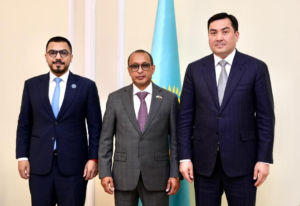
From L to R: Masdar’s Deputy Chairman for Business and Projects Abdullah Zayed, UAE Ambassador to Kazakhstan Mohamed Saeed Mohamed Al-Ariki and Energy Minister Yerlan Akkenzhenov. Photo credit: Ministry of Energy.
The storage component of the Masdar project is particularly important in this context. Wind generation can fluctuate with weather conditions, while electricity demand changes throughout the day. A large-scale storage system can help absorb excess generation and make electricity available when renewable output declines or demand rises.
The Energy Ministry has identified energy storage as a strategic priority. Speaking at the Go Net Zero – Central Asia and Caspian business summit, Turar Alimzhan, director of the ministry’s Department of Renewable Energy, said legislation on energy storage systems is currently under consideration, alongside a long-term concept for the development of green energy.
“We are moving toward this goal systematically. The law on energy storage systems is already under consideration, and this is one of our strategic priorities,” he said.
Under Kazakhstan’s electricity-sector development plan through 2035, the country intends to implement at least 8.4 GW of installed renewable-energy capacity. That target means that the next challenge will increasingly be not simply generating renewable electricity, but ensuring that it can be reliably delivered to consumers.
The Masdar project has already moved beyond the planning stage
The current construction phase also marks a significant progression for the Zhambyl project. When The Astana Times spoke with Masdar Chief Operating Officer Abdulaziz Alobaidli ahead of Abu Dhabi Sustainability Week 2026, the project was still undergoing wind-resource assessment. Alobaidli explained that developing a bankable wind project requires detailed on-site measurements rather than relying only on satellite or historical data.
“We have signed the Power Purchase Agreement, and we have moved into the development phase,” he said, noting that wind projects require specific on-site work, including at least one year of ground-based measurements to establish the project’s bankability.
Since then, the project has advanced to construction. On June 29, Kazakhstan and Masdar held a capsule-laying ceremony and officially launched work at the site in the Zhambyl Region. The progression illustrates the lengthy process behind utility-scale renewable investments, from resource assessment and power-purchase agreements to financing, construction and eventual grid integration.
Masdar sees Central Asia as a core growth market
The Zhambyl project is also part of Masdar’s broader expansion across Central Asia. “In Central Asia, we remain one of the largest renewable energy investors, with Uzbekistan, Azerbaijan, and Kazakhstan as core focus markets,” Alobaidli told The Astana Times. “We also continue dialogue with other Central Asian countries, supporting energy policy development and reform to improve bankability and attract investment.”
This regional approach reflects a broader transformation underway across Central Asia, where countries face similar pressures to increase electricity generation, modernize aging infrastructure and reduce the carbon intensity of their economies.
At the Go Net Zero summit, Alimzhan said Kazakhstan, Azerbaijan and Uzbekistan were increasingly coordinating their efforts to develop a new energy model in which renewable generation, energy storage and low-carbon technologies play a central role. The discussions also focused on the development of a green energy corridor linking Central Asia, Azerbaijan and Europe. The initiative has entered a practical implementation phase and is being considered as a potential area for deeper regional energy cooperation.
The grid will determine how far renewables can go
Kazakhstan’s renewable-energy ambitions ultimately depend on infrastructure beyond the power plants themselves. Large volumes of wind and solar generation require transmission networks capable of moving electricity from resource-rich areas to major consumption centers. This is particularly relevant for southern Kazakhstan, where additional generation capacity is being developed partly to address electricity shortages.
The transition therefore requires simultaneous progress in several areas: renewable generation, storage, transmission infrastructure, digitalization and regulation. The regional dimension adds another layer. Kazakhstan, Uzbekistan and Azerbaijan already have interconnected energy interests, while the proposed Central Asia-Azerbaijan-Europe corridor could eventually create new opportunities for cross-border electricity trade.
Energy security and decarbonization are converging
For Kazakhstan, the renewable-energy transition is not only a climate-policy issue. The country needs to increase electricity supply while maintaining energy security and gradually reducing the carbon intensity of its economy. These objectives make renewable generation increasingly attractive, but they also expose the limitations of a power system designed around more predictable generation sources.
At the Sept. 8 meeting, Akkenzhenov said Kazakhstan was interested in expanding cooperation with international investors and technology partners in renewable energy.
“Partnership with Masdar contributes to the development of renewable energy and Kazakhstan’s progress toward carbon neutrality,” the minister said, adding that the project would support regional energy security, attract modern technologies and create new opportunities for energy infrastructure development.
