
ASTANA — South Korea is moving to place its nearly two-decade engagement with Central Asia on a presidential footing, bringing the region’s five leaders to Seoul in September for an inaugural summit expected to focus on critical-mineral supply chains, energy infrastructure and artificial intelligence, Ambassador of the Republic of Korea Jung Ki-Hong said in an interview with The Astana Times, his first interview since formally assuming the post.
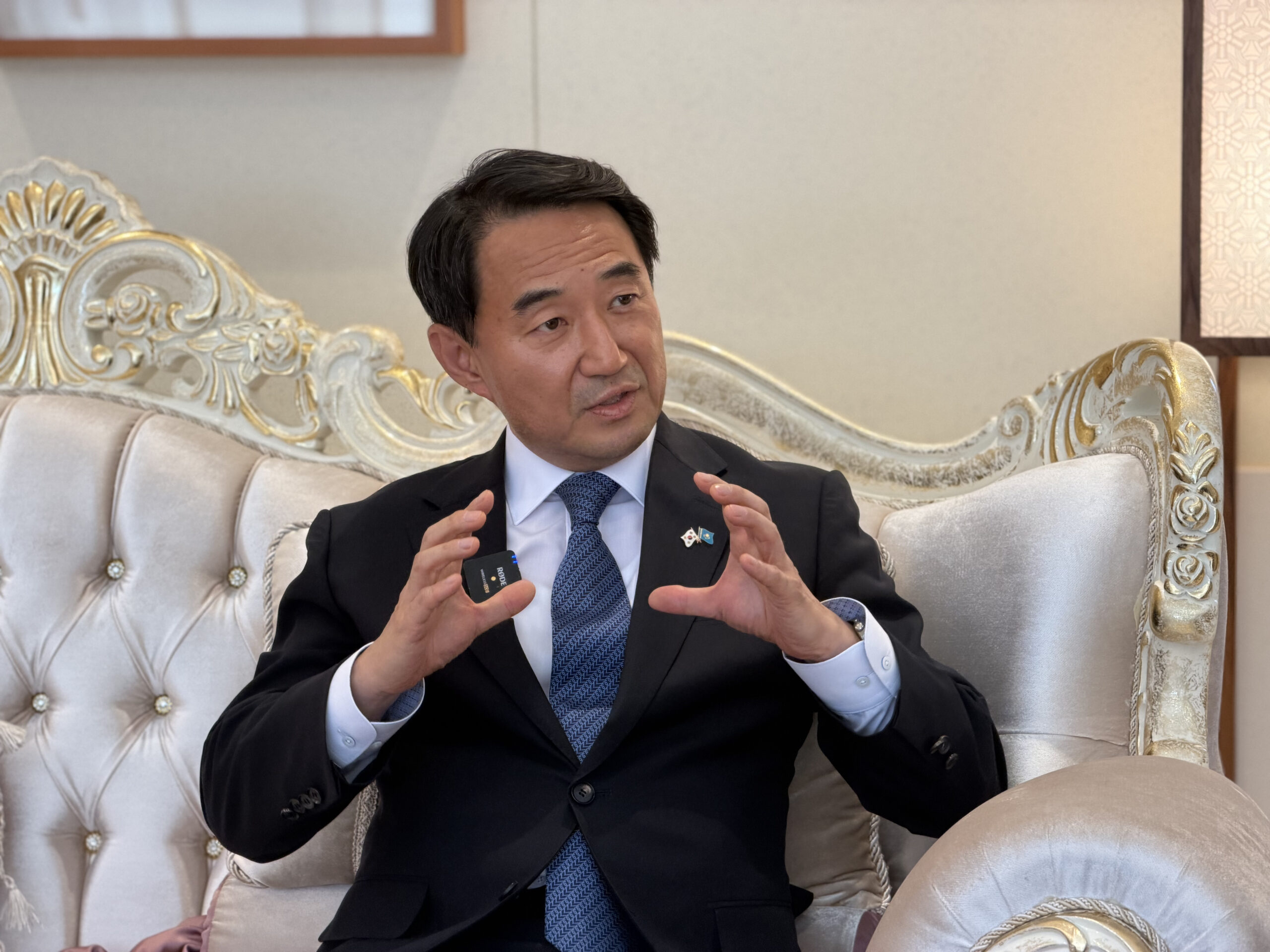
Ambassador of the Republic of Korea Jung Ki-Hong. Photo credit: The Astana Times
The gathering, scheduled for Sept. 16-17 in Seoul, will elevate a diplomatic mechanism launched at the deputy minister level in 2007 into a leaders’ platform, a shift the ambassador described as more consequential than any single agreement expected from the summit.
“I think the formation of this multilateral forum at the presidential level itself is the most important outcome,” said Jung, who presented credentials to President Kassym-Jomart Tokayev on Aug. 19.
Ambassador Jung and President Tokayev on Aug. 19. Photo credit akordaa.kz.jpg
Jung said the leaders are expected to discuss cooperation on critical minerals and energy infrastructure, the resilience of supply chains, artificial intelligence and digital transformation, as well as cultural and people-to-people ties.
“This is not going to be just a one-time event,” he added.
Untapped potential
Kazakhstan is South Korea’s largest trading partner and investment destination in Central Asia, but considerable potential remains untapped, Ambassador Jung said.
According to the Ministry of Trade and Integration, bilateral trade reached $3.17 billion in 2025, up 1.4% from the previous year. In the first six months of this year, trade reached $1.3 billion, while Kazakhstan’s exports to South Korea increased 17.2% to $510 million. In 20 years, South Korea’s gross investment in Kazakhstan surpassed $10 billion.
Ambassador Jung identified three particularly promising areas: critical minerals, artificial intelligence, and power generation and the transition to cleaner energy.
The 21st century is about critical minerals
“Critical minerals are not just mineral resources, they are geopolitical resources,” he added, echoing a recent assessment by President Kassym-Jomart Tokayev.
“They say the 20th century is about oil and gas, but the 21st century is about critical minerals,” Jung said. Semiconductors, batteries, renewable-energy systems and AI infrastructure all depend on these materials, he added, making Kazakhstan’s resource base increasingly important to South Korean industry.
Jung emphasized the two economies bring complementary strengths. Kazakhstan possesses substantial critical-mineral resources in deposits, concentrates and mine tailings, while South Korea has advanced processing technologies, industrial capacity and demand as an end user.
Cooperation on critical minerals is beginning to show progress. On Aug. 5, Kazakh and South Korean institutions met at Satbayev University in Almaty to finalize arrangements for a joint research center focused on rare and rare-earth metals. The initiative brings together the Korea Institute of Industrial Technology, or KITECH, and Korea National Institute of Rare Metals, known as KORAM, with Satbayev University’s Institute of Metallurgy and Ore Beneficiation.
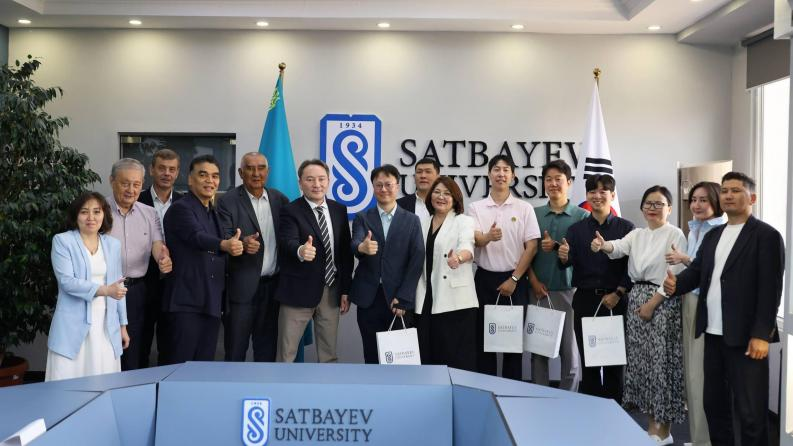
Representatives of Kazakh and Korean institutions met in Almaty in August to finalize the arrangement and agreeing on the joint Kazakh-Korean center for rare and rare earth metals. Photo credit : Satbayev University
According to Ambassador Jung, the initiative followed two years of feasibility work supported by the two governments. The center is intended to assess Kazakhstan’s mineral resources and identify technologies that could extract and process rare metals from ores, concentrates and industrial waste.
Yersain Nagaspayev and Ambassador Jung. Photo credi: Ministry of Industry and Construction.
Jung said South Korea wanted the partnership to move beyond research and development toward business partnerships and commercially viable processing projects.
“We want a business-to-business matchmaking in the critical mineral sector.”
Jung said he had raised the proposed transition toward commercial cooperation during talks with Kazakhstan’s Minister of Industry and Construction Yersain Nagaspayev on Aug. 21. The two sides would need to match South Korean processing technologies with specific Kazakh deposits and determine whether potential projects could be scaled to commercially viable production, he said. If major Kazakh mining companies, including Tau-Ken Samruk and Eurasian Resources Group, identify common interests with South Korean industrial companies, Jung said, they could potentially establish processing facilities in Kazakhstan to produce intermediate materials or higher-value finished products.
AI ‘revolution’ is underway
AI offers another area for closer cooperation, Jung said, describing South Korea as one of the few countries outside the United States and China with advanced homegrown AI capabilities. Kazakhstan, meanwhile, has positioned itself as a regional leader in the sector.
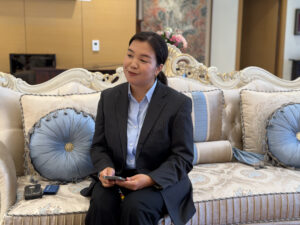
The Astana Times journalist Assel Satubaldina during an interview with Ambassador Jung and President Tokayev. Photo credit: The Astana Times
“I think we have a huge room to help each other, exchange data and exchange our technologies together,” he said.
Jung noted energy cooperation would become increasingly important. Expansion of AI and data-center infrastructure would sharply increase electricity demand, creating further opportunities for cooperation in power generation. He pointed to South Korea’s experience in gas-fired generation and nuclear energy, including small modular reactors.
That cooperation is already visible in Kazakhstan’s power sector, where South Korean companies have taken on major generation projects. Doosan Enerbility completed the 310-megawatt Karabatan combined-cycle gas power plant in the Atyrau Region in 2020 and is now the engineering, procurement and construction contractor for a 1,000-megawatt power plant in the Turkistan Region.
Cooperation is also expanding into nuclear energy. During talks in Astana on June 8, Kazakh and South Korean officials discussed a proposed memorandum covering small modular reactors, workforce training and scientific and technical cooperation. The officials said Kazakhstan was interested in drawing on South Korean expertise in reactor technology and nuclear safety.
What Korean companies want to see in Kazakhstan
Nearly 800 companies with South Korean participation operate in Kazakhstan. Yet Jung cautioned that commercial interest alone would not be enough to unlock a new wave of South Korean investment. Large energy projects carry substantial financial risks, he said, while the experience of some earlier Korean investors in Kazakhstan has made companies more cautious.
He contrasted South Korean companies’ approach to risk with that of larger American and Chinese competitors.
“I met many Korean entrepreneurs and companies who have already invested here in this country,” he said. “If you want to get more profit, you have to take the risk as well. But Korea is not the U.S. and not China, so they [companies] are very much worried about the risk factor. If the Kazakh government or the big companies can share this risk factor together with the Korean investor, I think it would encourage Korean companies to further invest.”
Rebuilding confidence, Jung said, would require projects that demonstrate that long-term investment in Kazakhstan can succeed.
“We need to create more success stories of Korean investment here in this country. (…) We need fresh investment and new success stories between our two countries. That’s our hope,” he added.
Kazakhstan’s flagship project
Jung pointed to Alatau City as both an opportunity for deeper cooperation and a test of whether the two countries can turn political ambition into commercially viable projects.
Senior Kazakh officials were in Seoul in October presenting opportunities stemming from Kazakhstan’s flagship project. In December, Kazakhstan’s Ministry of Industry and Construction, the Alatau City Authority and Korea Overseas Infrastructure and Urban Development Corporation (KIND) signed a memorandum of understanding establishing a framework for cooperation on Alatau Smart City. KIND, a state-backed corporation, has worked on urban and infrastructure projects in South Korea and abroad, including in Vietnam and Indonesia.
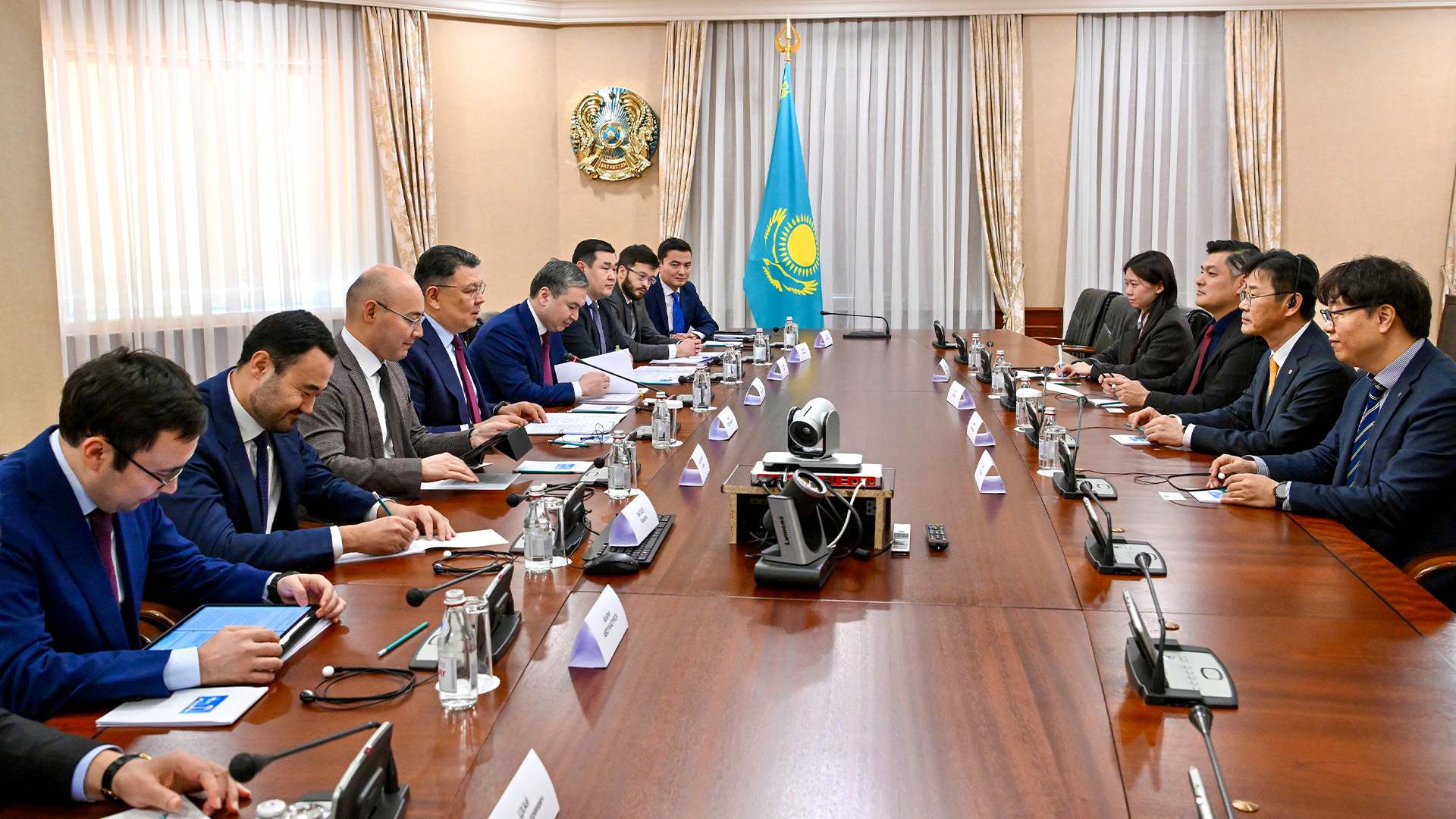
Deputy Prime Minister Kanat Bozumbayev held a meeting with Kim Bok-hwan, President and CEO of the Korea Overseas Infrastructure & Urban Development Corporation (KIND) in December 2025. Photo credit primeminister.kz
“They are eyeing this Alatau City project with great interest, but with great prudence. They are now undertaking pre-feasibility study,” said the ambassador.
Jung expects Alatau City to feature in talks between South Korean President Lee Jae Myung and Kazakh President Kassym-Jomart Tokayev during their meeting in Seoul in September.
“We will see what the future holds,” he added.
“We found the Alatau City project fascinating, but it is also true that it entails huge risk as well. When I arrived in Kazakhstan, the first thing that I did was to go there. I made a field trip to Alatau City,” said Jung.
There, the ambassador also visited K-Park, a Korean cultural and business complex now under construction, as well as sites planned for urban air mobility infrastructure and a new science and technology university modeled on South Korea’s Korea Advanced Institute of Science and Technology, or KAIST.
“If all these important projects are realized in the future, it is an ideal scenario,” he added.
Educational opportunities
Beyond investment and technology, Jung said South Korea’s cultural appeal among young Kazakhs had created demand for deeper educational and professional ties. South Korea remains a popular higher-education destination for Kazakh citizens, with more than 1,500 students enrolled at Korean universities as of April 2024.
Dozens of universities and secondary schools across Kazakhstan also offer Korean-language instruction, he said, while the Korean Cultural Center in Astana and the Korean Education Center in Almaty provide language courses and cultural programs.
“I feel a huge demand for and great interest in Korean culture among the Kazakh young generation. (…) You can make the most of the diverse programs that Korean institutions can offer you, so I very much encourage the Kazakh young generation to think seriously about learning Korean language,” he said.
According to the ambassador, tangible progress has also been made on the proposed Qazaqstan Advanced Institute of Science and Technology, or QAIST. A feasibility study for the planned KAIST branch campus in Alatau City was completed and presented in Astana in July. The university is modeled on the experience of KAIST, Korea’s leading research university, established in 1971.
Jung said the September summit will also advance Kazakhstan’s admission to South Korea’s Employment Permit System, or EPS. South Korea designated Kazakhstan as the system’s 18th labor-sending country on Aug. 14, with the first Kazakh workers expected to arrive in 2028.
The program provides a regulated pathway for foreign workers to take jobs in South Korean industries facing labor shortages, such as manufacturing, construction, agriculture and fisheries. Kazakhstan’s participation would expand opportunities for its citizens to work legally in South Korea, acquire professional experience and receive formal labor protections.
Jung also pointed to direct air links as another factor bringing the two countries closer. Nonstop flights connect Seoul with both Astana and Almaty, placing the cities within roughly six to seven hours of one another.
A sense of familiarity
When asked what had made him feel most connected to Kazakhstan in the two months since he arrived in the country, Jung pointed first to a sense of cultural familiarity. During a diplomatic career spanning more than 33 years, he has served primarily in Europe and the United States, as well as Argentina. Kazakhstan is his first posting in Central Asia.
“Frankly speaking, I feel very much comfortable living and working in this country because people are quite similar to me. Sometimes I found many Kazakh people more similar than the Koreans in Seoul,” he said smiling.
That connection is reinforced by Kazakhstan’s community of more than 120,000 ethnic Koreans, known as Koryo-saram. In 2027, Kazakhstan will mark 90 years since Soviet authorities forcibly relocated Koreans from the Russian Far East to Central Asia.
“We have a very strong bridge that connects our two countries already,” said Jung.
