
ASTANA – Kazakhstan’s transition to a single-chamber legislature entered a new stage Aug. 23 as voters went to the polls to elect the country’s first Kurultai, with international observers monitoring the process.
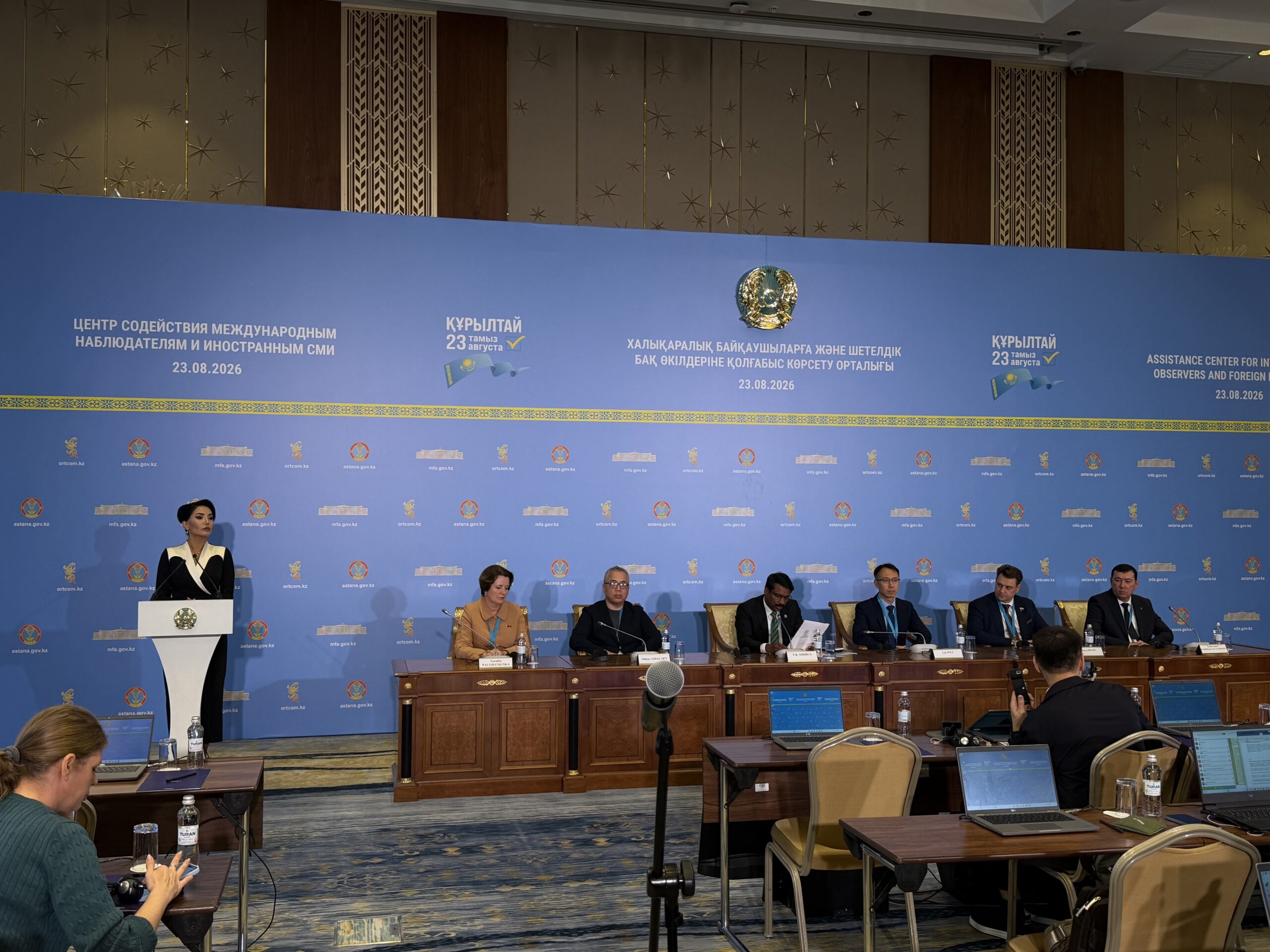
During an Aug. 23 press briefing on the Kurultai election, observers from various international organizations shared their assessments of the voting process. Photo credit: The Astana Times/Nargiz Raimbekova
The election is part of a broader effort to modernize Kazakhstan’s political institutions and strengthen their ability to respond to the country’s changing social and economic landscape, Deputy Foreign Minister Arman Issetov said during an Aug. 22 briefing with foreign media.
He noted that Kazakhstan is pursuing political reform not because it is facing a crisis, but because the country is developing and its institutions should be prepared for the next stage of that development.
“We expect that the new political system will help maintain stability and continuity while ensuring the further development of state institutions. It should also provide more effective representation of public interests and improve the quality of decision-making,” Issetov said.
He also linked the reforms to the country’s economic development, saying a more complex economy requires more effective state institutions, predictable legislation and high-quality public administration.
“The more diverse society becomes, the more important it is to have mechanisms that allow for the various public interests to be taken into account. This is one of the main reasons behind the current constitutional reform,” Issetov said.
“It is not aimed at changing for the sake of change. Its objective is to bring political institutions in line with modern Kazakhstan and prepare them for the next stage of the country’s development,” he said.
The election has drawn international attention, with observers from foreign countries and organizations monitoring the electoral process, visiting polling stations and meeting with election officials and political parties. Their assessments offer an international perspective on how the new political system is taking shape in practice.
Shanghai Cooperation Organization
According to SCO Deputy Secretary-General T.R. Midhun, voting was well organized and polling stations were fully prepared.
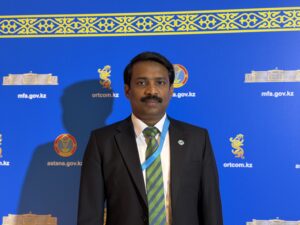
The SCO Deputy Secretary-General T.R. Midhun. Photo credit: The Astana Times/Nargiz Raimbekova
“We went to the polling stations when they opened. We saw the procedures and the queues of people who were willing to participate in the election. It was early morning, and people were still very keen to start as early as possible,” he said.
Midhun noted that the mission’s task was to observe all stages of the electoral process and form an objective assessment based on direct observation and factual information. The mission will also monitor the closing of polling stations and procedures required under Kazakhstan’s legislation.
The SCO’s final assessment will be presented at a press conference on Aug. 24, he said.
In an interview with The Astana Times, Midhun said Kazakhstan’s political and economic reforms marked a profound transformation for the country.
“I think and hope that after these reforms Kazakhstan will strengthen its position and potential in the international arena. This, of course, will contribute to the SCO,” he said.
Midhun highlighted Kazakhstan’s role as a founding member of the SCO and praised its contributions in transport, logistics, political relations and cultural cooperation.
He also pointed to the country’s initiative to convene a meeting of heads of ports and logistics centers, calling it a “very constructive” contribution to the organization.
According to Midhun, SCO member states and dialogue partners account for around 40% of the world’s population and approximately one-quarter of global GDP.
“As one of the largest regional organizations, we have always paid special attention to the development of relations between countries in the fields of security, political relations, energy, and transport. When the world is changing, the role of the SCO is, of course, growing,” he said.
Parliamentary Assembly of Turkic Speaking Countries (TURKPA)
Osman Mesten, a Turkish lawmaker who chairs TURKPA’s Commission on Legal Affairs and International Relations, called the election a historic milestone.
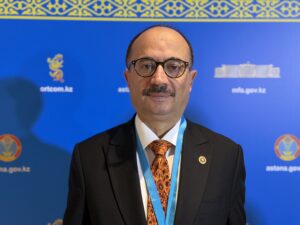
Osman Mesten, chairman of the TURKPA Commission on Legal Issues and International Relations and a member of the Grand National Assembly of Türkiye. Photo credit: The Astana Times/ Nargiz Raimbekova
“Following the referendum and the transition to a single-chamber legislature, the elections are the first held under the new system,” Mesten said.
Parliamentarians from Azerbaijan, the Kyrgyz Republic and Türkiye are participating in election observation missions.
Mesten noted that the delegation had met with the Central Election Commission chairman and representatives of political parties participating in the election.
“We observed that each party had been able to prepare for the elections and conduct outreach among voters to encourage participation and the exercise of their democratic rights,” he said.
He also highlighted women’s representation among candidates, noting that women account for around 43% of all candidates.
Mesten said Kazakhstan’s transition to a unicameral parliament could streamline the legislative process and improve its efficiency.
“A single-chamber legislature is certainly important from the perspective of democratic representation and for ensuring that the legislative process functions in a more orderly, efficient and effective manner,” he told The Astana Times.
Mesten noted that Türkiye had previously a bicameral legislature but transitioned to a unicameral parliamentary system following constitutional reforms.
“I believe that a single chamber enables decisions to be made more effectively, more quickly and more efficiently. It also eliminates some of the disadvantages associated with a dual-chamber system,” he said.
He also welcomed Kazakhstan’s decision to name the new legislature the Kurultai, describing the term as a reference to the country’s historical roots and shared heritage across the Turkic world.
“By choosing this name, Kazakhstan is referring to its deep historical roots. It also conveys the message that the country seeks to build a strong nation and a strong state by drawing strength from its heritage,” Mesten said.
“The name Kurultai is meaningful not only for Kazakhstan. It reflects our shared history and common roots. For this reason, it has inspired pride and enthusiasm throughout the Turkic world, including in Türkiye,” he said.
A total of 777 foreign observers from 42 countries and 13 international organizations have been accredited to monitor Kazakhstan’s Kurultai election.
