
ASTANA – The Kurultai has long served as one of the defining institutions of governance across the Eurasian steppe. Long before the emergence of the Kazakh Khanate, assemblies of tribal leaders gathered to settle disputes, legitimize rulers, declare war and shape the political course of nomadic states.
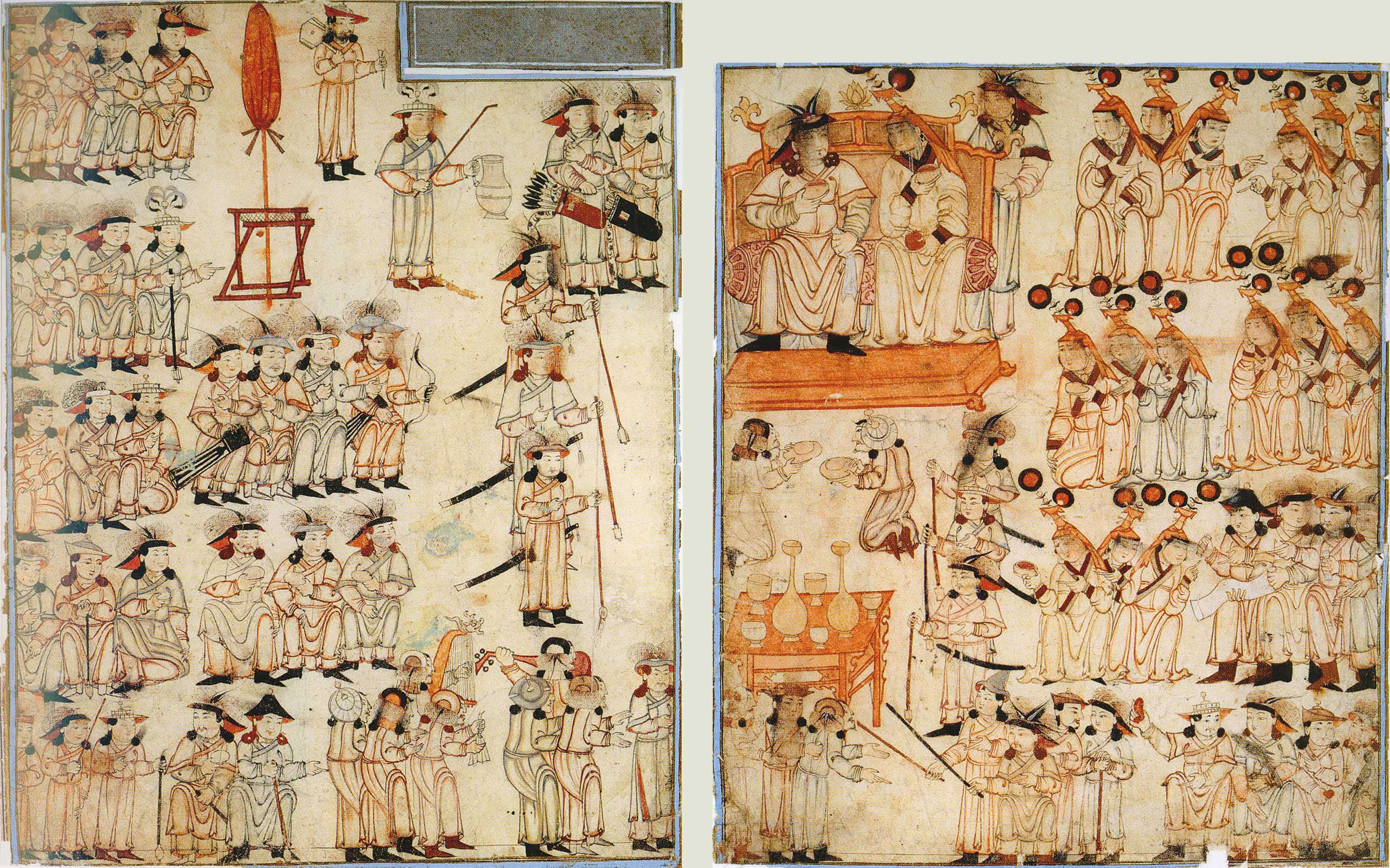
Mongol Kurultai. Double-page illustration from Rashid al-Din’s Jami’ al-Tawarikh (Compendium of Chronicles), 14th century. Photo credit: wikipedia.org
Over time, the Kurultai evolved from a gathering of tribal leaders into the highest political institution of Turkic and Mongol states. Its development laid the foundation for a system of governance built on consultation, consensus, and the legitimacy of collective decision-making.
Origins in early Nomadic states
In the first state formations of the Saka, Huns, and Wusun, assemblies resembling the Kurultai became an integral part of governance. These gatherings addressed questions of war and peace, tribal boundaries, the allocation of pastures and farmland, irrigation systems, and other economic matters.
Among the Saka, historians identify the earliest form of the Kurultai as a “military-democratic” assembly in which tribal representatives met to discuss common affairs. The Huns later united 24 tribes into a single political entity, making the Kurultai an essential mechanism for representing diverse tribal interests within government. During the Hun period, the defining characteristics of the nomadic state and the institutional foundations of the Kurultai began to take shape.
One of the defining principles of nomadic governance was the legitimacy of political authority. Rulers derived their authority from both inheritance and military power, as well as from adherence to Tore, the sacred principles of justice and lawful governance.
By the 6th-8th centuries, during the Turkic Khaganates, the Kurultai had evolved into the highest political institution. The sources of supreme law consisted of three elements: the decrees of the khagan, customary Turkic law and legislation adopted by the Kurultai.
The assembly held exclusive authority over the most consequential decisions, including the election of rulers, declarations of war and the ratification of international agreements. Without Kurultai’s approval, such decisions were generally not considered legally valid.
Evolution under the Mongol Empire
The institution continued to evolve during the Mongol period in the 13th-14th centuries, becoming an even more influential political body. The Kurultai of the Kazakh Khanate was shaped largely by traditions developed under the Mongol Empire, which united numerous tribes under a single administration.
The best-known Kurultai took place in 1206 near the Onon River in present-day northeastern Mongolia. There, Temujin was proclaimed Genghis Khan, and the establishment of the Great Mongol State was formally announced.
The assembly also confirmed the Great Yassa of Genghis Khan, a legal code that entered into force following Kurultai’s recognition of his supreme authority. Under Genghis Khan, the Kurultai expanded beyond its traditional judicial role to acquire legislative and executive powers, becoming the empire’s central political institution.
Another landmark gathering was the Talas Kurultai of 1269, which formally recognized the fragmentation of the Mongol Empire. The assembly paved the way for the emergence of independent successor states, including the uluses of Jochi and Chagatai, as well as Moghulistan.
The Kurultai in the Kazakh Khanate
The institution assumed a particularly important role during the Kazakh Khanate in the 15th-19th centuries, where it became the highest consultative and representative body.
The Kurultai helped consolidate Kazakh tribes in the face of external threats, particularly the rise of the Dzungar Khanate. It served as the principal forum where questions of war and peace, recognition of political authority and other matters of national importance were debated and decided.
Its significance extended beyond decision-making. The Kurultai functioned as a mechanism for balancing the interests of various tribal groups and preserving political unity. In a society organized along clan and tribal lines, stability depended not on centralized authority but on consensus among influential leaders.
Participants included sultans, biys, military commanders, tribal elders and other respected figures. Decisions were reached through consultation and agreement rather than unilateral decree, allowing representatives of the three zhuz and major tribes to develop common positions and prevent internal conflicts.
Kurultai stood at the apex of the Kazakh Khanate’s political system. Below it operated institutions such as the Khan’s Council and councils of elders at the local level. Decisions adopted by these lower bodies acquired legal force only after receiving Kurultai’s approval.
The assembly was typically convened twice a year, after winter and before seasonal migration. However, extraordinary meetings were called whenever major political decisions or the election of a new khan required collective approval.
During deliberations, all participants had the opportunity to present their arguments openly. Final decisions were reached through persuasion, authority, experience and broad consensus among the leaders capable of uniting the people.
