
ALMATY – Caspian Sea Day is being marked on Aug. 12, the 20th anniversary of the entry into force of the Tehran Convention, the main regional agreement on protecting the Caspian Sea’s marine environment, as environmental concerns over declining water levels and the future of the world’s largest enclosed body of water continue to grow.
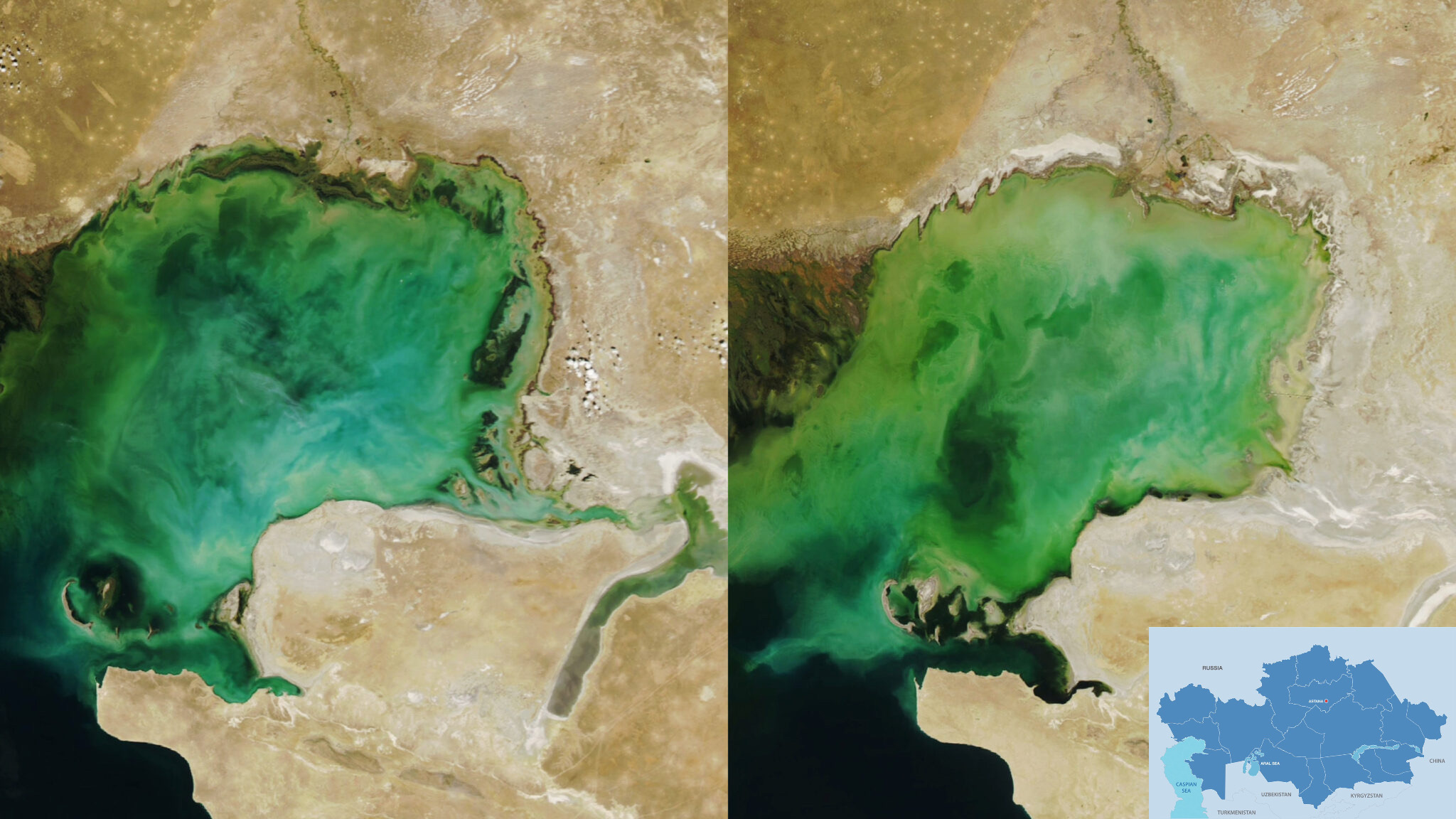
NASA satellite images of the Caspian Sea as of September 2006 (L) and September 2022 (R). Photo credit: NASA Click to see the map in full size. The map is designed by The Astana Times.
The anniversary coincided with the conclusion of the international Caspian Sea Action Week 2026, which brought together delegations from Azerbaijan, Iran, Russia and Turkmenistan, as well as representatives from Uzbekistan, the Kyrgyz Republic and Tajikistan, alongside volunteers, environmental activists, scientists and young people in Aktau.
Held under Taza Kazakhstan environmental culture development concept, the week combined scientific discussions, environmental campaigns, volunteer initiatives and innovation projects aimed at drawing attention to the shared challenges facing the Caspian.
From regional agreement to environmental action
The Framework Convention for the Protection of the Marine Environment of the Caspian Sea, known as the Tehran Convention, entered into force in 2006. It created a regional framework for the five Caspian littoral states to cooperate on pollution prevention and the protection of the sea’s ecosystem. Two decades later, the nature of the challenge has become more complex.
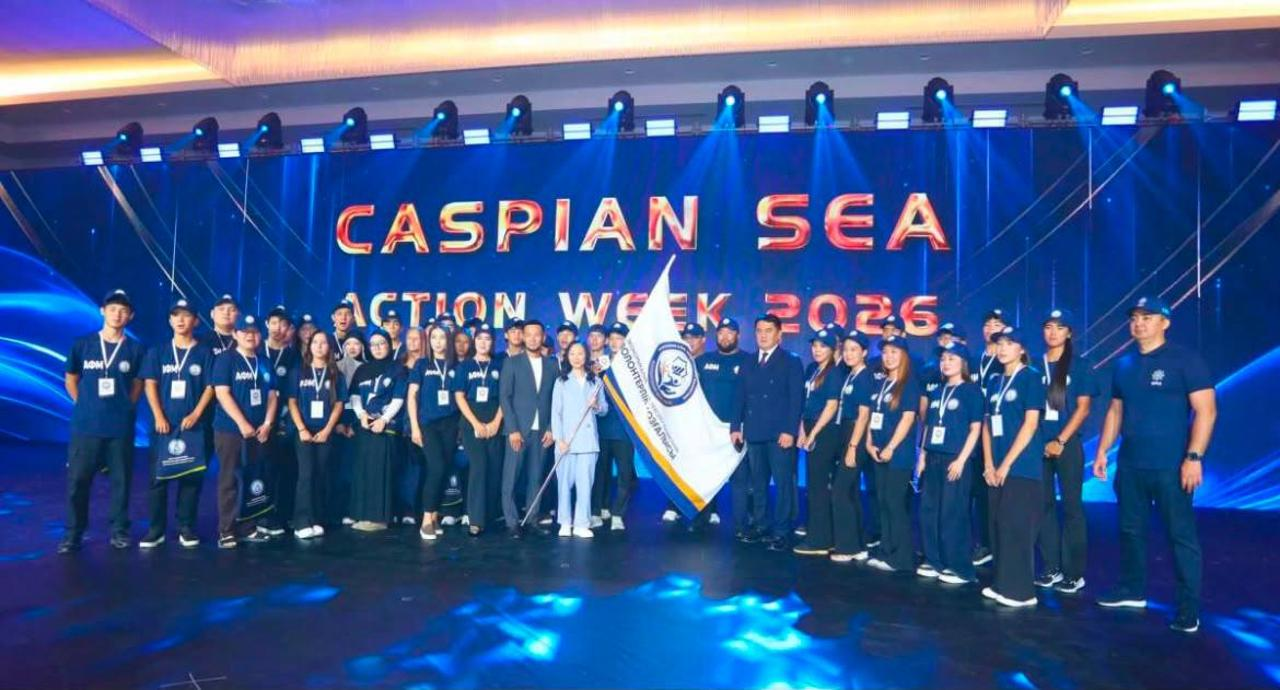
The anniversary coincided with the conclusion of the international Caspian Sea Action Week 2026. Photo credit: Ministry of Ecology and Natural Resources.
Environmental cooperation initially focused heavily on managing pollution and protecting marine biodiversity. Today, the long-term decline in the Caspian’s water level has added another dimension to the region’s environmental agenda.
Laura Malikova, chair of the Association of Practicing Environmentalists, recently warned about rapid shallowing in the northern Caspian. She linked some of the concerns to dredging operations conducted by the North Caspian Operating Company and its contractors to support navigation and cargo deliveries.

Laura Malikova, chair of the Association of Practicing Environmentalists. Photo credit: Kazinform
“Photos and videos clearly show how far the water has retreated. The northern Caspian is becoming shallow at an extremely rapid pace,” Malikova said, as quoted by Kazinform.
According to Kazakhstan’s Ecology Ministry, climate change remains the principal driver of the long-term water-level decline. Precipitation in the Caspian region is decreasing while evaporation is increasing, making the region particularly vulnerable to rising temperatures.
The combination of climate pressures and human activity creates a more complicated policy challenge. As water levels decline, coastal infrastructure, shipping routes, ports and industrial projects may need to adapt, while efforts to maintain economic activity can themselves place additional pressure on an already changing ecosystem.
Science becomes central to the response
This growing complexity explains the emphasis on scientific cooperation during Caspian Sea Action Week. An international seminar and roundtable on Aug. 6-7 brought together scientists and experts from Caspian countries to discuss environmental monitoring technologies and ongoing research. The focus reflects an important question for regional environmental policy: whether countries have sufficiently coordinated data and scientific capacity to understand changes occurring across the entire Caspian basin.

Held under Taza Kazakhstan environmental culture development concept, the week combined scientific discussions and environmental campaigns dedicated to the Caspian Sea. Photo credit: Ministry of Ecology and Natural Resources.
The Caspian is one interconnected ecosystem, but environmental information, monitoring systems and policy responses are largely organized at the national level. More effective cooperation could therefore depend not only on exchanging research results but also on developing compatible monitoring systems and a clearer shared understanding of environmental risks.
The One Caspian – One Future session held during the week reflected this idea by bringing together volunteer communities from different countries to discuss common approaches to protecting the sea.
From environmental awareness to practical solutions
The week also demonstrated an effort to connect high-level environmental discussions with public participation. The Caspian Clean Challenge, held in Aktau on Aug. 8 with the participation of Kazakh Vice Minister of Ecology and Natural Resources Mansur Oshurbayev, brought volunteers together for a large-scale coastal cleanup and waste-sorting campaign. More than 80 trees were planted at the newly opened Friendship Alley of Caspian Region Volunteers, while participants also placed a time capsule with messages for future generations.
A cleanup campaign was also held on Aug. 9 in the Bozzhyra area of the Mangystau Region. The international hackathon also invited participants to develop projects aimed at protecting the Caspian ecosystem, while an open TED-style discussion brought environmental volunteers and experts together to exchange ideas. The event concluded on Aug. 12 with the Caspian Talks international volunteer summit, where participants discussed current environmental challenges and exchanged experiences.
A shared sea, facing two possible futures
The central difficulty of protecting the Caspian is that environmental consequences do not stop at national borders. Changes affecting one part of the sea can eventually influence fisheries, biodiversity, coastal communities, ports and economic infrastructure across the region.
Between 2006 and 2025, the shoreline in some areas retreated by 30 to 35 kilometers, according to officials. The average water level across Kazakhstan’s sector of the Caspian stood at –29.35 meters relative to the Baltic height system in 2025.
The longer-term outlook presents two possible scenarios. A forecast prepared by Kazhydromet outlines an optimistic scenario under which the sea level could fall to –32.4 meters by 2050. Under a more pessimistic climate scenario, it could decline as far as –34 meters.
Neither scenario points to a return to previous conditions. Instead, the difference between them represents two levels of adaptation that Caspian countries may have to prepare for. A decline toward –32.4 meters would require substantial adjustments to coastal infrastructure and economic activity. A fall toward –34 meters could bring far more profound changes, pushing the shoreline farther from existing ports and coastal settlements and transforming parts of the former seabed into land.
This changes the nature of the policy challenge. The Caspian countries are no longer dealing only with the task of protecting an existing ecosystem from pollution and overuse. They may increasingly have to manage the economic and environmental consequences of a sea whose physical geography is changing.
Twenty years after the Tehran Convention entered into force, this may be the next major test of Caspian cooperation. The region now faces two broad futures, neither of which assumes the sea will remain unchanged. The critical question is whether Azerbaijan, Iran, Kazakhstan, Russia and Turkmenistan can use scientific monitoring and shared data to anticipate the consequences of either scenario before environmental change turns into an economic and infrastructure crisis.
