
ASTANA — Archaeologists and regional authorities are advancing research and preservation projects at major sites across Kazakhstan. From Bronze Age settlements in Rudny to Golden Horde monuments and a Caspian trade hub, the work is expanding knowledge of the country’s archaeological heritage and supporting its long-term preservation.
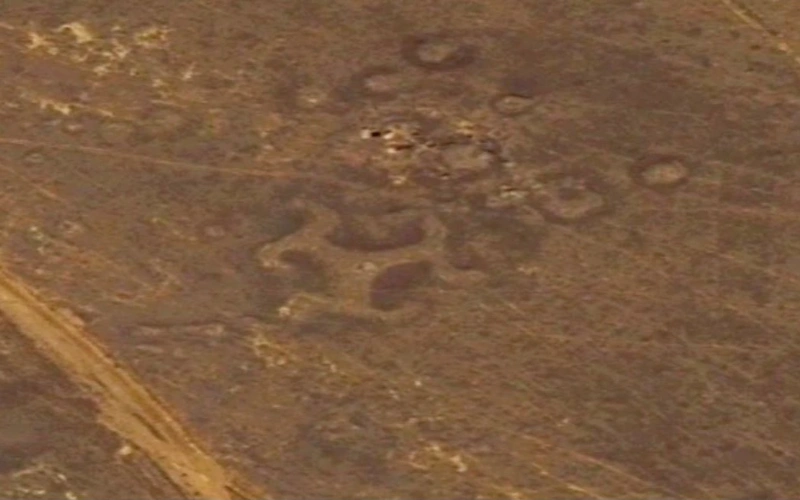
The Turgai geoglyphs in the Kostanai Region. Photo credit: Dmitry Dey – Google Earth / Kazinform
Kostanai’s Bronze Age sites and monumental steppe designs
The Alekseyevka site, located within the territory of present-day Rudny in the Kostanai Region, contains an unusual combination of three Bronze Age monuments, including a burial ground, a sacrificial mound and an ancient settlement.
The complex belongs to the Andronovo archaeological horizon, a broad group of related Bronze Age cultures once spread across large parts of the Eurasian steppe. Archaeologists have identified Andronovo sites across northern Kazakhstan, the southern Urals and Siberia, but the combination found at Alekseyevka is considered rare.
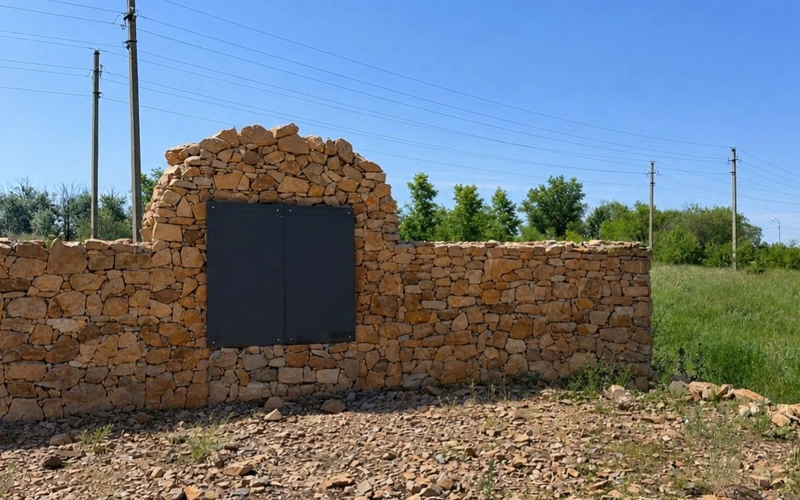
The Alekseyevka archaeological site in Rudny, Kostanai Region. Photo credit: Darya Averchenko/Kazinform
According to Alexander Kurguzkin, a specialist at Rudny’s museum of history and local lore, the site came to scientific attention by chance in 1921. A geology student named Sokolov was visiting Alekseyevka when he noticed that water along the left bank of the Tobol River was washing fragments of vessels and ancient tools out of the sandstone.
Sokolov initially thought the objects might have come from an old Kazakh cemetery in the area. He took several of the better-preserved finds to his institute, although further examination was delayed amid the period’s political instability. Researchers returned to Alekseyevka in 1931, when Soviet archaeologist Olga Krivtsova-Grakova began several seasons of excavation. Because the site was close to an old cemetery, some of the work was conducted under police protection.
The excavations uncovered 21 burials, the sacrificial mound and remains of a dwelling.
Rare burial: clues to Bronze Age society
“No comparable complex has been found elsewhere in Russia or Kazakhstan. At other sites, researchers identified only a burial ground, a settlement or a sacrificial mound. Here, all three were found together,” Kurguzkin told Kazinform.
One of the most remarkable discoveries was a woman buried in the center of the cemetery. According to Kurguzkin, the remains belonged to a woman whose height may have approached two meters, while most individuals examined at the site were estimated to have been approximately 1.3 to 1.4 meters tall.
The woman was also buried differently from the others. Her body was placed on its right side rather than the left, and eight vessels were arranged beside her – four near her head and four near her feet.
According to Kurguzkin, people of high standing were commonly buried in the central part of a cemetery, and the woman’s unusual stature suggested she held a special place in the community. Her well-preserved skull was later sent to Moscow, where anthropologist Mikhail Gerasimov reconstructed her presumed appearance.
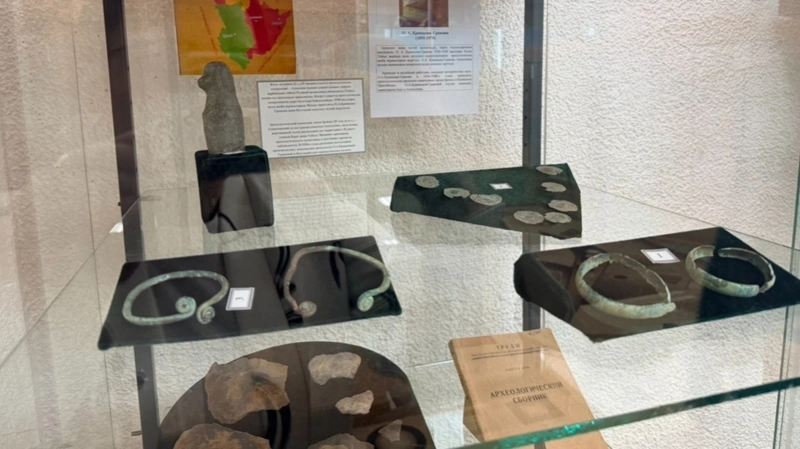
Bronze, silver and gold jewelry, weapons and ceramics uncovered during excavations at the Alekseyevka site. Photo credit: Darya Averchenko/Kazinform
The excavations also produced bronze, silver and gold jewelry, weapons and a large collection of ceramics.
The approximately nine-meter sacrificial mound yielded another significant group of finds. Archaeologists discovered more than 50 vessels around its perimeter containing traces of ritual food, including meat from wild and domesticated animals.
Most of the vessels were handmade, but their durability impressed both researchers and residents.
“One resident said he had found such a vessel while digging in his garden. It stood for 20 years beside a modern jug. Ironically, the modern one crumbled long ago, while the ancient vessel remained intact,” said Kurguzkin.
Excavations continued after World War II, with the last major fieldwork conducted in 1968. Only a small part of the sacrificial mound survives today, and a memorial sign at the site recounts the history of the research.
Kurguzkin has compared Alekseyevka to Arkaim, the fortified Bronze Age settlement in Russia’s southern Urals, calling the sites closely related monuments of the same archaeological period.
Geoglyph research to advance UNESCO tentative listing
Elsewhere in the Kostanai Region, researchers are studying the Turgai geoglyphs – large geometric earthworks whose forms are most clearly visible from above. According to Kuralbek Atamuratov, the head of the Kostanai Region’s culture department, fieldwork is underway at the Sandyktau Line and the Ushtogay Square geoglyphs in the Amangeldy District.
The region has 1,327 registered historical and cultural monuments. Thirty-nine are included in Kazakhstan’s Sacred Map, a national register of culturally significant locations, including 10 sites of nationwide importance and 29 of regional importance.
Regional authorities are preparing research materials for the Urpek I archaeological complex and the wider Turgai geoglyph group for inclusion on Kazakhstan’s Tentative List for the United Nations Educational, Scientific and Cultural Organization (UNESCO) World Heritage status.
The project also includes emergency preservation work around the perimeter of the Turgai Triquetra, one of the region’s largest geometric earthworks.
Before the sites can be added to the tentative list, specialists must examine archival and cartographic records, conduct field studies using modern technologies, prepare a historical and cultural assessment, and establish legally protected zones around the monuments.
While preservation work continues in Kostanai, archaeological expeditions elsewhere in northern Kazakhstan are uncovering evidence of the medieval past.
Northern steppe reveals Golden Horde mausoleum
Scientists and students from Margulan University are investigating Golden Horde-era monuments in the Pavlodar, North Kazakhstan and Akmola regions, with one of the main research sites located at the Jantai tract.
Archaeologists uncovered fragments of fired bricks measuring 25 by 25 centimeters, a size associated with monumental Golden Horde architecture used in palaces, mosques and mausoleums. Together with a nearby medieval necropolis, the discoveries suggest the site was a mausoleum built for members of the steppe elite in the 14th or 15th century.
Excavations also yielded decorative metal plaques once sewn onto clothing, imported beads and a cowrie shell native to the Indian Ocean. Researchers say the finds point to long-distance trade and cultural contacts linking the Great Steppe with South Asia and other parts of Eurasia.
Mangystau сoins: ancient Caspian crossroads
On the Caspian coast, ongoing research at the Karakabak settlement is shedding new light on trade and production in the Mangystau Region. Located in the Tupkaragan District, Karakabak dates from the first to the sixth century. According to the Kazakh Ministry of Science and Higher Education, it was discovered in 2006 during a project to compile an official register of historical monuments in the region.
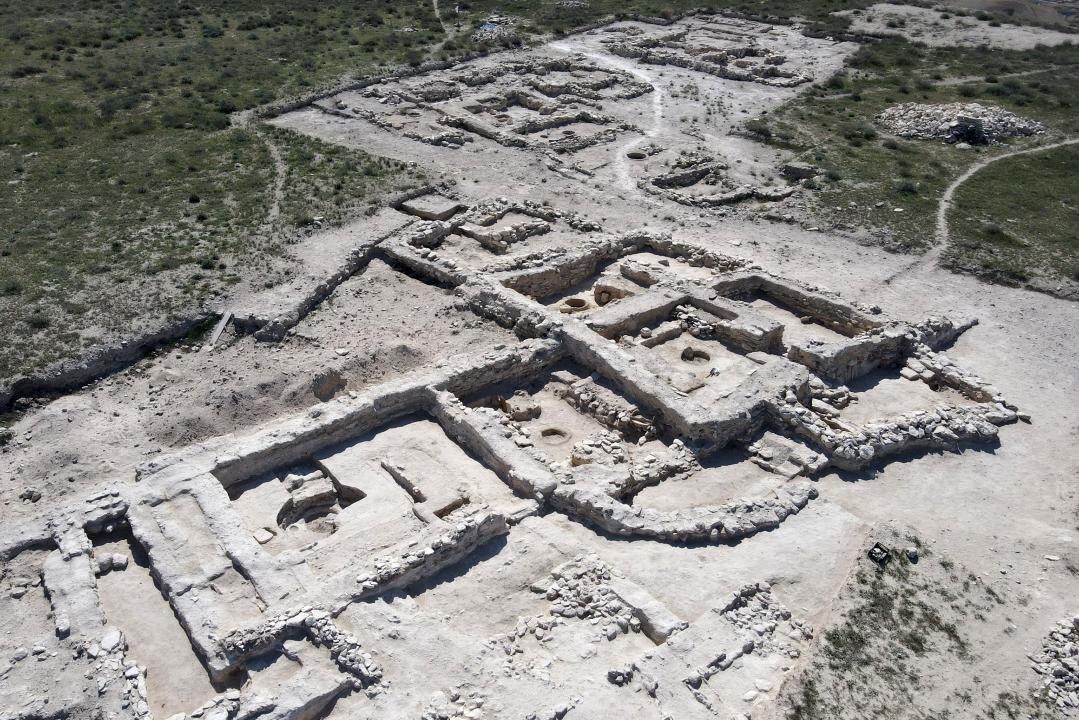
The ancient Karakabak settlement in the Mangystau Region. Photo credit: Kazakh Ministry of Science and Higher Education.
Since 2022, research at the settlement has been conducted by the Alkey Khakanuly Margulan Institute of Archaeology. Work on the site has resulted in 24 scholarly publications, including three monographs and nine articles indexed in the Scopus academic database. Researchers are also examining how Karakabak could be incorporated into regional tourism routes.
Archaeological evidence identifies Karakabak as a major manufacturing, craft and commercial center that flourished for several centuries. Its inhabitants practiced metallurgy, jewelry production, glassmaking and pottery, leaving behind locally produced objects and imported materials from different parts of Eurasia.
Among the most significant discoveries is a collection of more than 150 coins.
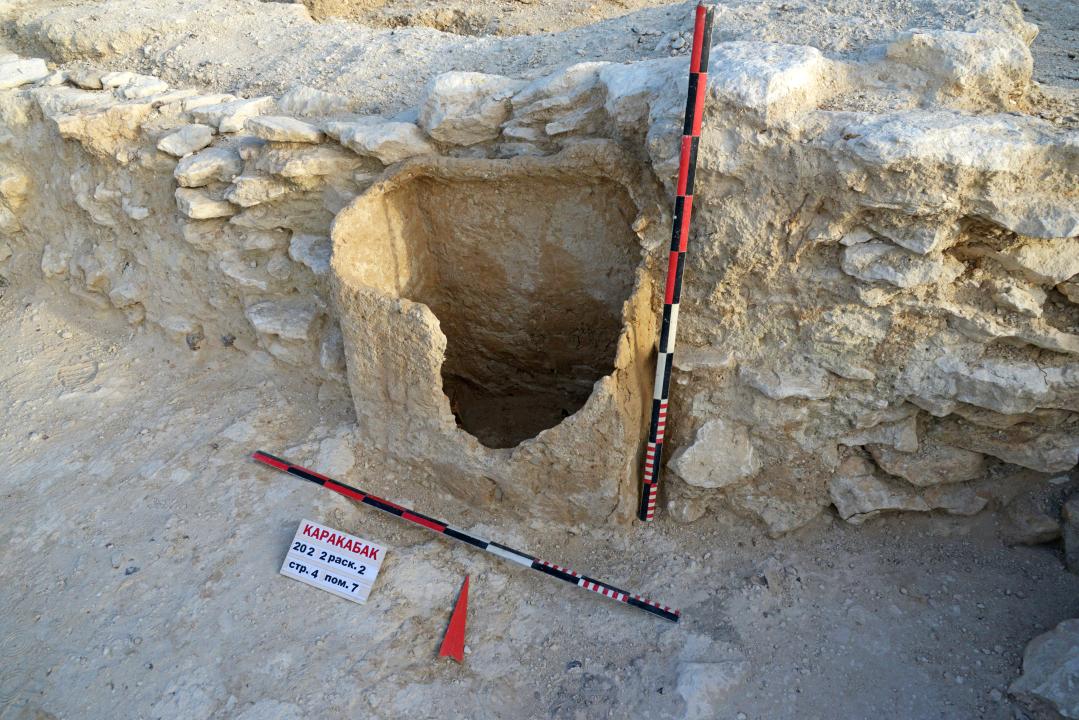
The Karakabak settlement was a major manufacturing, craft and trade center in ancient Mangystau. Photo credit: Kazakh Ministry of Science and Higher Education
“Of particular scientific interest is a collection of more than 150 coins dating from the first century to the first half of the sixth century. It includes coinage from Parthia, ancient Khorezm, Bukharan Sogdia, Sasanian Iran, the Kushano-Sasanian state, the Byzantine Empire and China. These finds confirm Karakabak’s active participation in the international trade and economic relations of its time,” said archaeologist Andrey Astafyev.
Researchers believe one branch of the Silk Road may have passed through Mangystau, connecting Central Asia with the Caspian region and Eastern Europe. They also say the discoveries support the existence of a previously little-known Azov-Caspian trade corridor, with Karakabak potentially serving as one of its key hubs. Materials from the site indicate contacts with the North Caucasus, the Sea of Azov region, the lower and middle Volga areas, the southern Urals, Central Asia and the Middle East.
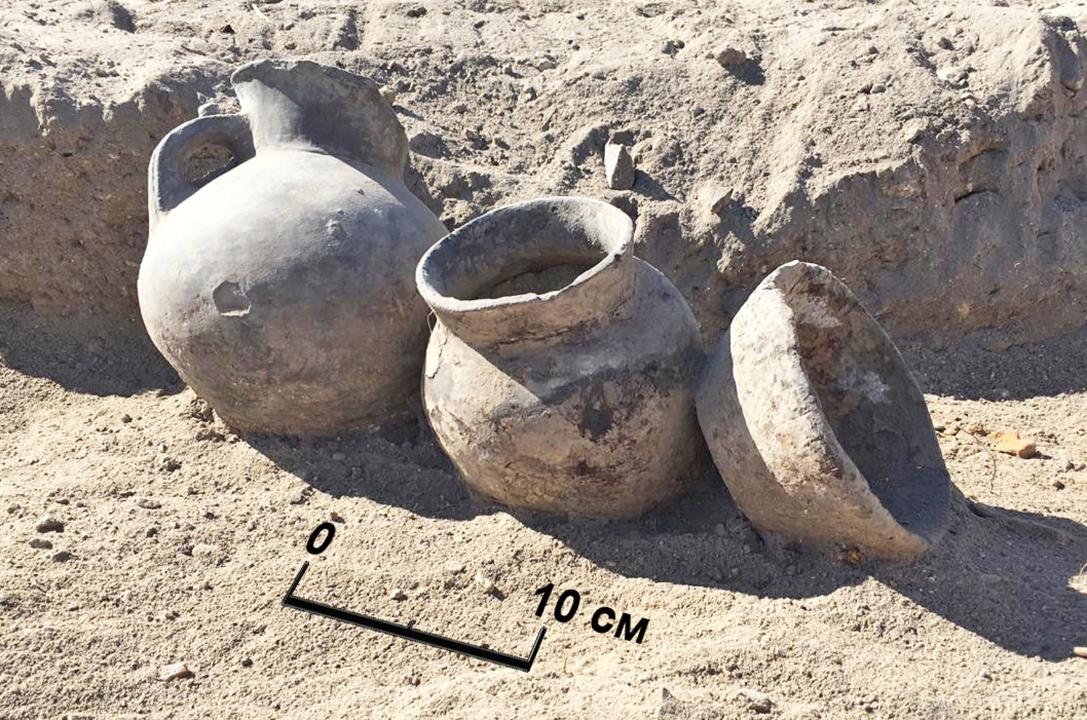
A recently discovered jug from the ancient Karakabak settlement, preliminarily dated to the sixth century. Photo credit: Kazakh Ministry of Science and Higher Education
A recently discovered jug, preliminarily dated to the sixth century, is undergoing further examination. Researchers expect the artifact to provide information about daily life, craft production and local traditions.
Archaeologists are also considering whether Karakabak may be connected with Aspabota, a city shown on the map of the ancient Greek geographer Claudius Ptolemy on the eastern coast of the Caspian Sea. The proposed identification remains a research hypothesis rather than an established conclusion.
“Karakabak allows us to take a new look at the history of Mangystau and Kazakhstan’s place in the system of ancient international communications. Archaeological finds confirm that for many centuries, this region was an important link in the trade routes connecting East and West,” said Astafyev.
Further research at the site will provide new information about the development of the Silk Road and strengthen scientific understanding of the historical processes that took place in the territory of modern Kazakhstan,” he added.
