
ASTANA – Kazakhstan’s aluminum, iron and steel sectors are expected to be the most affected by the European Union’s Carbon Border Adjustment Mechanism (CBAM), according to Fabiana Fong, component lead at the International Trade Centre (ITC).
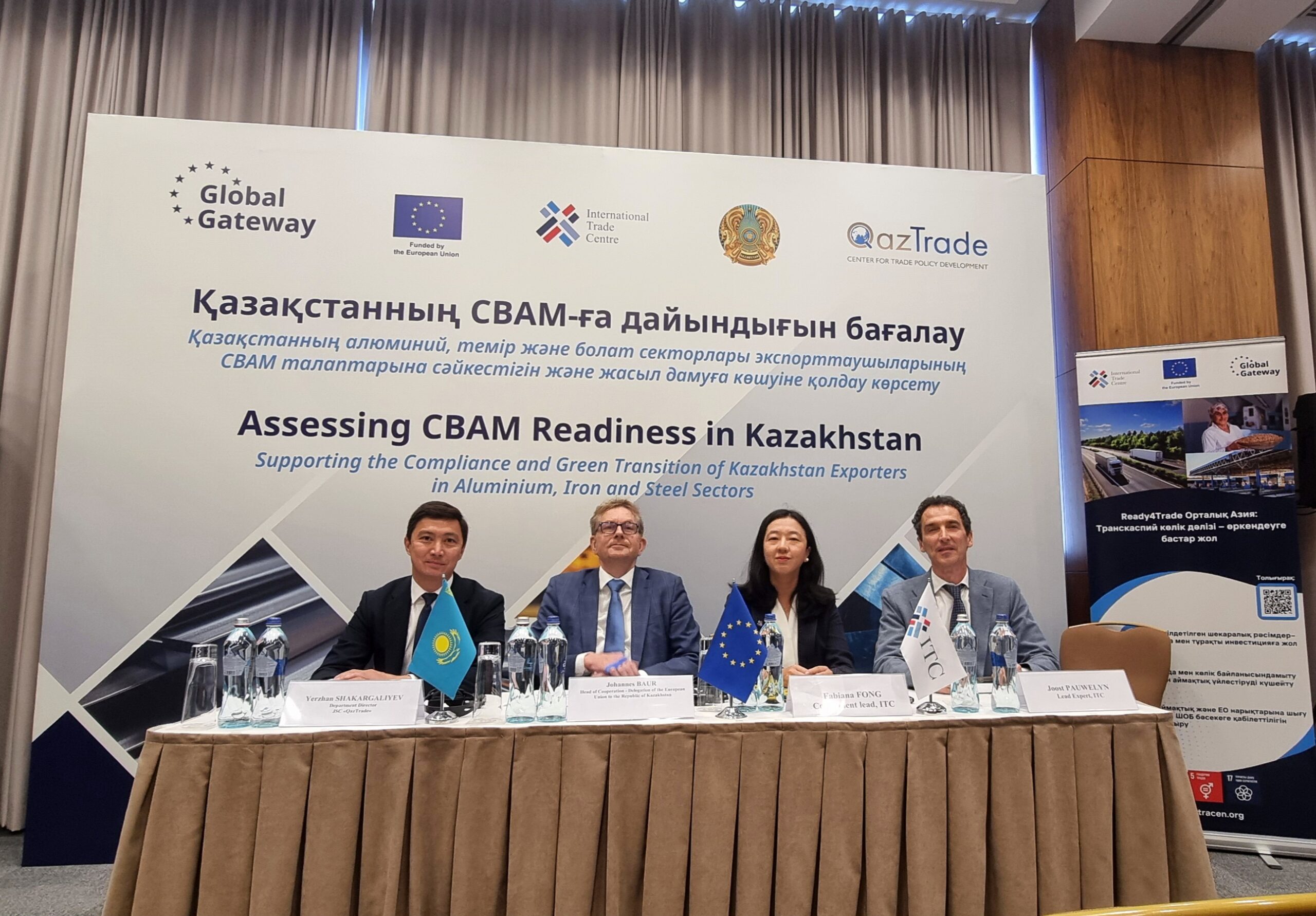
From left to right: Yerzhan Shekargaliyev, Johannes Baur, Fabiana Fong and Joost Pauwelyn. Photo credit: The Astana Times
Speaking at the presentation of a CBAM impact assessment report in Astana on June 3, Fong said the study provides a practical guide to help exporters understand the requirements and take the necessary steps toward compliance with the EU’s carbon pricing rules.
Presented by the ITC in partnership with the QazTrade Trade Policy Development Center, the report examines the potential effects of the European Union’s CBAM on Kazakhstan’s aluminum, iron and steel sectors and offers practical recommendations to help exporters adapt to evolving sustainability requirements. The study includes a phased compliance roadmap, guidance on emissions reporting and recommendations for strengthening cooperation with EU partners to maintain competitiveness in European markets.
CBAM is the EU’s mechanism designed to ensure that imported products are subject to a carbon price equivalent to that paid by European producers. The measure is part of the EU’s broader climate agenda aimed at reducing greenhouse gas emissions.
Fong, ITC described CBAM compliance as a highly technical process requiring companies to measure, calculate and report carbon emissions throughout production chains.
She added that the report addresses complex technical issues, including methodologies for calculating direct and indirect emissions, and provides step-by-step recommendations for exporters.
According to Johannes Baur, head of cooperation at the EU Delegation to Kazakhstan, the EU aims to reduce net greenhouse gas emissions by at least 55% by 2030 compared to 1990 levels and introduced CBAM to ensure fair competition between European and foreign producers.
“The emissions trading system places a price on every ton of carbon dioxide emitted by industry in the EU. CBAM ensures that imported products face a comparable carbon cost, creating a level playing field in the EU market,” Baur said.
He emphasized that Kazakhstan remains an important trade and investment partner for the EU. While the country’s exposure to CBAM is lower than that of some other regional economies, such as Uzbekistan, the mechanism will still affect Kazakhstan’s exports of aluminum and steel, among other covered products.
Baur also encouraged Kazakhstan to strengthen its domestic emissions trading system, noting that a more effective carbon pricing framework could help align the country’s regulations with EU standards and potentially reduce CBAM-related costs for exporters.
The report’s main takeaways
Presenting the report’s findings, Joost Pauwelyn, a law professor at the Graduate Institute in Geneva and ITC lead expert, said CBAM has become a new reality for exporters selling covered products to the EU market.
He warned that companies that fail to monitor and report their actual emissions risk being charged based on EU default values, which are significantly higher than many producers’ real emissions levels.
“Exporters who fail to submit actual emissions will be subject to EU default values, which assume carbon-intensive production and carry additional markups of 10% in the current period, rising to 20% and then 30% by 2028,” Pauwelyn said.
According to the report, the EU accounted for 54% of Kazakhstan’s aluminum exports. Based on a carbon price of 80 euros (US$93) per ton, the estimated CBAM cost for aluminum exports would be about 5.6 million euros (US$6.5 million), or roughly 2% of export value.
The impact on iron and steel exports could be far greater. Using default emissions values, CBAM costs could exceed 108 million euros (US$125 million), equivalent to 123% of the value of some steel exports.
He said that if Kazakh exporters properly monitor, verify and report their actual emissions, the total CBAM liability could be cut from roughly 114 million euros (US$132 million) to approximately 57 million euros (US$66 million) annually.
The report also highlights Kazakhstan’s relatively low domestic carbon price. While the EU carbon price currently stands at around 80 euros per ton, Kazakhstan’s emissions trading system charges around 40 euro cents per ton.
“As long as Kazakhstan’s domestic carbon price remains low, exporters will effectively pay the full EU carbon price when entering the European market,” Pauwelyn said.
He argued that raising Kazakhstan’s domestic carbon price and improving emissions monitoring, reporting and verification systems could significantly reduce costs for exporters while allowing the government to retain more carbon-related revenues domestically.
According to Pauwelyn, coordinated action by government agencies, exporters and technical assistance providers could significantly reduce compliance costs and help preserve Kazakhstan’s competitiveness in the EU market.
