
ASTANA – Space exploration and environmental risks are increasingly intertwined as defunct spacecraft turn into uncontrolled debris orbiting Earth. Dr. Dmitry Sizov, an aerospace engineering expert at Astana-based Nazarbayev University, discussed the growing threat of space debris and its global implications during a lecture at the university on Jan. 29.
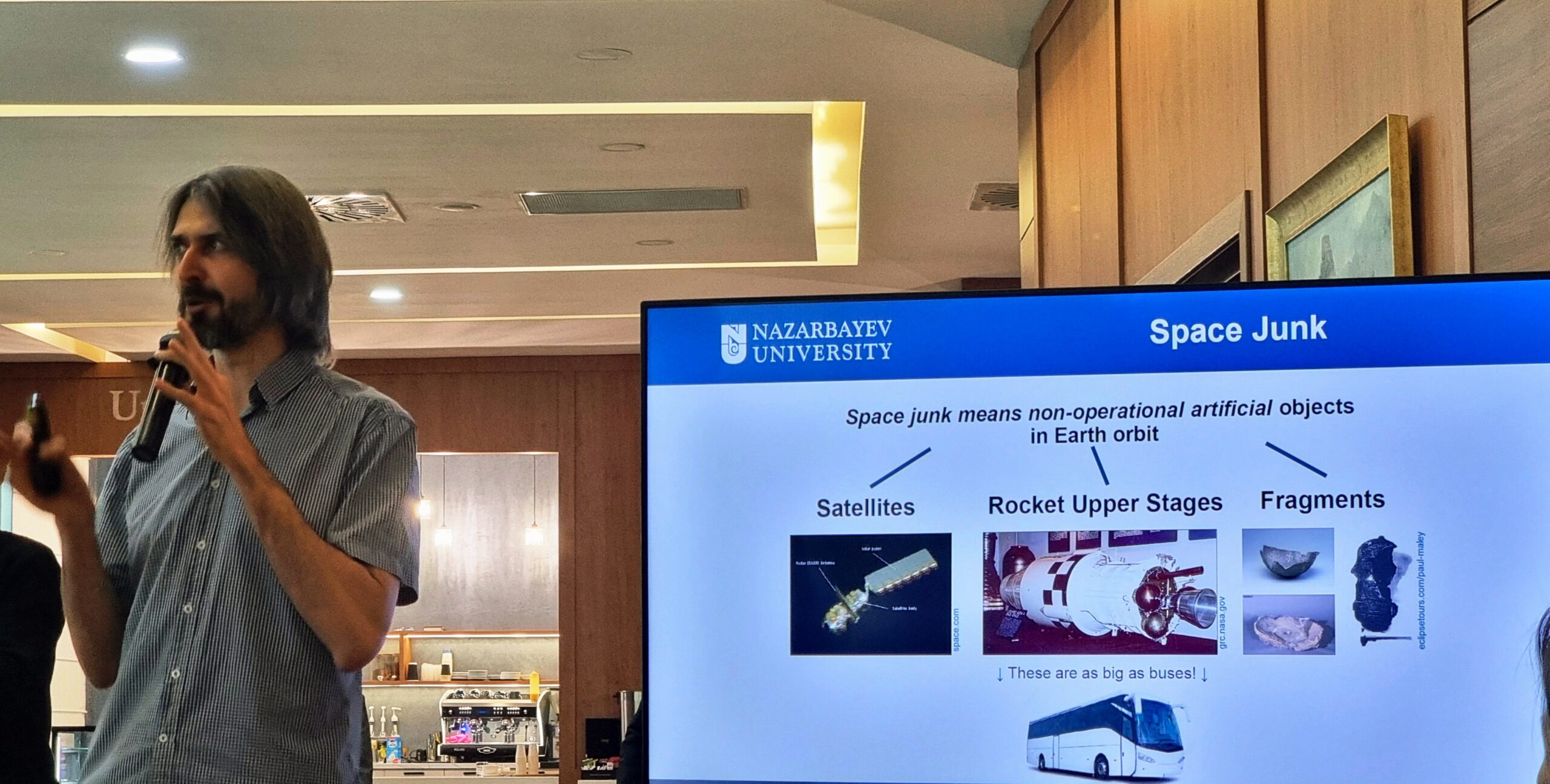
Dr. Dmitry Sizov, an aerospace engineering expert at Nazarbayev University. Photo credit: The Astana Times
Space pollution problem
As space activity expands, the accumulation of man-made objects in orbit has become a critical challenge. Space debris includes inactive satellites, spent rocket stages, and fragments created by collisions. Left unmanaged, these objects threaten operational satellites, space stations, and future missions.
Sizov defined space debris as nonfunctional satellites, rocket components and structural fragments traveling at orbital speeds of about seven kilometers per second.
“Space debris can be large, like rocket stages, or very small, like metal fragments. However, at that speed, even a tiny object can cause serious damage,” Sizov said.
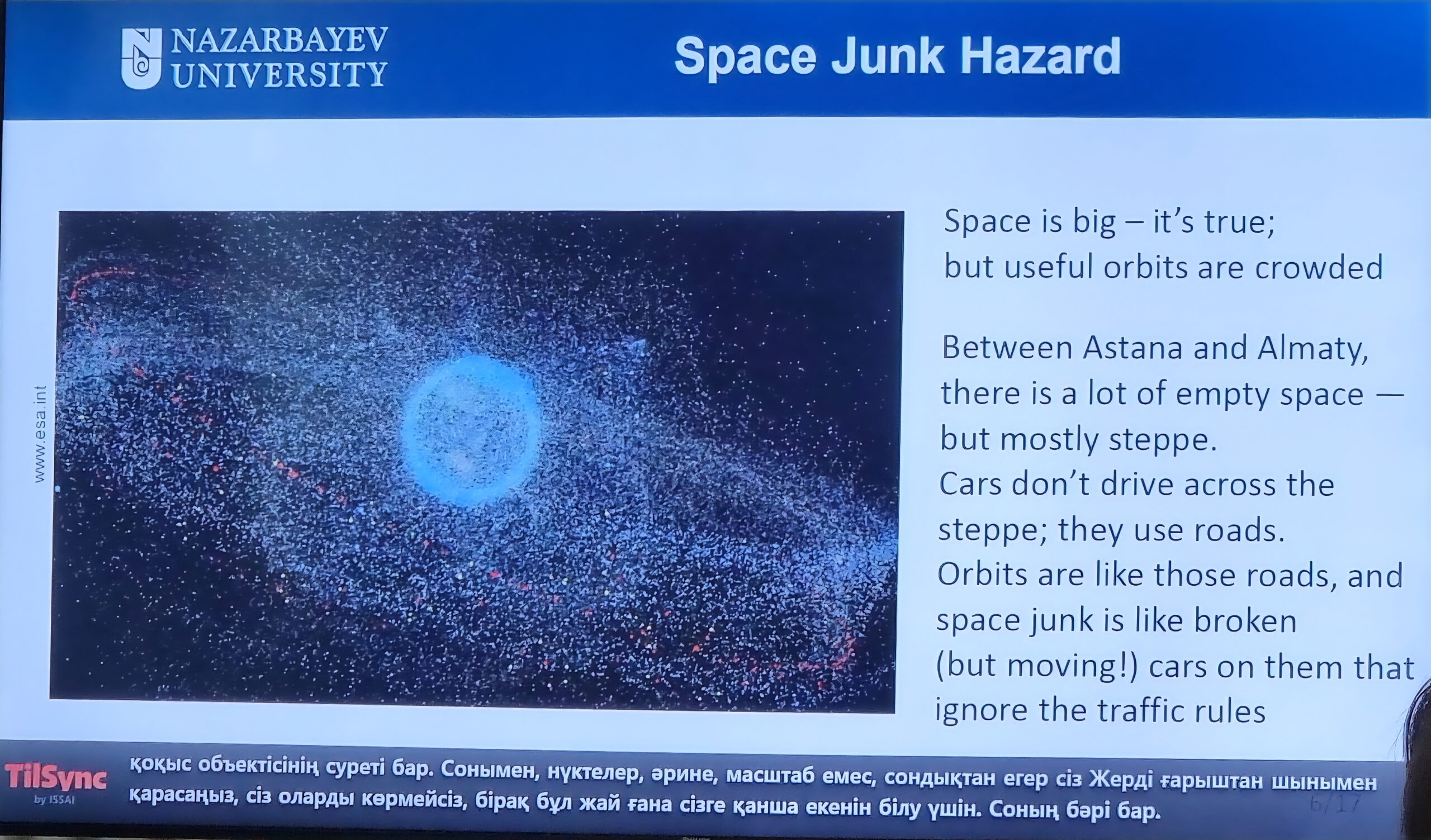
Most satellites occupy only a few key orbits, which Sizov compared to highways filled with uncontrolled traffic. Photo credit: The Astana Times
International organizations such as NASA monitor orbital debris and publish regular reports on potential risks. According to Sizov, the International Space Station was forced to maneuver twice in November 2024 to avoid possible collisions, underscoring how routine such threats have become for astronauts and satellite operators.
Despite its size, space is not used evenly. Most satellites occupy only a few key orbits, which Sizov compared to highways filled with uncontrolled traffic.
“People think space is huge, but in reality, we use only certain useful orbits, and they are heavily polluted. It is like cars driving without rules on the same road. That is what makes the situation dangerous,” he said.
The consequences of this congestion extend far beyond scientific laboratories. Modern life depends heavily on satellite-based infrastructure, from navigation systems and mobile communications to weather forecasting and internet connectivity.
“If this orbital system collapses, we risk losing GPS, communications, and weather monitoring. That would affect transportation, emergency services, and the global economy,” Sizov said.
Addressing the problem begins with preventing new debris from being created.
Sizov said that modern spacecraft are increasingly designed to burn up in Earth’s atmosphere at the end of their missions through controlled deorbiting, reducing the number of abandoned objects in orbit.
However, prevention alone is not enough. Large pieces of debris in orbit remain a major concern because they can generate thousands of new fragments if they collide with another object or explode.
The global race to clean space
Among the proposed solutions are robotic arms, magnetic capture systems and aerodynamic braking technologies. Sizov is currently working on a mathematical model for removing debris using an aerodynamic torus, a structure designed to slow objects and force them into lower orbits where they can safely disintegrate in the atmosphere.
Beyond engineering challenges, Sizov described the debris problem as an ethical issue.
“These objects can remain in orbit for hundreds of years. By polluting space now, we are limiting the opportunities of future generations to explore it safely,” he said.
Interest in space debris removal is rising worldwide, he noted, and competition among private companies and national space agencies is intensifying. However, no large object has yet been successfully removed from orbit.
He believes Kazakhstan can play a role in this emerging field, not by launching massive satellite fleets, but by contributing scientific research and innovative solutions.
“Kazakhstan does not have to be a major space power to join this race. What it needs are engineers, scientists and strong ideas. The country can help develop the methods and mathematical models that future missions will rely on,” said Sizov.
