
ALMATY – Kazakhstan will assume the chairmanship of the Eurasian Economic Union (EAEU) in 2026, President Kassym-Jomart Tokayev said at the Dec. 21 meeting of the Supreme Eurasian Economic Council in St. Petersburg. He also confirmed that the next council meeting will be held in Astana on May 28–29.
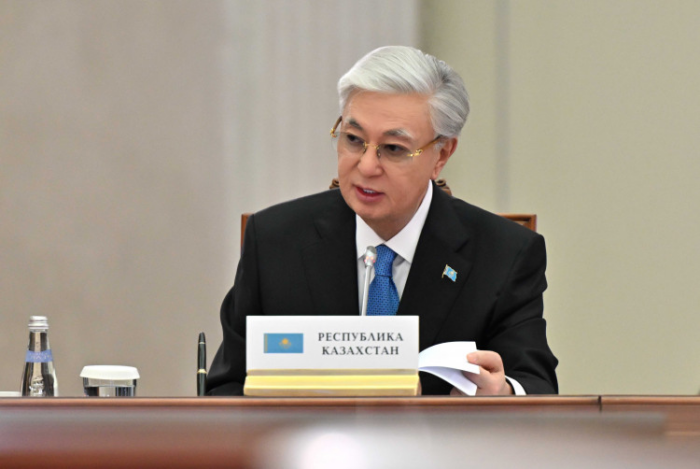
President Kassym-Jomart Tokayev at the Dec. 21 meeting of the Supreme Eurasian Economic Council. Photo credit: Akorda
During the meeting, Tokayev noted that 2025 marks the tenth anniversary of the Eurasian Economic Union (EAEU), which has entered its second decade with solid economic foundations, reported the Akorda press service.
“Over this period, we have ensured steady growth in mutual trade, successfully implemented infrastructure projects, and expanded industrial cooperation,” Tokayev said, adding that despite global shocks, the union has preserved positive economic momentum.
Economic results and investment growth
According to Tokayev, the combined GDP of EAEU member states is expected to grow by 2% in 2025, with forecasts pointing to sustained growth over the next two years.
“Since the establishment of the Eurasian Economic Union, the accumulated volume of mutual direct investment has exceeded $20 billion. Investment inflows into Kazakhstan increased almost sevenfold from $600 million in 2015 to $4 billion in 2024. Industrial production grew by 29%, reaching $1.5 trillion,” he said.
Tokayev also emphasized the need to consistently strengthen the union’s economic potential and outlined priority areas for its further development.
AI as a new integration driver
Turning to future-oriented policies, Tokayev said the world has entered an era of total digital transformation and artificial intelligence, urging EAEU members to keep pace with global change.
“We must ensure the introduction of modern technologies in all sectors of the EAEU economies. We propose launching work on integrating artificial intelligence technologies into the union’s activities,” he said.
According to Tokayev, AI systems could already be used to forecast trade flows and assess the impact of customs tariffs. He suggested that, during Kazakhstan’s upcoming chairmanship of the EAEU bodies, the annual Eurasian Economic Forum could adopt a joint statement on the responsible development of AI across the union.
Transport corridors
Tokayev highlighted that the EAEU has the potential to become a global transport and logistics hub, citing major international corridors passing through member states, including West–East and North–South routes, as well as the Trans-Caspian International Transport Route.
“Kazakhstan is developing a network of international multimodal logistics centers and terminals with foreign partners. We invite our partners to join this work to optimize trade flows and reduce transportation costs,” he said.
President Tokayev also highlighted the importance of expanding Kazakhstan’s maritime infrastructure on the Caspian Sea and called for accelerating the entry into force of the Shipping Agreement to strengthen transit capacity across the union.
Industrial cooperation and high-value production
Tokayev emphasized the importance of focusing on new industrial production aimed at high value-added goods demanded on global markets.
“According to Eurasian Development Bank analysts, additional production and export opportunities for industrial goods in EAEU countries are estimated at $67 billion. If fully realized, the total growth effect could reach $500 billion,” he said, noting that achieving this goal requires stronger industrial cooperation and investment in breakthrough innovation projects.
Removing barriers to trade
A key part of Tokayev’s address focused on eliminating administrative barriers within the union. He said practices that restrict free movement undermine the credibility of integration.
“We must eliminate artificial restrictions on the movement of citizens and kilometer-long queues of freight transport at borders. Customs regulation and state control measures should not be used as tools to pressure decisions within the union,” he said.
Tokayev called for strict compliance with existing EAEU agreements and proposed using artificial intelligence to monitor legislative initiatives in member states to identify potential barriers early.
“Full functioning of a barrier-free single market and ensuring free transit of goods must remain unconditional priorities. Citizens and businesses must feel the practical benefits of integration,” he said.
Expanding external partnerships
Tokayev also urged expanding the geography of trade and economic cooperation. He welcomed the signing of a free trade agreement with Mongolia, an economic partnership agreement with the United Arab Emirates, and a new agreement with Indonesia.
“These are important results of our joint work and evidence of growing interest from third countries in deepening trade ties with the EAEU,” he said, adding that cooperation should be expanded with the Global South, the Arab world, Southeast Asia, Africa, and organizations such as the Shanghai Cooperation Organisation and ASEAN.
The summit was attended by the leaders of Russia, Belarus, Armenia, the Kyrgyz Republic and Uzbekistan, as well as representatives from Indonesia, Iran, and Cuba. Several documents were also adopted following the meeting.
