
ASTANA – The Kazakh capital hosts the two-day Think Tank Forum on Oct. 15-16, bringing together leading scholars, diplomats, and policymakers across the globe, from the United States to Eurasia, to explore practical ways to rebuild trust and strengthen cooperation in an increasingly fragmented world. The event, organized by the Kazakhstan Institute for Strategic Studies (KazISS), sought to generate new ideas for a more resilient and inclusive international order.
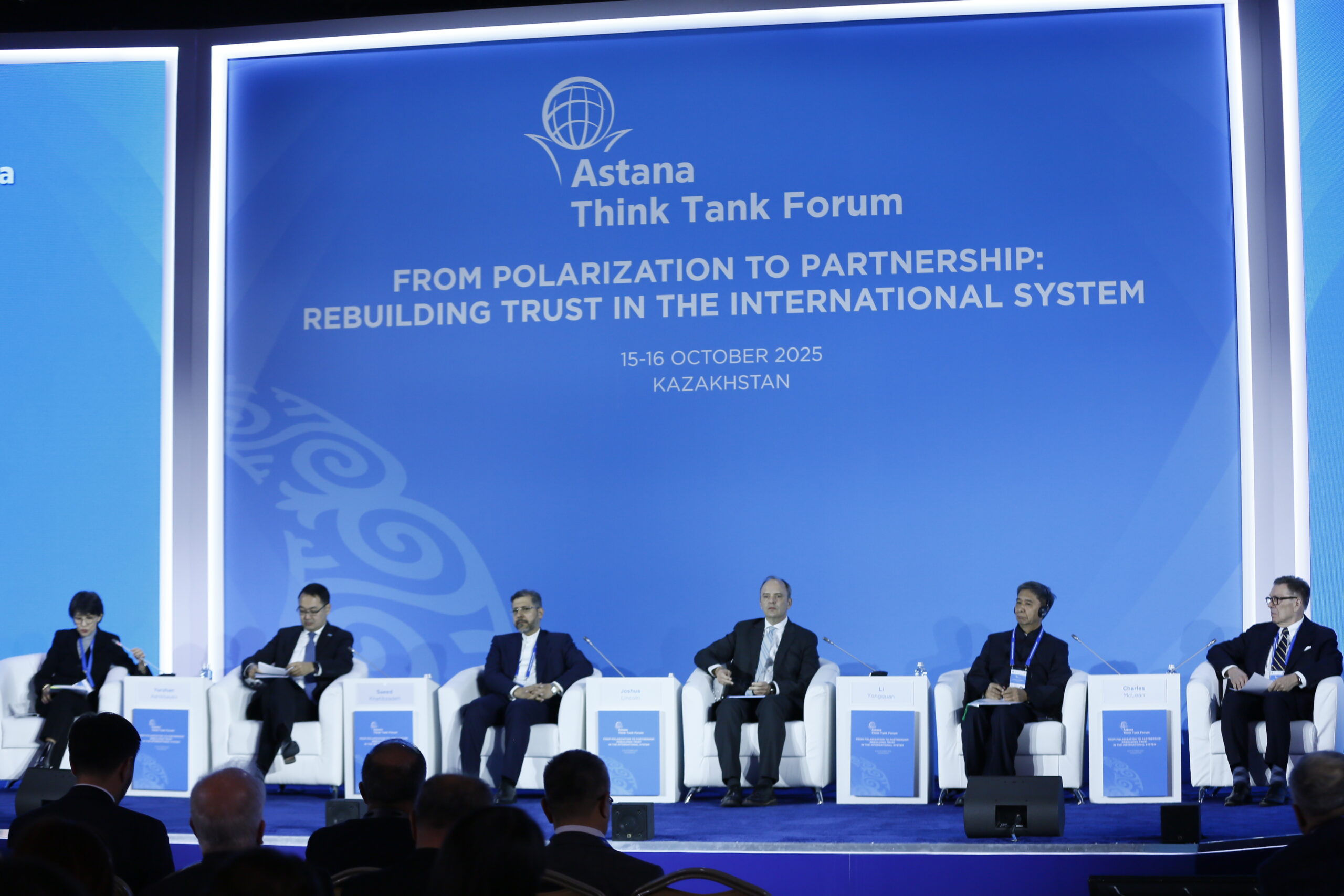
From left to right: Sarangoo Radnaaragchaa, Yerzhan Ashikbayev, Saeed Khatibzadeh, Joshua Lincoln, Li Yongquan and Charles McLean. Photo credit: press service of the KazISS.
Addressing the opening session, Magzum Mirzagaliyev, the Kazakh President’s advisor, said the world today faces a profound “deficit of trust” between nations, within societies, and toward institutions. He warned that polarization has become a defining feature of international relations, undermining multilateral cooperation.
“Polarization has become not only a political phenomenon but also a defining feature of international relations, challenging the very foundations of multilateral cooperation. In such times, dialogue and engagement are essential, not optional. They form the backbone of progress and mutual understanding. Kazakhstan firmly believes that trust is the cornerstone of peace and that dialogue is a more reliable path through uncertainty,” Mirzagaliyev said.
He emphasized that events like the Astana Think Tank Forum play a vital role in renewing confidence in global cooperation and in reminding the world of shared goals.
“Events such as this remind us that despite our differences, we are bound by the same aspirations – security, stability, and sustainable development. The discussions that begin here in Astana will, I hope, contribute to renewing faith in cooperation among all nations. Kazakhstan will continue to serve as a facilitator of balance both in our region and beyond, and as a trusted partner in addressing global challenges through reason, respect, and collaboration,” he said.
Middle powers and the future of global cooperation
One of the central sessions, titled Multilateralism at a Crossroads: Reforming Global Governance in a Divided World, focused on how to restore trust and adapt institutions to today’s shifting geopolitical landscape.
Yerzhan Ashikbayev, First Deputy Minister of Foreign Affairs of Kazakhstan, highlighted the growing role of middle powers in promoting peace and sustainable development, both regionally and globally.
He also reaffirmed Kazakhstan’s global initiatives, including the proposal to establish an International Agency for Biological Security under the United Nations auspices to prevent pandemics and bioterrorism, as well as the opening of the UN Regional Center for Sustainable Development for Central Asia and Afghanistan in Almaty.
Ashikbayev further pointed to emerging challenges linked to technological progress, particularly artificial intelligence (AI).
“Security challenges are taking on new and complex dimensions. We believe access to AI must be fair, open, and non-discriminatory. This is not simply a technological issue. It’s about equal opportunity, digital sovereignty, and the equitable participation of all countries,” he said.
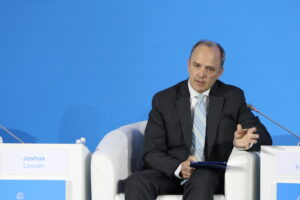
Joshua Lincoln, senior fellow at the Fletcher School of Law and Diplomacy at Tufts University cited Kazakhstan as an interesting illustration of the diplomatic balance needed in global governance. Photo credit: press service of theKazISS
Joshua Lincoln, senior fellow at the U.S. Fletcher School of Law and Diplomacy at Tufts University and visiting fellow at Oxford University, brought an academic lens to the discussion, urging participants to “think together” beyond national boundaries, cultures, and worldviews.
Lincoln observed that global institutions created in 1945 now face “unprecedented challenges.”
“The UN Charter was pre-digital, pre-nuclear, pre-human rights, pre-climate crisis. We are living in a moment that requires slow, managed renewal, what Canadian scholar Thomas Homer-Dixon calls ‘constrained breakdown.’ If the breakdown is slowed and moderated, it allows the possibility of renewal rather than total collapse,” he said.
Lincoln discussed the rise of alternative multilateral formats such as BRICS and the Shanghai Cooperation Organization (SCO), which he said emphasize sovereignty and multipolarity but often lack strong enforcement mechanisms. In contrast, smaller groupings such as the Quadrilateral Security Dialogue (QUAD) and the Organization for Economic Co-operation and Development (OECD) “allow faster decision-making but risk deepening fragmentation.”
He cited Kazakhstan as an “interesting illustration” of the diplomatic balance needed in global governance.
“Kazakhstan is a member of the SCO, CSTO, and the Eurasian Economic Union, and an associate member of BRICS Plus. At the same time, it continues to call for sovereign equality, the inviolability of borders, and the peaceful resolution of disputes. This kind of dual-track diplomacy we will need in the period ahead,” said Lincoln.
Upholding international law and sovereignty
Saeed Khatibzadeh, Deputy Foreign Minister of Iran and president of the Institute for Political and International Studies, spoke about the current state of global politics, warning that the principles of sovereignty and international law are under threat.
“What we are seeing is the weakening of international institutions, but it is not only about the UN. Many principles of national sovereignty, territorial integrity, and humanitarian law are being violated,” said Khatibzadeh.
He emphasized that the emergence of a multipolar world and the rise of the global south offer a chance to build a more inclusive system of governance.
“In the multipolar world we are seeing, the global south is important. We should avoid getting into an endless war and the mistakes that led to the first and second world wars, and instead build inclusive regional and international arrangements,” he said.
Searching for leverage
Rounding out the discussion, Charles McLean, founder and managing director of the Borderless Consulting Group in the United States, reflected on the need for effective “leverage” to address today’s crises.
“It’s a question of how you get the leverage to deal with big problems, such as the Gaza-level problems, the Ukraine-level problems. Sometimes we need external leverage, something powerful enough to make us sit together. We’ve experimented with everything – dynamite, aircraft, bombs, even nuclear weapons, but maybe what we now need is the leverage to bring us back to multilateralism,” he said.
A new hub for Central Asian knowledge
At the forum’s side event, the KazISS unveiled a new digital platform for scientific knowledge, InsightsCentral.Asia, designed to integrate, share, and promote analytical and academic research across Central Asia.
The platform offers access to a large database of scientific publications, analytical reports, and joint projects, fostering a unified digital space for scientific collaboration.
During the presentation, reports featured on the platform highlighted key areas of sustainable development in Central Asia, including cooperation challenges and opportunities with Afghanistan, urban development, demographic trends, and green energy.
