
ASTANA – Central Asia could unlock significant economic benefits from closer cooperation between its electricity systems, with a developed regional architecture potentially generating up to $640 million in annual gross benefits, according to a new report by the Eurasian Development Bank (EDB). However, the region’s ability to realize this potential will depend less on building new power lines alone than on addressing grid bottlenecks, improving operational coordination and establishing reliable rules for cross-border electricity trade.
Photo credit: Shutterstock
The report, titled Energy Without Borders: The Architecture of Power Connectivity in Central Asia, prepared in cooperation with the United Nations Economic and Social Commission for Asia and the Pacific (ESCAP), notes that the region is not starting its energy integration from scratch. Yet what was designed for a different energy reality is increasingly struggling to accommodate rising demand, new renewable energy capacity and changing patterns of electricity consumption.
The problem goes beyond generating capacity
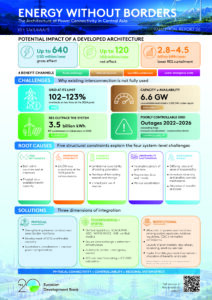
The Central Asia Power System (CAPS), which connects Uzbekistan, the Kyrgyz Republic, Tajikistan and southern Kazakhstan, had an installed capacity of 38.6 gigawatts as of Jan. 1, 2025. In 2024, the system generated 125.4 billion kilowatt-hours, while consumption totaled 142.2 billion kilowatt-hours.
Source: EDB
Regional electricity trade has recovered considerably, increasing from 2.5 billion kilowatt-hours in 2010 to 12.1 billion kilowatt-hours in 2024. Nevertheless, its share of consumption remains below historical levels, at about 8.5% compared with 13% in 1990, and is about half the level observed in the European Union (EU), the report reads.
The EDB identifies a distinction that is particularly important for understanding the region’s energy constraints: installed capacity does not necessarily translate into electricity that can actually be supplied. During critical hours, generating capacity may be unavailable because of fuel shortages, hydrological limitations, equipment conditions, thermal power plants operating in cold reserve or insufficient transmission capacity.
Around 6.6 gigawatts of capacity was unavailable for various reasons during the 2024 annual peak, illustrating why the region cannot rely on installed generation figures alone when assessing its energy security.
Transmission infrastructure presents another constraint. During the 2024-2025 winter operating period, actual electricity flows on several monitored transmission interfaces exceeded allowable levels, with the actual-to-permissible ratio ranging from 102% to 123%.
In Kazakhstan, the North-South transit corridor operated at 2,395 megawatts against an allowable 2,100 megawatts, or 114% of its permissible level. The Kazakhstan-Kyrgyzstan interface also recorded flows of 1,600 megawatts against allowable levels of 1,100-1,300 megawatts.
“Physical interconnection does not equal commercially available transmission capacity,” the report emphasizes, explaining that a power line between two systems does not automatically mean additional electricity can be transmitted safely or commercially at any given moment.
For regional electricity trade to expand, transmission capacity must be assessed against stability requirements, voltage conditions, emergency protection systems and existing power schedules.
Why Kazakhstan’s North-South Corridor matters
The report places southern Kazakhstan among the region’s major electricity load centers, highlighting its dependence on the North-South transmission corridor that connects it to the country’s northern power system.
The electricity balance of southern Kazakhstan is covered roughly equally by domestic generation and electricity flows from northern Kazakhstan, meaning that the transmission corridor is not simply a route for regional electricity trade but an essential part of the country’s domestic energy security.
An emergency shutdown of the North-South line would deprive the southern regions of approximately 2,000 megawatts of power flows, significantly complicating the system’s ability to respond to an outage. At the same time, imbalances elsewhere in the Central Asian power system can place additional pressure on the corridor, increasing the risk of overloads.
Kazakhstan also participates in seasonal electricity exchanges with Kyrgyzstan, receiving electricity during the agricultural growing season under reciprocal arrangements linked to irrigation water supplies and providing electricity during other periods. In recent years, Kazakhstan’s electricity exports to Kyrgyzstan have exceeded imports, reflecting lower water levels in the Toktogul Reservoir and growing domestic demand in Kyrgyzstan.
This makes the reliability of Kazakhstan’s internal transmission network directly relevant to the broader regional system. The report identifies strengthening northern and southern transmission corridors, as well as the Kazakhstan-Kyrgyzstan interconnection, as important priorities for improving the availability of electricity transfers across the CAPS.
Among the possible longer-term solutions, the report discusses an approximately 1,500-kilometer, 2,000-megawatt high-voltage direct current link from Ekibastuz GRES-1 toward the Zhambyl or Shymkent area, as well as a potential back-to-back HVDC connection between the CAPS and Kazakhstan’s Unified Power System. Both options would require separate feasibility assessments.
Renewable energy requires more flexibility
The expansion of solar and wind generation is adding another dimension to the challenge. While countries across Central Asia are increasing renewable energy capacity, the region’s transmission infrastructure, storage and balancing capabilities are not developing at the same pace.
Uzbekistan’s renewable energy capacity could reach 25 gigawatts by 2030 under announced plans. However, under conservative assumptions, the country’s renewable electricity curtailment is projected to rise from about 2.2 billion kilowatt-hours in 2026 to 3.5 billion kilowatt-hours in 2028.
Curtailment occurs when electricity generation must be reduced because the power system cannot absorb or transmit the available energy. This means that newly installed renewable capacity may not translate into an equivalent increase in usable electricity, while financial obligations under power purchase agreements may continue even when generation is curtailed, depending on contractual terms.
The EDB notes that regional integration could help address this problem by expanding the area where electricity surpluses can be used, providing access to flexible hydropower generation, and allowing neighboring systems to balance fluctuations in solar and wind output.
Kyrgyzstan and Tajikistan are particularly important in this regard. Their hydropower plants, including the Toktogul Reservoir, the Naryn Cascade and the Nurek hydropower plant, provide peak support, operating reserves and seasonal flexibility to neighboring systems.
However, the report stresses that hydropower flexibility should not be treated as a free resource automatically available to downstream countries. Water is also essential for irrigation, food security and interstate water-management obligations. Providing electricity on demand or adjusting hydropower generation to balance renewable sources involves operational costs and constraints that must be recognized and compensated.
The report therefore recommends treating hydropower flexibility as a measurable ancillary service, with payment mechanisms that reflect the value of balancing capacity while respecting national water-management responsibilities.
Integration could bring $120 million in annual net benefits
The economic case for regional cooperation extends beyond increasing the volume of electricity traded between countries. According to the EDB, the potential benefits come through four main channels: electricity trade arbitrage, shared reserves, reduced renewable energy curtailment and lower emergency-support costs.
Its preliminary scenario-based assessment estimates that partial integration could generate an annual gross system-wide effect of $193 million, against annualized costs of $75 million, for a net benefit of about $118 million.
Under a deeper integration scenario, the gross effect increases to $398 million, while annualized costs reach $275 million, producing a net benefit of approximately $123 million.
An advanced regional architecture could generate up to $640 million in annual gross benefits. However, the associated annualized costs would also rise to approximately $600 million, bringing the estimated net effect to around $40 million in the central case.
These figures suggest that deeper integration does not automatically translate into proportionally greater economic returns. The EDB identifies diminishing marginal returns as an important consideration, noting that relatively inexpensive improvements in coordination and the use of existing infrastructure can deliver substantial gains, while later stages require much larger investments in transmission networks, digital systems and institutions.
The report’s authors stress that these calculations are preliminary screening estimates rather than forecasts or guaranteed financial returns for individual countries, utilities or investors. Under unfavorable conditions, particularly when infrastructure utilization is low and investment costs are high, the net effect could even become negative, especially under the advanced integration scenario.
The distribution of benefits is another issue to address. One country may benefit from reduced renewable energy curtailment, another from transit revenues, while another may receive payments for hydropower flexibility or reduce its emergency electricity costs. Without transparent arrangements for allocating expenses and benefits, a project that makes economic sense for the region as a whole may still prove difficult to implement politically.
Regional market without a supranational regulator
Rather than recommending the immediate creation of a fully integrated regional electricity market or a supranational regulator, the EDB proposes a phased approach that builds on existing bilateral arrangements while gradually introducing more sophisticated trading and balancing mechanisms.
The first stage, covering 2026-2028, focuses on the operational foundations: settlement metering, secure data exchange, coordinated dispatch schedules, a registry of cross-border transactions, rules for settling electricity imbalances and accounting for emergency supplies.
The next stage, for 2028-2030, would introduce a pilot day-ahead electricity market, subject to confirmed available transmission capacity, alongside priority grid upgrades, improved automatic generation control and payment mechanisms for balancing energy and ancillary services.
After 2030, provided the necessary technical and institutional conditions are in place, the region could move toward full-scale real-time balancing, regional assessments of resource adequacy and mechanisms recognizing reliable cross-border contributions to electricity supply. Importantly, national system operators would retain full control over their domestic power systems throughout the process.
The report also considers the region’s external electricity connections as part of a broader portfolio of opportunities, including the northern route linking Kazakhstan with Russia and the Eurasian power system, the CASA-1000 southern corridor to South Asia, the eastern route toward China and the proposed Trans-Caspian Green Energy Corridor. Their commercial potential, however, depends on the reliability of the internal Central Asian system, available generation and external political and regulatory conditions.
Ultimately, the report’s argument is that the future of regional energy cooperation will depend on whether countries can move beyond physical connectivity toward predictable operating rules, transparent data exchange and a credible system for sharing both costs and benefits.
“Central Asia already has power lines. What is still lacking is an ‘architecture of trust’ among countries, operators, and investors,” reads the report, warning that without these foundations, existing infrastructure may remain little more than lines on a map.
