
ASTANA — Thirty-five years after Kazakhstan closed the Semipalatinsk nuclear test site, researchers and community advocates say its legacy still shapes health, science and policy. As evidence becomes more precise, experts say the focus is shifting toward how that knowledge can better support affected communities.
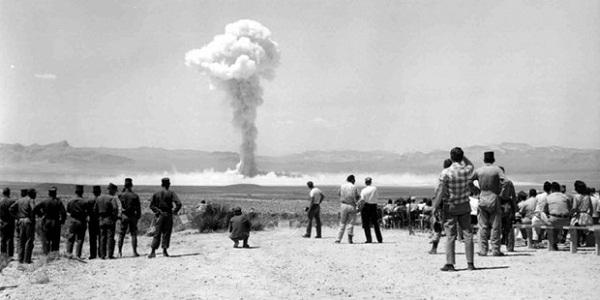
Photo credit: e-hostory.kz
The Aug. 29, 1991, closure ended more than four decades of Soviet nuclear testing at the site in eastern Kazakhstan. Between 1949 and 1989, 456 nuclear tests were conducted there, including 116 atmospheric explosions, some of which sent radioactive fallout over surrounding populated areas.
The date later gained international significance when the United Nations General Assembly, at Kazakhstan’s initiative, designated Aug. 29 as the International Day against Nuclear Tests. The anniversary now marks both the historic closure and continuing questions surrounding the long-term effects of exposure.
Reconstructing invisible exposure
Radiation exposure was far from uniform. Doses could differ significantly depending on the test, the path of radioactive fallout, where a person lived, their age, activities and diet. Reconstructing individual exposure decades later is particularly difficult because personal radiation measurements were generally unavailable at the time.
Vladimir Drozdovitch. Photo credit: National Cancer Institute
In a comment for this story, Vladimir Drozdovitch, a staff scientist in the Radiation Epidemiology Branch of the United States National Cancer Institute’s Division of Cancer Epidemiology and Genetics, said researchers therefore combine historical environmental data with information about individual circumstances.
“Even when exposure occurred 60-75 years ago and individual radiation measurements were not made at the time, scientists can reconstruct doses by combining many different types of historical evidence,” Drozdovitch told The Astana Times.
“For the Semipalatinsk population, this includes archival measurements of radiation exposure rates in air made after the nuclear tests, information about the nuclear tests and radioactive fallout, measurements of residual radionuclides in soil and, where available, retrospective physical dosimetry using materials such as bricks and tooth enamel,” he said.
Researchers must then establish where people lived during individual tests, whether they were temporarily away, their age and occupation, housing conditions and, for internal exposure, their consumption of locally produced food. Milk and dairy products were particularly relevant because radioactive iodine deposited on pasture could enter the food chain.
A 2026 study by Drozdovitch and an international team estimated external whole-body doses for 14,789 people from 15 settlements affected by fallout between 1949 and 1962. Such estimates allow epidemiologists to examine whether disease risk changes with radiation dose rather than treating everyone living near the test site as a uniformly exposed population.
“Dose reconstruction tells us who was exposed, how much they were exposed, and why some people received much larger doses than others,” said Drozdovitch.
That evidence can help distinguish possible radiation effects from other influences on health and inform how decades of research might translate into healthcare today.
From research to healthcare
Aigerim Seitenova, a human rights professional, nuclear disarmament advocate and co-founder of the Qazaq Nuclear Frontline Coalition (QNFC), said access to specialists, diagnostics, medicines, rehabilitation and long-term treatment remains a concern in affected communities.

Aigerim Seitenova. Photo credit: Seitenova’s personal archives
“For remote villages and rural areas, it is still difficult for people to get access to proper medical healthcare. The lack of proper medical equipment and technology is still one of the concerns,” Seitenova told The Astana Times.
Seitenova and Yerdaulet Rakhmatulla, co-founder and director of operations and communications at QNFC, co-authored the coalition’s June 2026 policy paper, “From Harm to Justice.” Based on a nationwide survey of 516 respondents, two focus group workshops and interviews, the paper examined healthcare, recognition, social protection and other needs among nuclear-affected communities.
Among respondents who reported health conditions they associated with nuclear testing, 63.4% said they were not receiving medical assistance, while 68.6% said they needed financial assistance.
The paper’s recommendations include expanding diagnostic capacity and specialized medical infrastructure, providing long-term treatment and rehabilitation, incorporating mental health and psychosocial support, and strengthening long-term health monitoring and research.
“We also highlight the issue of mental and psychosocial health, because nuclear harm is often discussed primarily through cancer or radiation-related physical illnesses. However, affected communities also live with anxiety and uncertainty about their own health and the health of their children, about social vulnerabilities and the psychological burden of living with the nuclear legacy,” said Seitenova.
She said new scientific findings should increasingly inform screening, diagnostic protocols and information available to doctors and patients, bringing research closer to practical care.
Closing gap between recognition and access
Similar concerns emerged from a 2025 Community Needs Assessment by the Steppe Organization for Peace (STOP), conducted with support from the Friedrich-Ebert-Stiftung in Kazakhstan. The research involved 200 participants in community discussions and 27 in-depth interviews across eight affected locations.

Alisher Khassengaliyev. Photo credit: Khassengaliyev’s personal archives
“One of our strongest findings in healthcare is that the problem is often not simply the absence of services, but the gap between formally recognised rights and people’s actual ability to access assistance,” STOP founding member Alisher Khassengaliyev told The Astana Times.
Participants described traveling long distances for specialists and diagnostics, paying out of pocket when services were unavailable locally, difficulties obtaining medicines and rehabilitation, and limited regular screening and long-term follow-up.
Khassengaliyev said formal recognition as a person affected by the Semipalatinsk tests, including through a Polygon certificate, does not always correspond to a clearly defined healthcare pathway. Clearer links between recognized status, healthcare and social assistance, he said, could make existing support easier to navigate.
“Kazakhstan has achieved something historically extraordinary: it closed the Semipalatinsk test site, renounced its inherited nuclear arsenal and became a global leader on nuclear disarmament. Thirty-five years later, the next step should be to make that leadership equally visible in the everyday lives of nuclear-affected communities,” said Khassengaliyev.
Legacy across generations
For younger people from affected families, the test site belongs to history but remains part of family memory.
Diana Murzagaliyeva, founder of Inclusive Academy and an advocate on the intergenerational impacts of nuclear testing, was born years after the test site closed. She told The Astana Times that the anniversary carries a distinct meaning for a generation that did not witness the testing but grew up with its consequences and family stories.

Diana Murzagaliyeva. Photo credit: Murzagaliyeva’s personal archives
“For me, the 35th anniversary of the test site’s closure is both a reminder of an important historical decision by Kazakhstan and a responsibility for our generation to ensure that this history is not forgotten,” she said.
Murzagaliyeva also said affected communities should participate directly in decisions concerning their health, land and future.
“It is important that communities affected by nuclear testing are not seen only as victims of a tragedy. We have our own voice, experience and the right to participate in decisions that concern our health, our land and our future. It is also important that decisions are not made without affected people themselves,” she said.
Khassengaliyev said STOP follows the same principle: “nothing about nuclear-affected communities without nuclear-affected communities.” QNFC’s policy paper similarly calls for their meaningful participation in healthcare, environmental remediation and other forms of assistance.
“I think one issue discussed too little is trust and access to information as part of nuclear justice. Residents told us that they often do not have access to understandable and regularly updated information about radiation conditions. The problem, therefore, is not simply whether monitoring exists institutionally. It is whether communities can access its results, understand them and trust them,” said Khassengaliyev.
Scientific questions also remain unresolved decades after the last test.
“The nuclear tests occurred decades ago, but the scientific questions remain highly relevant today. We know a great deal about the health effects of relatively high radiation doses. There is considerably greater uncertainty about risks from low and moderate doses, particularly for environmental exposures involving both external and internal irradiation,” said Drozdovitch.
According to Drozdovitch, the research on the Semipalatinsk nuclear test site can help narrow that uncertainty because affected populations experienced environmental exposure across a broad range of doses. The findings complement research on Hiroshima and Nagasaki, Chernobyl, occupational radiation and medical exposure, while dose-reconstruction methods can also be applied after nuclear accidents or radioactive releases when individual measurements are incomplete.
The connection between past exposure and present-day response also extends to international policy. Articles 6 and 7 of the Treaty on the Prohibition of Nuclear Weapons address victim assistance, environmental remediation and international cooperation. QNFC recommends using that framework to advance long-term health monitoring, research, psychosocial support and community participation.
For Murzagaliyeva, the future is also about changing how the region itself is seen. With appropriate safety standards, she said, parts of the former test site could eventually support educational and memorial tourism centered on the experiences of affected communities.
“We do not want Semipalatinsk to be associated only with pain and radiation. I want this land to have a future. I want there to come a day when people can go there not with fear, but with a thermos of tea and a blanket for a picnic,” she said.
