
ASTANA – Seven years into Kassym-Jomart Tokayev’s presidency, Kazakhstan’s economic record is increasingly defined not by a single indicator, but by the breadth of change across investment, manufacturing, infrastructure, small and medium-sized enterprises and the social sector.
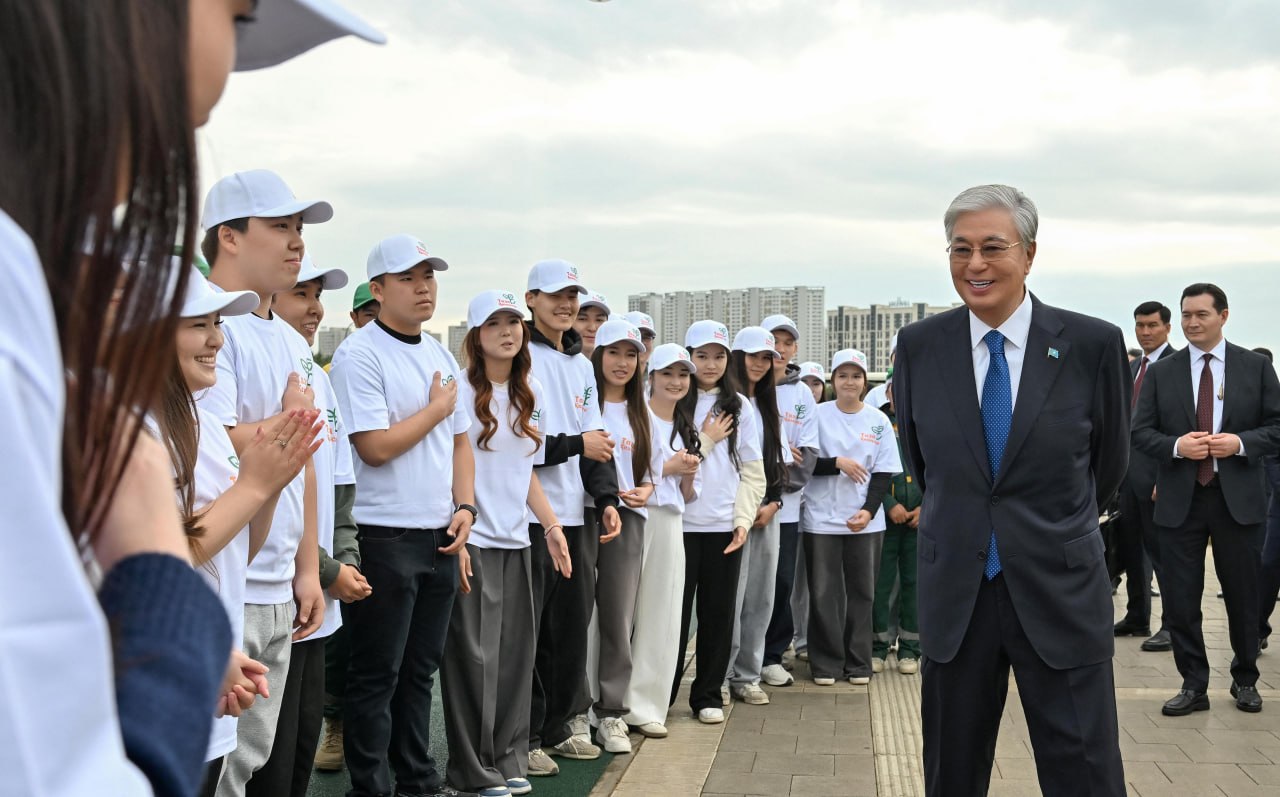
President Kassym-Jomart Tokayev meets young volunteers along Astana’s embankment on Sept. 19, reflecting a broader focus on civic engagement, community and quality of life. Photo credit: Akorda
The period since 2019 has also been unusually demanding. The economy has gone through the pandemic, global inflation, disrupted supply chains and a sharply altered geopolitical environment. Amid all this, the central economic question is no longer simply whether Kazakhstan has grown. It is whether growth has become more resilient and can generate greater value inside the country. The available indicators point to substantial progress, while also showing where the next phase of economic policy will be more demanding.
Growth with a broader base
Kazakhstan’s GDP per capita rose from $9,813 in 2019 to $15,006.4 in 2025, a 52.9% increase. Real GDP growth reached 6.5% in 2025, according to the updated national statistics. Transport and warehousing grew 19.4%, construction 17.5%, industry 7.7% and information and communications 6.4%.
Economist Ruslan Sultanov noted that the significance of the recent performance is less about one year’s growth than about the economy’s ability to absorb repeated external shocks.
“Over seven years, Kazakhstan has essentially passed several stress tests in a row. The pandemic, broken logistics chains, global inflation, a sharp change in the geopolitical situation and sanctions risks around Russia. Each time, the Kazakh economy adapted relatively quickly,” Sultanov said.
The 2025 figures support that argument. Growth was spread across sectors rather than concentrated exclusively in oil. Manufacturing expanded 6.4% on preliminary production data, while construction and transport posted particularly strong gains. Together, they suggest domestic investment, infrastructure development, and trade are playing a larger role in the growth mix.
At the same time, resilience should not be confused with insulation.
“But it is important to understand that dependence on external conditions has not disappeared. Oil prices, export routes, the state of the Russian and Chinese economies and global interest rates still matter greatly to us. There is also continued dependence of the budget on oil revenues,” Sultanov said.
That distinction is central to Kazakhstan’s economic trajectory: the country has become better able to absorb shocks, but the longer-term goal is to reduce the structural dependence that makes external shocks so consequential in the first place.
This has also been a recurring theme in Tokayev’s economic agenda. In his 2023 state-of-the-nation address, he called for a transition to a new economic model combining political reform with deep social and economic transformation, and identified a strong industrial foundation and greater economic self-sufficiency as key priorities.
The structural shift in industry
One of the clearest indicators of that ambition is the gradual change in the composition of GDP. In 2019, manufacturing accounted for around 11.4% of GDP, while mining accounted for 14.5%. By 2025, manufacturing had risen to around 13%, and mining had declined to around 12%, according to preliminary figures cited by Sultanov.
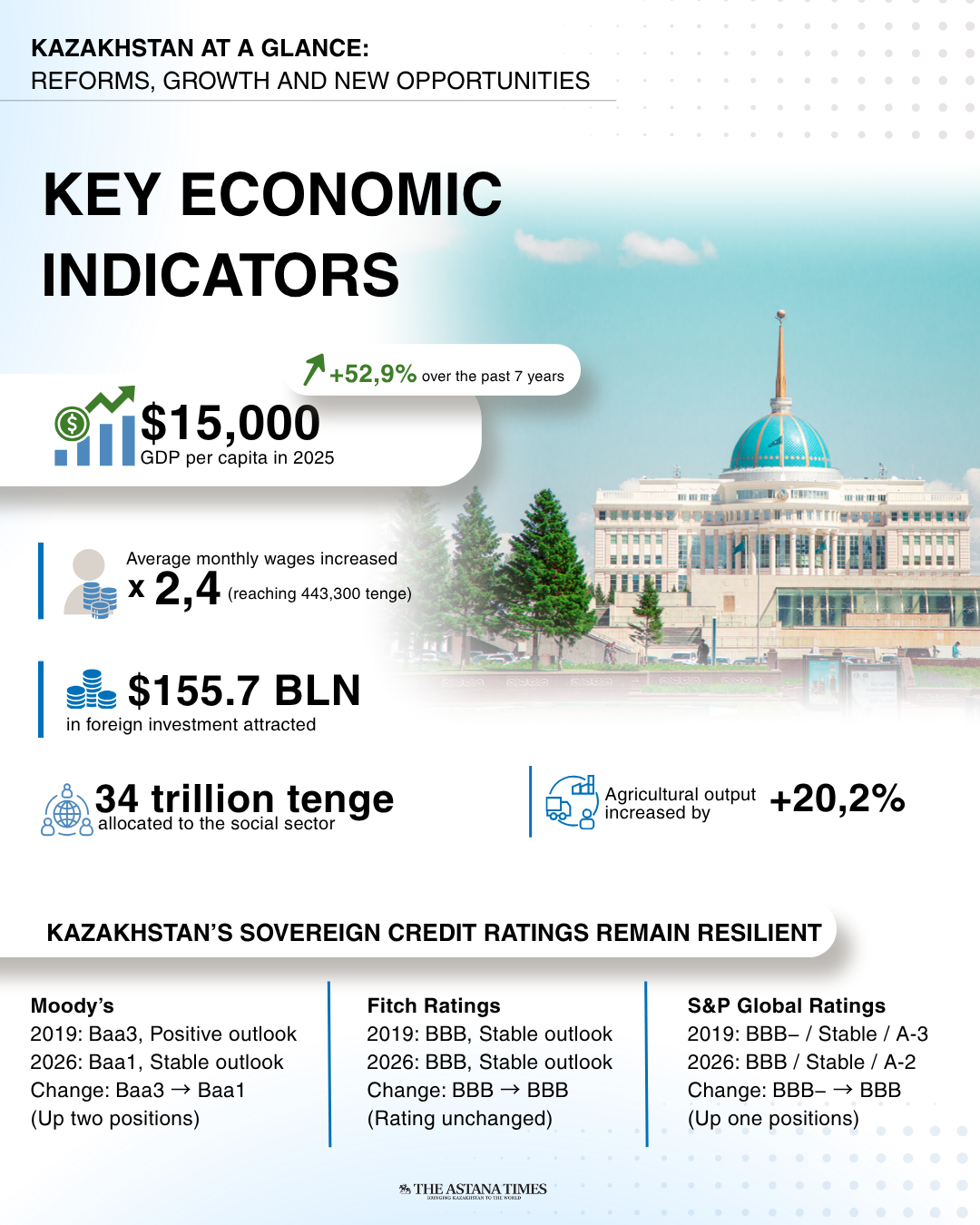
The shift is accompanied by a wider industrial footprint. From 2019 to 2025, 625 new industrial enterprises were established, creating 61,300 jobs. Over the same period, Kazakhstan attracted $155.8 billion in gross foreign direct investment.
“The changes are there. I would simply not hurry to declare diversification complete. The economy does not diversify faster just because we use the word. The work is permanent,” Sultanov said.
The distinction between industrial expansion and industrial competitiveness is important. Manufacturing growth becomes more meaningful when it brings technology, skilled jobs, supply chains and export capacity rather than simply assembling or processing imported inputs.
“Therefore, the next stage for Kazakhstan is not simply to increase manufacturing’s share of GDP. It is to increase the added value created inside the country,” Sultanov said.
Investment, infrastructure and connectivity
Kazakhstan’s investment proposition has also become more multidimensional.
“Kazakhstan is gradually developing a more interesting combination. There are resources. There is territory between China and Europe. There is growing transit potential. There is an industrial base. There is sufficiently developed digital infrastructure and a financial system. There is the Astana International Financial Centre. And there is an ability to work simultaneously with several major economic centers,” Sultanov said.
The country’s geography has long been described as an advantage. Under Tokayev, however, the emphasis has increasingly shifted from geography itself to the economic value that can be built around it.
In August 2025, addressing transport sector workers, Tokayev said Kazakhstan’s transport system was a driving force of the economy and that the country’s vast geography and transit potential placed transport at the core of economic growth and regional integration. The expansion of the Trans-Caspian International Transport Route, along with rail links and other logistics infrastructure, reflects this approach: geography is being turned into connectivity, and connectivity into an economic opportunity.
The scale of infrastructure development under President Tokayev is visible beyond transport corridors. Over seven years, 118.3 million square meters of housing were commissioned, 14,200 kilometers of roads were repaired, and construction and repair works covered 21,000 kilometers on the local road network. These investments are not only about construction volumes. Their longer-term economic value lies in whether they improve connectivity, reduce logistical costs, raise productivity and expand access to markets.
For foreign investors, Sultanov said, infrastructure is only one part of the calculation.
“Resources can bring an investor to the country. But institutions keep capital. Here we are doing substantial work, and there is still much to be done,” he said.
That makes predictability an increasingly important component of Kazakhstan’s investment model. Large industrial projects are measured in decades, not election cycles, and investors therefore pay attention to the stability of taxation, regulation, tariffs and market access.
A wider business base
The country’s economic transformation is also visible in the expansion of small and medium-sized enterprises (SME). As of the beginning of 2026, 2.36 million SMEs were registered in Kazakhstan, with 4.53 million people employed in the sector. SME employment increased by 31.6% over seven years.
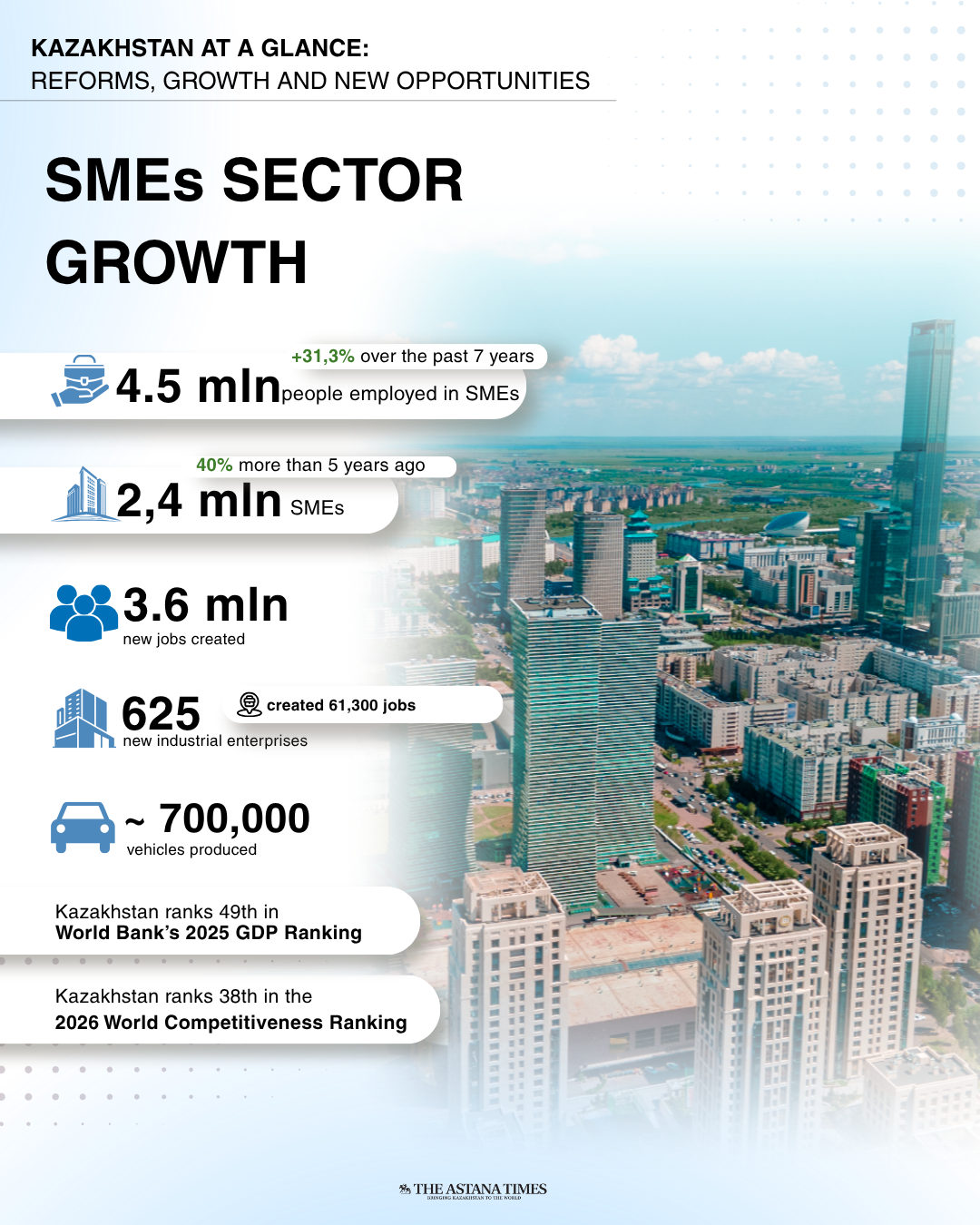
The figures should be read in the context of the pandemic, which caused a temporary decline in SME employment and business activity. The subsequent recovery was particularly strong in 2022, when SME employment increased 18.3%, and the number of registered SMEs rose 19.6%.
Taken together, the data point to a broader business base than at the start of Tokayev’s current presidential term. The next economic question is how much of that base can move from domestic consumption toward productivity, investment and exports.
Growth and the household economy
The economic transformation has also brought improvements in several social indicators.
Average monthly nominal wages reached 443,300 tenge (US$990) in 2025, 2.4 times the 2019 level. Over seven years, more than 3.6 million jobs were created, and life expectancy reached 75.97 years.
At the same time, Kazakhstan’s growth has unfolded against a difficult inflationary backdrop. Consumer prices rose 12.3% in 2025, with food prices up 13.5% and paid services 12%. These figures add an important dimension to the broader growth story. The next stage of economic policy will increasingly be judged not only by headline GDP or nominal incomes, but by productivity, purchasing power and the quality of life they support.
Tokayev has repeatedly made that connection himself. In a January 2025 interview, he said that all economic development measures and reforms were ultimately aimed at improving citizens’ quality of life, calling this the government’s top priority.
The social and infrastructure footprint is significant. Over seven years, the government allocated 34 trillion tenge (US$76 million) to the social sphere. Kazakhstan built 761 schools, 345 kindergartens and 696 hospitals and polyclinics, while completing 536 new sports facilities.
The scale of these investments illustrates Tokayev’s increasingly expansive approach to economic development: infrastructure and social policy are being treated not as separate tracks, but as part of the country’s productive capacity and quality of life.
Institutional reform and the economic environment
The economic trajectory has also unfolded alongside institutional reforms. Banu Segizbayeva, an expert at the Kazakhstan Institute for Public Development, traces the first institutional steps of the current reform agenda to 2019-2021, including changes to laws on peaceful assemblies and political parties and the introduction of elections for rural akims (governors).
The reform process acquired a more systemic character in 2022, she said, when constitutional amendments were approved by referendum, the Constitutional Court was restored, a single seven-year presidential term was introduced, and the electoral system was updated.
“Modernization rests on constitutional norms and new institutions. Just Kazakhstan became the framework into which new political and economic mechanisms were consistently built. Today, the main question concerns the durability of these institutions in practice, and that work is continuing,” Segizbayeva said.
For the economy, that institutional dimension matters because investment decisions ultimately depend on predictable rules. Tokayev has increasingly linked institutional modernization with economic performance, noting that reforms should strengthen the quality of governance while creating a more predictable environment for business and investment. The broader reform trajectory has therefore increasingly connected institutional change with economic modernization.
The next stage
The seven-year record gives Kazakhstan a larger economic base, deeper infrastructure and a wider set of growth drivers than it had in 2019. GDP per capita has increased by more than half, the industrial base has expanded, SME participation has grown, and investment has remained substantial. But the next stage will require a different kind of progress.
Sultanov identifies the main test as the ability to sustain growth with a gradually smaller dependence on state stimulus. The transition, he notes, should lead toward greater private investment, stronger export performance, higher productivity, deeper processing and a stronger domestic pool of engineers and specialists.
This is also where the scale of Tokayev’s current development agenda becomes significant. The emphasis on infrastructure, industrial capacity, transport connectivity and social construction can create the physical foundations for the next growth cycle. The challenge will be to translate those assets into sustained productivity and competitive businesses.
Seven years of economic policy have produced a broader and more diversified set of capabilities, but the transformation remains a work in progress.
The direction outlined by President Tokayev in recent years points to a next phase that goes beyond maintaining headline growth: toward greater industrial capacity, deeper value creation, stronger private investment, modern infrastructure and higher productivity. His recent remarks have consistently emphasized a new investment cycle, economic diversification, infrastructure development and the improvement of citizens’ well-being.
For Kazakhstan, the central economic task is therefore increasingly clear: not simply to grow faster, but to make growth more resilient, more productive and more deeply rooted in the domestic economy.
