
ASTANA – Central Asia’s foreign direct investment (FDI) stock rose 3.6% to $235.5 billion in 2025, with Kazakhstan retaining roughly two thirds of the region’s total, according to the latest World Investment Report released by UN Trade and Development (UNCTAD).

Photo credit:Shutterstock
Kazakhstan accounted for nearly 66% of Central Asia’s total, solidifying its position as the region’s largest destination for foreign investment. The nation’s FDI stock, which refers to the accumulated value of FDI held in a country, stood at $156.4 billion as of 2025. It went up a little bit from $155.1 billion in 2024. In 2010, the figure was just $82.6 billion.
Uzbekistan, meanwhile, recorded the strongest annual increase from $20.5 billion in 2024 to $26 billion in 2025.
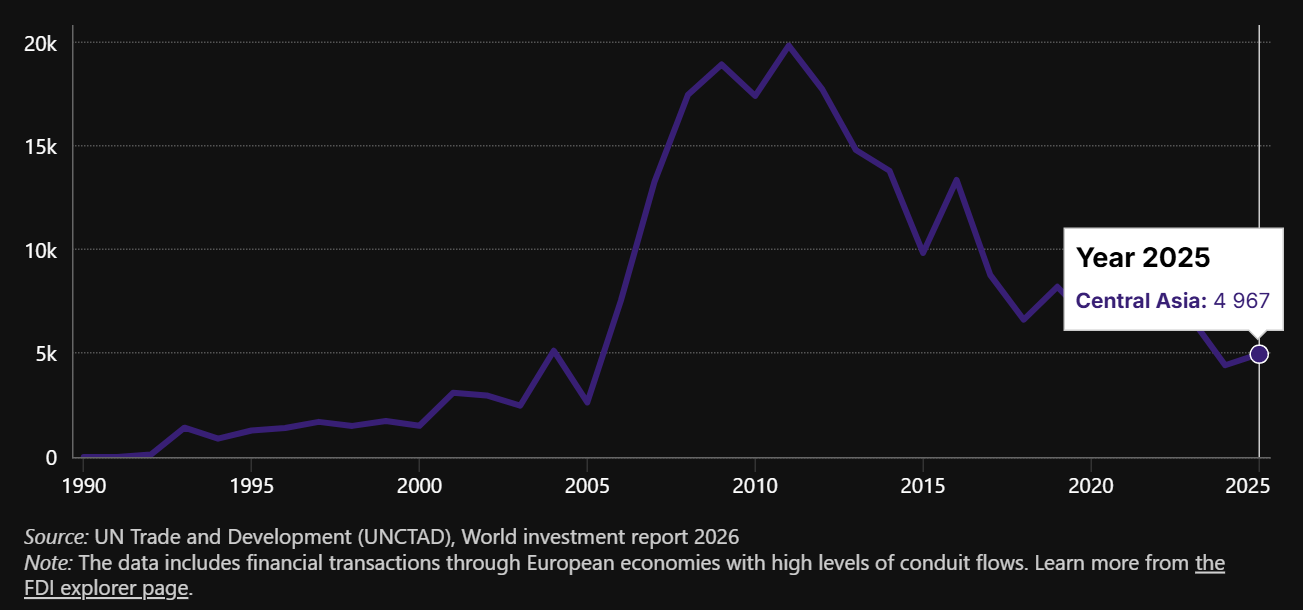
Central Asia’s FDI inflows. Photo credit: UNCTAD
Kazakhstan was a major destination for newly announced large-scale investment projects. One of them relates to a non-ferrous metals project worth more than $12 billion announced by China’s East Hope Group. The report ranks it among the 10 largest greenfield projects announced in developing Asia during the year.
FDI inflows
In terms of FDI inflows, Central Asia received $4.97 billion in 2025, up 12.1% from $4.43 billion in 2024. This is a substantial fall compared to $9.8 billion that the region recorded in 2022.

Foreign direct investment growth is concentrated in developed economies. Photo credit: UNCTAD
According to the report, Uzbekistan drove Central Asia’s foreign investment recovery in 2025, attracting nearly $4.4 billion as inflows into Kazakhstan turned negative. Kazakhstan recorded net FDI outflows of $861 million in 2025, compared with net inflows of $227 million a year earlier.
The Kyrgyz Republic posted the region’s fastest percentage increase, with inflows more than doubling to $642 million. Tajikistan’s FDI inflows fell to $86 million, down 70% from $291 million.
According to the report, resource and infrastructure projects in Kazakhstan and Uzbekistan featured prominently in the region’s investment activity and project pipeline.
“Investment activity was concentrated in metals and metal products, which together accounted for approximately 45% of total greenfield project activity in the region, followed by energy, transport and storage, chemicals, food processing, and ICT,” reads the report.
Global trends
While global FDI increased by 6% to $1.6 trillion in 2025, this recovery has been uneven and fragile. When excluding financial flows routed through Europe’s largest investment hubs, the increase narrows to 4%.
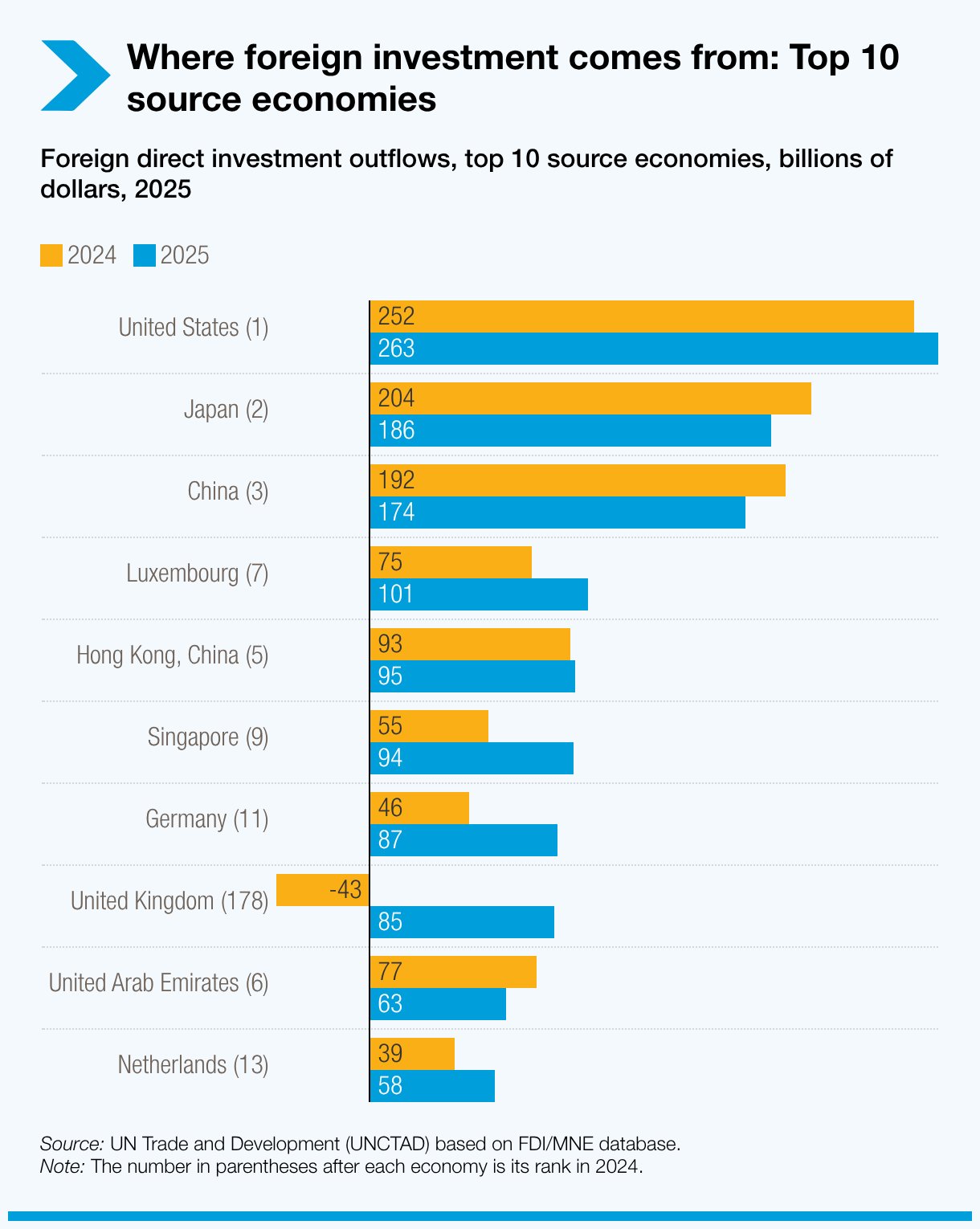
Where foreign investment comes from. Photo credit: UNCTAD
FDI inflows in developed economies increased by 11% to $723 billion, whereas developing economies received $901 billion in FDI, an increase of 2%.
The largest FDI destination in 2025 was the United States, which received $277 billion. It was also the largest source of FDI last year, followed by Japan and China.
The report indicates that investment activity is becoming more concentrated across regions and sectors.
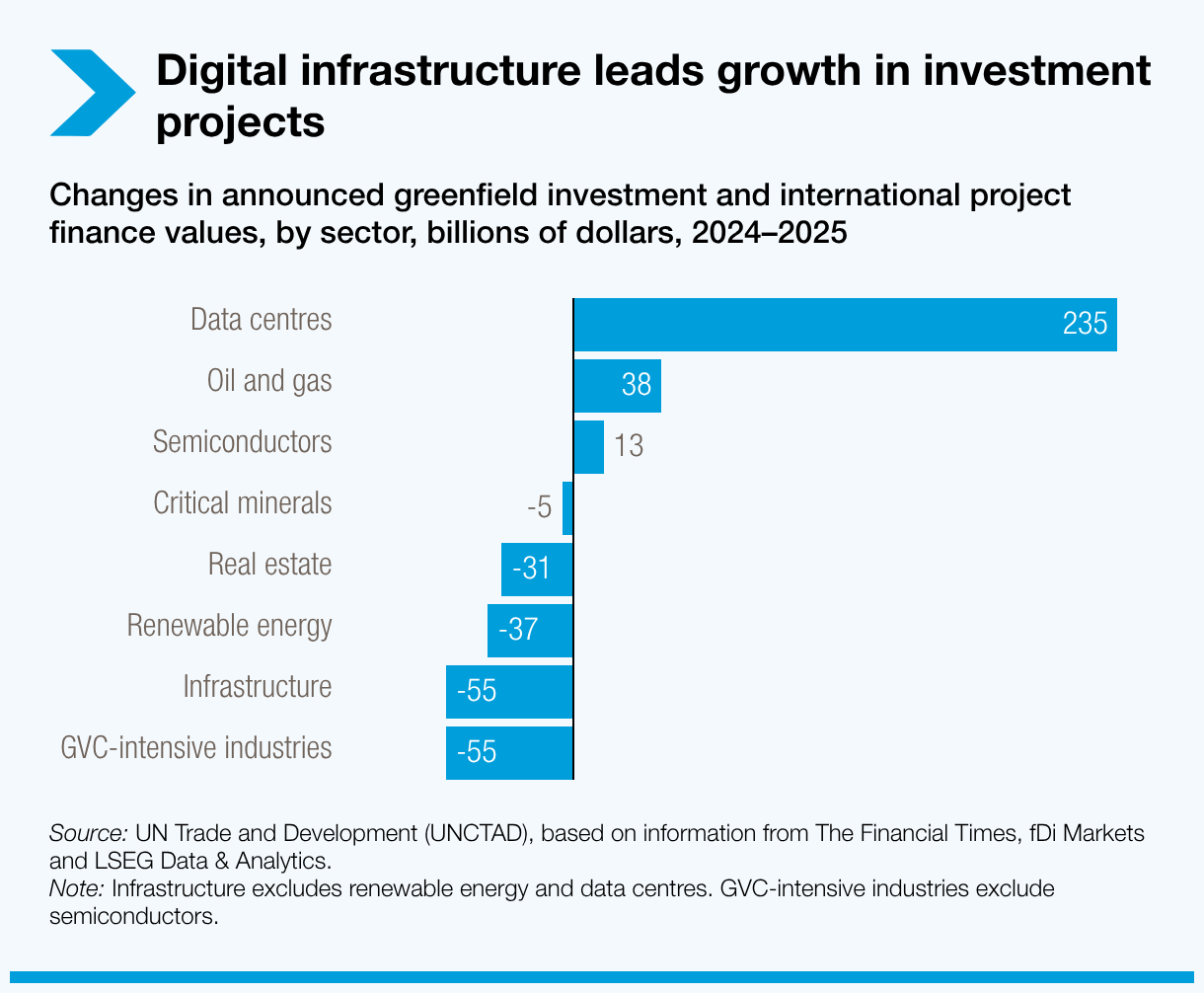
“Semiconductors, electronics, AI infrastructure, data centres, renewable energy and battery supply chains continued to drive large projects. Project activity was concentrated in China, India, Kazakhstan, Malaysia and the United Arab Emirates, mainly in electronics, digital infrastructure and construction,” it said.
These industries accounted for 44% of global greenfield investment last year, growing from 16% in 2020. Kazakhstan is positioning itself to benefit from the same shift, with major investment plans spanning renewable energy, battery materials, data centers, AI infrastructure and advanced processing of metals and critical minerals, instead of relying solely on extractive industries.
Changing model
Expert Sultan Valikhanov echoes this point in his piece for the EconomyKZ analytical website, cautioning that the rise in global FDI should not be read automatically as a boom in new factories.
“For three decades, the formula was simple: production moved to where labor was cheaper and costs were lower. That allowed dozens of developing countries to join global supply chains and attract factories, logistics hubs and industrial clusters. Capital followed efficiency. The cheaper it was to produce, the greater the chance of attracting an investor,” Valikhanov wrote.
This model is now breaking down. He explained that part of last year’s increase came from intracorporate flows, restructuring and capital routed through international financial centers rather than the expansion of productive capacity.
“What matters, therefore, is not how much capital crossed borders, but where exactly it went,” Valikhanov added.
Stronger domestic capacity
“If most investment is flowing into digital infrastructure and advanced manufacturing, the decisive advantage becomes a country’s ability to support such projects through reliable energy, transport links, engineering talent and a digital ecosystem built around production,” Valikhanov wrote.
That is particularly relevant to Kazakhstan. The headline figures tell only part of the story. What is important is whether that capital went to industries that are capable of generating local value, technology transfer and skilled employment.
UNCTAD also emphasized that countries need to make “deliberate national policy choices,” which among others include “realistic entry points” into changing value chains, and coordinating investment, jobs, supplier policies and infrastructure.
Where foreign investment comes from. Photo credit: UNCTAD
“This will also require renewed international cooperation, with partnerships that balance the resilience that investing countries expect with the development that recipient countries need,” said UNCTAD Acting Secretary-General Pedro Manuel Moreno.
Kazakhstan has increasingly treated trade and investment diplomacy as an instrument of industrial policy, not merely foreign relations. High-level diplomatic visits secure capital, technology, logistics links and access to new value chains. This logic shapes Kazakhstan’s ties with long-established strategic partners such as China and its engagement with newer partners.
“Today, investment follows strategic calculation and industrial policy marked by subsidies, economic security and technological advantage. Governments are competing with new investment policy measures, at a record high in 2025,” said Pedro Manuel Moreno.
He noted that the reshaping of global supply chains is creating opportunities for developing economies to become manufacturing bases, critical-mineral processing hubs and gateways to regional markets. In this context, Kazakhstan is trying to position itself in all three areas by developing transcontinental transport routes, expanding domestic processing of critical raw materials and investing in industrial, technological and skills capacity.
