
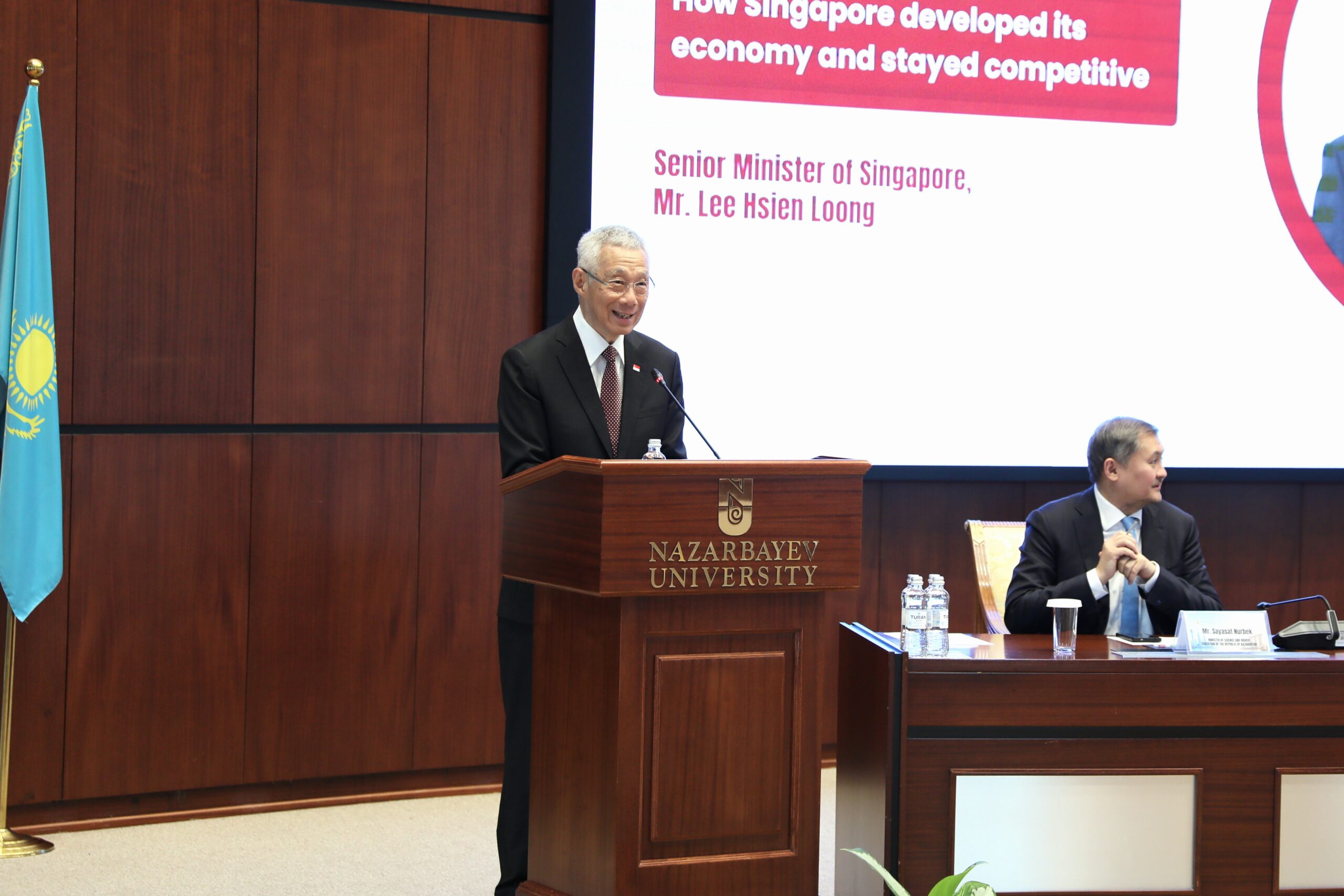
ASTANA – Singapore’s experience shows that countries seeking long-term economic competitiveness must be prepared to adapt their policies and institutions to changing circumstances continuously, Senior Minister Lee Hsien Loong said during a lecture at Nazarbayev University on Aug. 27.
A NU student asks a question during Lee Hsien Loong’s lecture in Astana on Aug. 27. Photo credit: NU
Speaking to students and the academic community, Lee outlined Singapore’s development journey from the 1950s, highlighting the policies that helped the small, resource-scarce country build a globally competitive economy.
A different path to competitiveness
He stressed that Singapore and Kazakhstan have very different geographical and economic circumstances. Singapore is a small island nation with limited natural resources, while Kazakhstan is a vast landlocked country rich in energy and mineral resources. Nevertheless, he said, the two countries share similarities, including their experience of gaining independence from larger federations and their efforts to build strong international partnerships.
Lee said Singapore’s economic development was driven by a willingness to look outward and compete globally. After becoming independent in 1965, the country focused on export-oriented manufacturing, attracted multinational corporations, developed its financial sector and invested heavily in infrastructure and human capital.
Over time, Singapore repeatedly adjusted its economic strategy, moving toward higher-value and technology-intensive industries, research and development, advanced manufacturing and services.
“Singapore has not progressed in a straight line. We have repeatedly had to reinvent ourselves in order to overcome setbacks and change circumstances and resume our journey forward,” Lee said.
Adapting to a changing world
He noted that Singapore is now facing another major turning point amid growing geopolitical rivalry, weaker multilateralism and increasing concerns over economic and supply-chain resilience.
A NU student asks a question during Lee Hsien Loong’s lecture in Astana on Aug. 27. Photo credit: NU
In response, Singapore intends to remain open and outward-looking while strengthening ties with non-traditional partners, including Kazakhstan and other Central Asian economies, Lee said.
He also stressed the importance of maintaining multilateral cooperation and supporting rules that apply to both large and small countries. He cited cooperation within the World Trade Organization, including Singapore’s work with Japan and Australia on e-commerce.
Lee identified state capacity, market discipline and an active government role as important elements of Singapore’s approach. While market forces remain central to creating wealth and encouraging enterprise, he said the government must invest in infrastructure and skills, develop new economic activities and address market failures.
Artificial intelligence is another area where government action will be important, notably in helping businesses adopt new technologies and preparing workers for changes brought by AI.
“Singapore must remake our economy again and again,” Lee said, stressing the importance of continuing education, worker retraining and support for people transitioning into new jobs.
He also highlighted social cohesion as a fundamental condition for economic success. Inclusive growth, public housing, healthcare and education, he said, help ensure that the benefits of economic development are broadly shared and that society remains united.
Lessons for Kazakhstan
The lecture comes amid intensifying Kazakhstan-Singapore relations. During a meeting with President Kassym-Jomart Tokayev on Aug. 26, Lee noted that bilateral ties had reached a new level, while Tokayev highlighted opportunities for cooperation in areas including AI, digitalization, transport, logistics, smart cities, agriculture, critical minerals and tourism.
Talgat Chinikeyev, Honorary Consul of Singapore in Kazakhstan, said Lee’s engagement with students was an important part of strengthening bilateral ties.
“Relations between countries are built not only through governments and businesses, but also through education, knowledge exchange and direct interaction between people,” he told The Astana Times.
According to Chinikeyev, Singapore’s development experience offers valuable lessons, while Kazakhstan has its own development path and ambitions. He said exchanges with the younger generation could help deepen mutual understanding and encourage new educational, academic and professional links between the two countries.
Lee concluded that while Kazakhstan may need to make different policy choices because of its distinct circumstances, the broader lesson from Singapore is the importance of building systems that can continuously adapt.
