
ASTANA – Kazakhstan and Singapore need to translate strong political ties and mutual trust into tangible economic outcomes, including more investment, joint projects and technology exchange, as cooperation expands into transport, artificial intelligence, digitalization and other strategic sectors, according to experts.
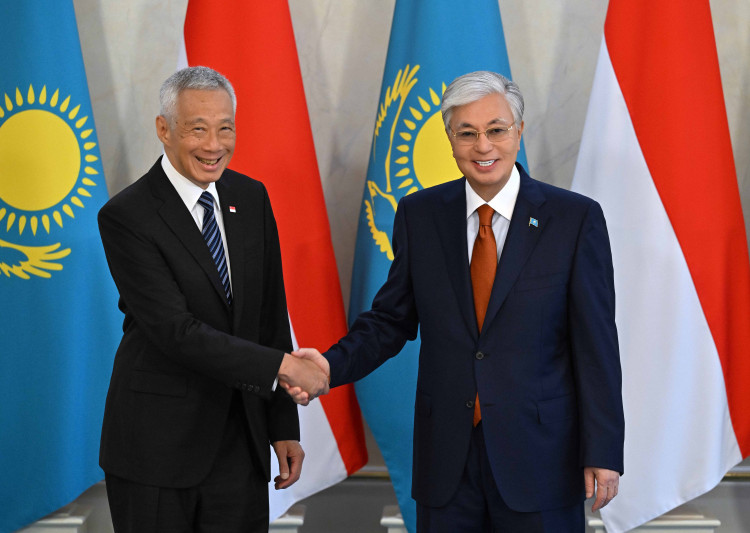
Singapore Senior Minister Lee Hsien Loong with President Kassym-Jomart Tokayev. Photo credit: Akorda
“The key now is to translate the excellent political relationship and mutual trust between our countries into tangible economic outcomes – more Singaporean investment and companies in Kazakhstan, more joint projects, greater technology and knowledge exchange, and stronger connections between our business communities and people,” Honorary Consul of Singapore in Kazakhstan Talgat Chinikeyev told The Astana Times.
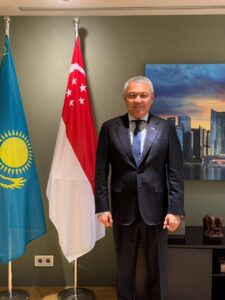
Talgat Chinikeyev, Honorary Consul of Singapore in Kazakhstan. Photo credit: Talgat Chinikeyev’s personal archive.
Singapore Senior Minister Lee Hsien Loong’s Aug. 26 visit to Kazakhstan highlighted the growing scope of bilateral cooperation, with discussions covering investment, transport and logistics, aviation, smart city development, agriculture, critical minerals, tourism, water management, AI and digitalization.
President Kassym-Jomart Tokayev highlighted Singapore’s transformation into a global center of finance, trade, innovation and technology.
“Your country’s experience serves as an inspiring example for the international community,” Tokayev told Lee.
Tokayev noted that bilateral relations are developing dynamically, supported by regular political dialogue, growing trade and an accelerated inflow of Singaporean capital.
“In fact, Kazakhstan and Singapore remain each other’s largest trading partners in their respective regions – Central Asia and Southeast Asia. The number of companies with Singaporean capital operating in our country has reached nearly 500 and continues to grow,” he said.
Bilateral trade approached $1 billion last year, while trade reached $777 million in January-June, up 2.5 times from the same period last year. Singapore’s gross foreign direct investment inflows into Kazakhstan doubled in 2025 to approximately $1.5 billion.
Lee said the relationship had reached “a qualitatively new level,” noting growing interest among Kazakh companies in entering the Singapore market. He welcomed the ratification of the Agreement on the Reciprocal Promotion and Protection of Investments and the Agreement on Trade in Services and Investment.
“Our relationship has significant potential to move forward,” Lee said.
Investment and regional connectivity
For Aidar Kurmashev, head of the Asian Studies Department at the Kazakhstan Institute for Strategic Studies under the President of Kazakhstan (KazISS), Singapore’s strategic value lies in combining investment and technology with access to Southeast Asia.
“I would not separate Singapore’s role as a source of investment and technology from its role as a ‘bridge’ to Southeast Asia. Its strategic value for Kazakhstan lies precisely in combining these functions,” he told The Astana Times.
Kurmashev said Singapore’s strengths in finance, logistics, technology and corporate governance could help Kazakh projects gain access to capital, modern standards and regional business networks.
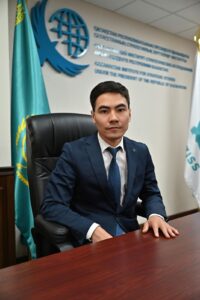
Aidar Kurmashev, head of the Asian Studies Department at the Kazakhstan Institute for Strategic Studies under the President of Kazakhstan (KazISS). Photo credit: KazISS
He identified the Middle Corridor as one of the most substantive areas of cooperation. A joint venture between PSA International and Kazakhstan Temir Zholy has already moved cooperation to practical route management. During the visit, the two countries also signed an agreement to develop the Middle Corridor.
The next stage, Kurmashev said, should focus on predictable delivery times, digital documentation, cargo tracking, integrated logistics solutions and links with port networks in Asia and Europe.
Aviation and digitalization
Aviation is another area where Kazakhstan plans to draw on Singaporean expertise.
Tokayev said Kazakhstan intends to build a new modern airport in Astana and highlighted Singapore’s Changi Airport as the “gold standard” of global aviation.
“We intend to draw on this experience in implementing the new project and take bilateral cooperation in the aviation sector to a new level,” Tokayev said.
Prime Minister Olzhas Bektenov earlier met with Changi Airport Group CEO Yam Kum Weng to discuss Astana’s airport infrastructure, including plans to build a second airport. Yam confirmed the group’s readiness to provide expertise and experience.
AI and digitalization also featured prominently in the visit. Tokayev proposed expanding cooperation in these areas, noting Kazakhstan’s establishment of the Ministry of Artificial Intelligence and Digital Development and its declaration of 2026 as the Year of Digitalization and Artificial Intelligence.
Lee visited Alem.ai, which Chinikeyev described as a promising new dimension of practical cooperation.
“Singapore has extensive experience in digitalization, innovation and technology, while Kazakhstan has made AI and digital development important national priorities,” he said.
Potential areas include cooperation among technology companies, start-ups, universities and specialists, as well as AI, GovTech and cybersecurity.
Expanding practical cooperation
The two countries are also exploring smart city development, water management, agriculture, critical minerals and tourism.
Kurmashev identified Alatau City as a potential project for Singaporean expertise in urban planning, digital city management, utilities, private investment and international business infrastructure.
An agreement on water management provides for experience exchange, professional development of Kazakh specialists and modern approaches to managing water resources.
Both experts emphasized that the next stage should focus on practical results rather than simply exchanging experience.
For Chinikeyev, Kazakhstan and Singapore can also serve as gateways to their respective regions: Singapore for Kazakh companies seeking Southeast Asian and ASEAN markets, and Kazakhstan for Singaporean businesses entering Central Asia.
The visit therefore underscored a partnership with significant potential in investment, connectivity, technology and human capital. The challenge now is to turn the strong political relationship into concrete projects and deeper economic links between the two countries.
