
ALMATY – Kazakhstan’s economy continued to expand in the first seven months of 2026, with investment and manufacturing providing an important source of growth even as mining output declined and exports remained heavily dependent on raw materials.
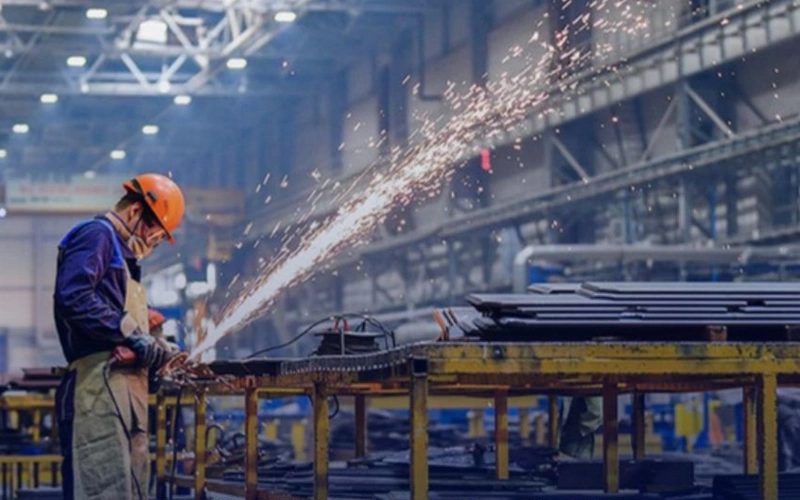
Photo credit: gov.kz
New data from the Bureau of National Statistics points to a mixed but potentially significant economic pattern. Industrial output reached nearly 40 trillion tenge (US$83.3 billion), while investment in fixed capital rose to 11.5 trillion tenge (US$24.9 billion) and foreign trade turnover reached $71.8 billion in the first half of the year.
Taken together, the figures suggest that Kazakhstan is attracting and directing more capital toward production and infrastructure. However, the structure of exports shows that the country’s external earnings remain strongly concentrated in commodities, particularly crude oil.
Manufacturing offsets decline in mining
Industrial production reached 39.97 trillion tenge (US$83.23 billion) between January and July, increasing by 3% compared with the same period last year. The most important driver was manufacturing. Output in the sector grew by 9% to 18.83 trillion tenge (US$39.2 billion), accounting for 47.1% of Kazakhstan’s total industrial production.
Growth was particularly strong in pharmaceutical production, which increased by 38.5%, followed by fabricated metal products (+35%), chemicals (+26.9%), and machinery, which grew by 22%. Production of rubber and plastic products increased by 18.6%, food production by 13.9%, and other non-metallic mineral products by 9.4%.
At the same time, mining and quarrying declined by 4.4% to 18.42 trillion tenge (US$38.4 billion). Crude oil production fell by 8.9%, while natural gas output declined by 5.5%.
The contrast between the two sectors is important. Kazakhstan’s industrial economy has historically depended heavily on extractive industries, but the latest figures show manufacturing expanding at a time when mining output is falling. Manufacturing also slightly exceeded mining in the value of industrial production during the seven-month period.
This does not mean that Kazakhstan’s economy has moved away from commodities. Instead, it suggests that other parts of the industrial sector are becoming more capable of supporting growth when output in extractive industries weakens.
Growth was also recorded in electricity, gas, steam and air-conditioning supply, which increased by 12.2%, and in water supply, wastewater and waste collection, which rose by 9.5%.
Investment concentrates on industry, infrastructure and construction
Investment in fixed capital reached 11.5 trillion tenge (US$24 billion) between January and July, increasing by 7.7% in comparable prices. Industry received the largest share of investment, accounting for 41.6% of the total. Manufacturing attracted 14.7% of all investment, while mining accounted for 14%.
The composition of spending also shows that investment is focused primarily on physical expansion. Construction and capital repairs of buildings and structures accounted for 62.1% of investment, while 33.6% was directed toward machinery, equipment and transport.
Transport and warehousing received 17% of total investment, followed by real estate operations at 18.6%. Agriculture, forestry and fisheries accounted for 5.7%. The regional distribution, however, was highly uneven. Investment increased by 94.4% in the Ulytau Region, 56.4% in the Zhambyl Region and 37.5% in the Turkistan Region. Growth was also recorded in the Almaty Region (+16.4%), Abai Region (+16.1%), West Kazakhstan (+13.3%), and the Pavlodar Region (+11.9%).
Meanwhile, investment declined by 24.5% in the Zhetysu Region, 14% in Shymkent, 10.4% in the Karagandy Region and 4.5% in the Mangystau Region. Astana accounted for 11.3% of all investment in fixed capital, while Almaty accounted for 10.8%.
Nearly half of all investment came from large and medium-sized enterprises. Companies’ own funds remained the main source of financing, accounting for 67.7%. Budget funds represented 14%, although their volume declined by 32% compared with January-July 2025.
Bank loans financed 5.6% of investment, while other borrowed funds accounted for 12.7%, including 3% from non-residents.
This financing structure suggests that the current investment cycle is being driven primarily by corporate resources rather than direct state spending or foreign borrowing. At the same time, the scale of investment in construction and industrial sectors indicates that much of the spending is aimed at expanding production capacity and physical infrastructure.
Trade growth still depends on commodities
Kazakhstan’s foreign trade turnover reached $71.8 billion in the first half of 2026, increasing by 7.2% year-on-year. Exports grew faster than imports, rising by 8.6% to $40.3 billion. Imports increased by 5.4% to $31.5 billion.
The resulting figures underline Kazakhstan’s continuing ability to generate a substantial trade surplus. However, the composition of exports remains concentrated.
Crude oil and crude petroleum products accounted for 46.5% of total exports. Refined copper and unwrought copper alloys represented 7.1%, copper ores and concentrates 5.1%, radioactive chemical elements and isotopes 3.7%, and ferroalloys 2.7%. Together, these figures show that Kazakhstan’s export performance continues to depend heavily on energy and mineral commodities.
China was the largest destination for Kazakh exports, accounting for 18.6%, followed closely by Italy at 17.3%. Russia accounted for 8.6%, Türkiye 8%, the Netherlands 6.4% and France 5.7%.
On the import side, Russia remained Kazakhstan’s largest supplier, accounting for 30.9%, followed by China at 29.1%. Germany accounted for 4.8%, the United States 4.2%, South Korea 2.5% and Türkiye 2.2%.
Passenger cars and other motor vehicles represented the largest individual category of imports at 3.2%, followed by telephone equipment at 2.7%, medicines and petroleum gases at 2.5% each, and electric generating sets and rotary electrical converters at 2.3%.
Investment is growing faster than economic diversification
The latest data presents two parallel stories about Kazakhstan’s economy. On one side, manufacturing is growing faster than the overall industrial sector and offsetting a decline in mining. Investment is rising, with more than two-fifths directed toward industry, while significant resources are being spent on machinery, equipment, construction and infrastructure.
On the other side, almost half of Kazakhstan’s exports still come from crude oil and petroleum products. Mining remains one of the largest recipients of investment, while the country’s trade performance continues to depend heavily on demand from major external markets for commodities.
If investment in manufacturing, equipment and new production capacity results in a broader range of competitive industries, Kazakhstan could gradually reduce the gap between its growing domestic industrial base and its commodity-heavy export structure. If not, higher investment and manufacturing output may expand the economy without fundamentally changing its dependence on raw-material exports.
