
ALMATY – Central Asia is moving beyond symbolic diplomacy toward a more durable system of regional coordination, according to Filippo Costa Buranelli, an associate professor of international relations at the University of St. Andrews in the United Kingdom. Following last week’s informal summit of Central Asian leaders and Azerbaijan in Cholpon-Ata, Buranelli said in an interview to the Baq.kz agency that the region has already built a stable political framework that now requires practical implementation through concrete mechanisms rather than new institutions.
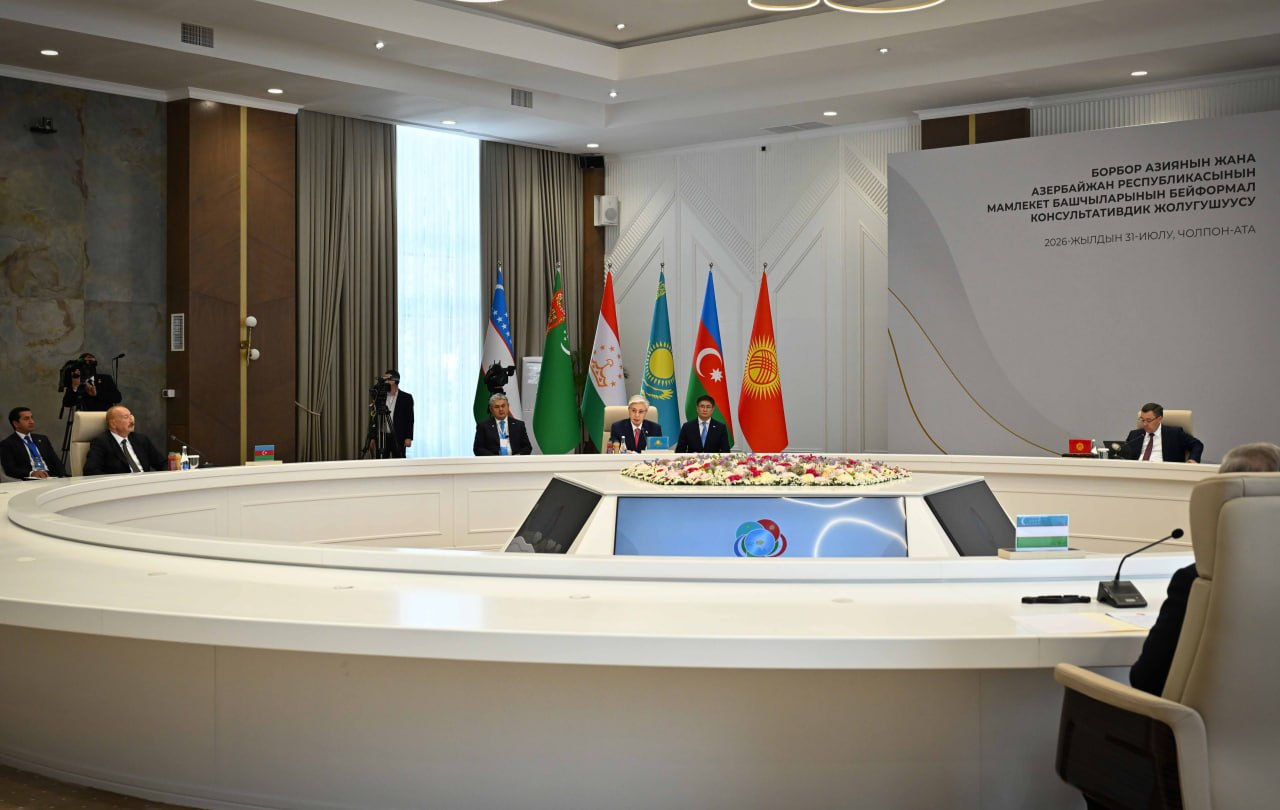
During the July 31 informal summit of Central Asian leaders and Azerbaijan in Cholpon-Ata, President Kassym-Jomart Tokayev described the current period as the most successful in Central Asia’s modern history. Photo credit: Akorda.
His assessment comes after the July 31 meeting, where regional leaders adopted the Cholpon-Ata Declaration and discussed transport connectivity, energy, trade and regional security. During the meeting, President Kassym-Jomart Tokayev described the current period as the most successful in Central Asia’s modern history and proposed developing an action plan to implement the Treaty of Friendship, Good Neighborliness and Cooperation for the Development of Central Asia in the 21st Century.
From confidence-building to coordination
According to Buranelli, the region has entered a new phase.
“The political, economic and broader development environment is becoming more regular, predictable and coordinated,” he said, noting that the significance of the Cholpon-Ata meeting lies not only in its outcomes but also in the frequency of high-level consultations.

Filippo Costa Buranelli.
Unlike previous years, when regional meetings primarily served to rebuild trust after a prolonged period of limited interaction, Central Asian leaders now meet twice a year under the consultative format – one formal summit and one informal gathering.
While Buranelli does not believe the format is necessarily evolving into a traditional international organization, he argues that institutionalization should not be measured solely by the creation of permanent bureaucracies.
“What matters more is that a stable political and coordination framework has already emerged, allowing countries to promote mutual interests in a coordinated manner,” he said.
That evolution, he said, mirrors Kazakhstan’s own approach to regional diplomacy, which has consistently favored pragmatic cooperation over supranational integration.
Why Tokayev’s proposal matters
One of the summit’s most consequential initiatives may not have been the declaration itself, but Tokayev’s proposal to prepare an implementation plan for the regional friendship treaty. For Buranelli, this shifts the conversation from political commitments toward measurable action.
The treaty, signed by all five Central Asian states, establishes principles of good-neighborliness, peaceful dispute resolution and sustainable development. Unlike many regional agreements, it has no expiration date and does not require countries to transfer sovereignty or harmonize foreign policy.
Instead, it creates what Buranelli describes as a “legally grounded but flexible framework” capable of accommodating different political systems and national priorities.
“President Tokayev’s proposal to develop a concrete implementation plan for the treaty gives this architecture a practical dimension. Kazakhstan consistently promotes the approach that political agreements should be transformed into clear mechanisms, guidelines, and joint projects,” he said.
That approach, he argued, allows Central Asia to deepen cooperation without sacrificing the flexibility that has become one of the consultative format’s greatest strengths.
Azerbaijan expands the region’s strategic horizon
The summit also reflected a broader geographical shift.
Following Azerbaijan’s accession as a full participant, cooperation increasingly extends beyond the five Central Asian states toward the Caspian region. Rather than fundamentally changing the nature of the consultative format, Buranelli believes Azerbaijan broadens its practical scope. Thus, transport corridors, energy exports, digital connectivity and investment now link Central Asia more directly with the South Caucasus and European markets.
The development complements Kazakhstan’s long-standing efforts to strengthen the Trans-Caspian International Transport Route, or Middle Corridor, reducing dependence on traditional transit routes while diversifying access to global markets.
The expanding agenda also includes tourism, innovation, digitalization, artificial intelligence and space technologies, illustrating how regional cooperation is gradually moving beyond traditional security and trade issues.
From declarations to delivery
For Buranelli, the Cholpon-Ata summit suggests that Central Asia has largely solved the political problem that dominated the region only a decade ago: rebuilding trust among its neighbors. The more difficult phase is only beginning as the challenge is no longer whether the countries can meet or agree on common principles. The challenge is whether those principles become part of everyday governance and cooperation between the countries.
That means making coordination routine rather than summit-driven, strengthening cooperation among ministries, expert communities and regional authorities, and increasingly evaluating national projects through a regional perspective.
In that sense, Tokayev’s proposal to develop an implementation plan for the regional friendship treaty may prove more consequential than the declaration itself. Rather than creating new institutions, it seeks to make existing commitments operational.
The next opportunity to measure that progress will come on Oct. 8, when Central Asian leaders and Azerbaijan are scheduled to reconvene in Avaza, Turkmenistan. By then, attention is likely to shift from broad political statements toward whether governments have begun translating the treaty into concrete initiatives, timelines and joint projects.
