
ALMATY – We often believe we understand a culture through its symbols. But can traditions truly be known without living them? Seeking answers beyond archives and history books, Kazakh artist Radina Yassuyeva spent a year living in a yurt on the steppe, experiencing the rhythms, hardships and routines of nomadic life firsthand. Her experience became the basis for “AQ YOURT,” a new solo exhibition at Esentai Gallery in Almaty that explores what remains of Kazakhstan’s nomadic heritage once images and myths replace living traditions.
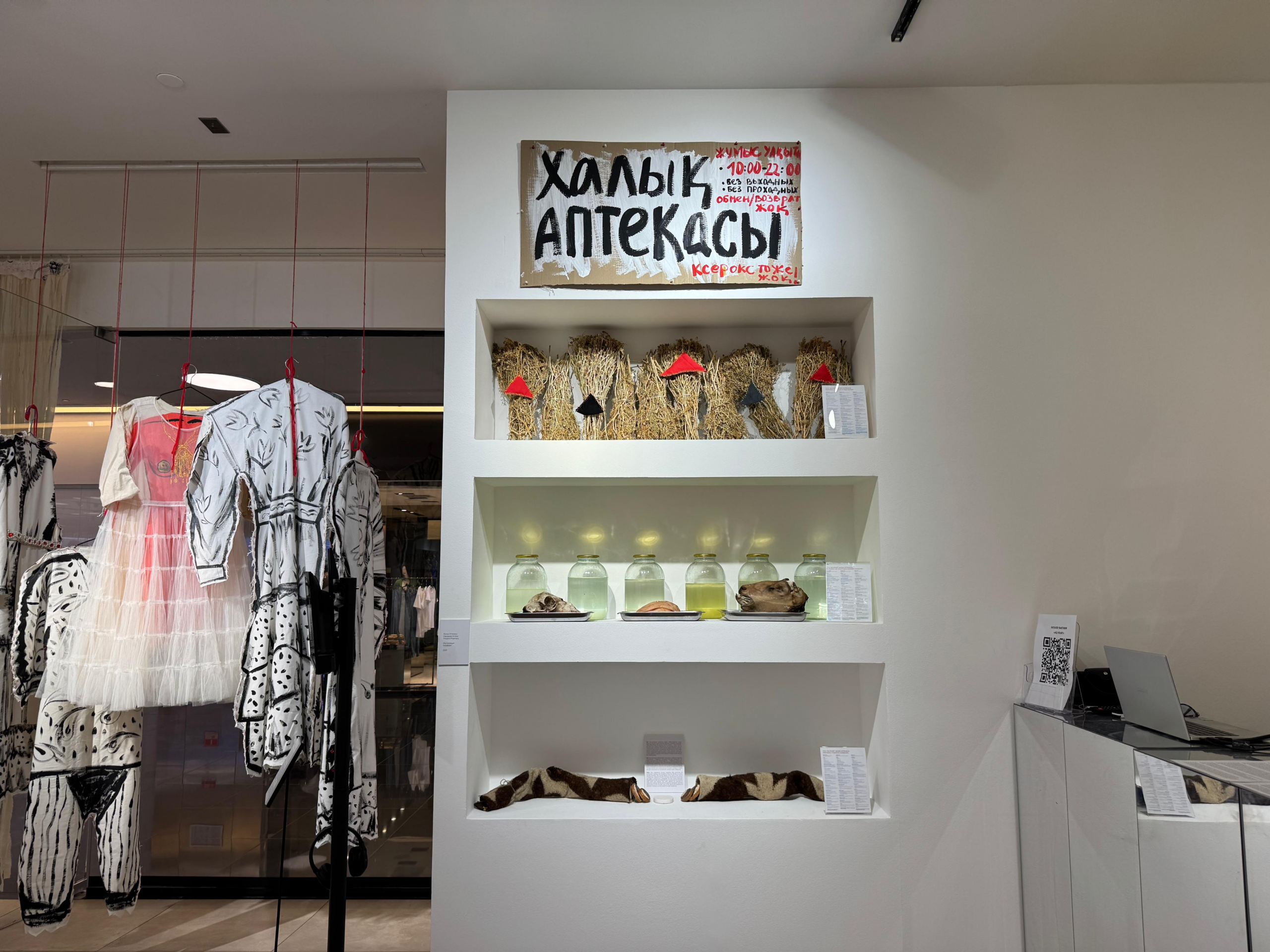
Kazakh Pharmacy references English artist Damien Hirst’s famous installation Pharmacy while translating it into a distinctly Kazakh context. Photo credit: Ayana Birbayeva/The Astana Times
Curated by Togzhan Sakbayeva, the exhibition argues that contemporary Kazakhstan often experiences its nomadic heritage through recognizable images – ornaments, felt carpets, yurts and steppe landscapes – rather than through everyday practice.
Rather than celebrating tradition nostalgically, the exhibition asks a more uncomfortable question: what knowledge disappears when a way of life can no longer be lived, only represented?
For Yassuyeva, the project is deeply personal. Experiencing all four seasons in the steppe under conditions close to traditional nomadic life, she confronted both its beauty and its realities such as relentless physical labor, dependence on weather and livestock, and the dense web of relationships that sustained steppe communities.
The experience became the foundation for the exhibition, transforming the gallery itself into a symbolic yurt where contemporary artworks explore memory, identity and the fragile continuity of cultural knowledge.
A gallery transformed into a yurt
The exhibition unfolds as a single immersive environment rather than a sequence of individual works. Like entering a traditional yurt, visitors step into one shared space where domestic life, family history and spiritual memory coexist.
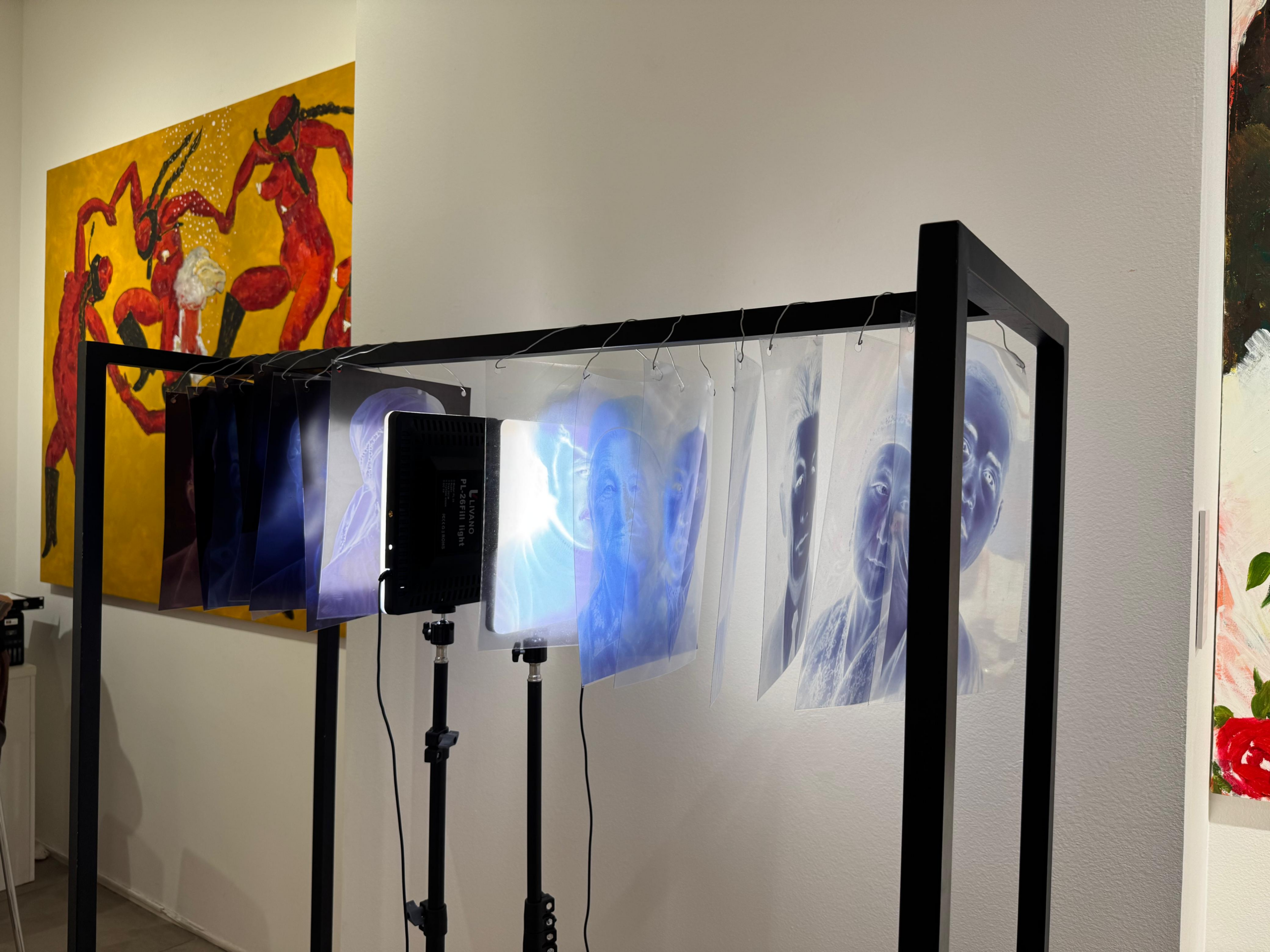
Images of the artist’s relatives become a metaphor for memory-fragmentary, incomplete, and requiring effort to be deciphered. Photo credit: Ayana Birbayeva/The Astana Times
The installation is divided into two symbolic zones – one dedicated to ancestors (aruakhs) amid fields of tulips, the other surrounded by roses. At the heart of the exhibition is the video installation.
Its central object is a syrmak – a traditional felt carpet that once formed part of the artist’s dowry. The center of its tulip ornament has been cut away and replaced with a blank white canvas, symbolizing the rupture in family and cultural memory created by the disappearance of the nomadic way of life.
Surrounding the projection is Mazhilis, an installation portraying family members, guests and ancestors as tulip-shaped faces arranged across a plastic carpet against a backdrop resembling a modern kerege, the lattice structure of a yurt. Once dismissing extended family gatherings as little more than social obligation, Yassuyeva came to understand them during her time on the pasture as an essential mechanism through which knowledge, memory and identity pass between generations.
Reclaiming women’s place in steppe history
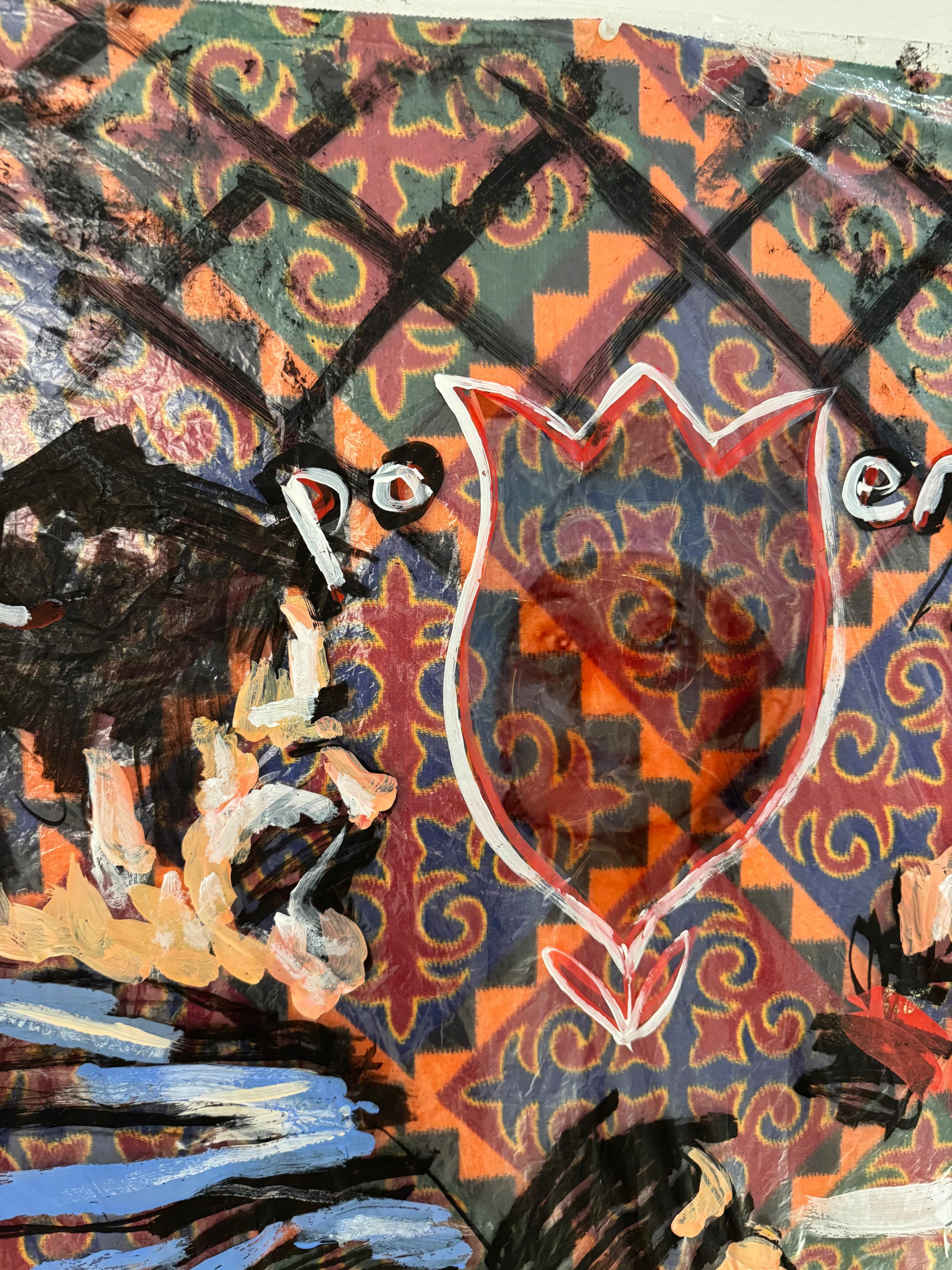
Mazhilis is an installation portraying family members, guests and ancestors as tulip-shaped faces arranged across a plastic carpet. Photo credit: Ayana Birbayeva/The Astana Times
One of the exhibition’s strongest themes is the role of women in nomadic society. Following the traditional division of space inside a yurt, monumental paintings line opposite walls devoted to men’s and women’s kokpar, the traditional horseback game. While male competitors are familiar figures in Kazakhstan’s national imagery, Yassuyeva draws attention to a largely forgotten history of women’s participation in equestrian events.
Her female riders race, wrestle over goat carcasses, leap barriers and even compete while pregnant. Positioned beneath the bold word POWER, these works challenge narratives that have gradually erased women’s public presence from the history of the steppe. Rather than presenting women solely as caretakers within domestic life, Yassuyeva restores them as active participants in physical competition, social life and cultural memory.
When ornament loses its meaning
Standing where the shanyrak, the circular crown of a yurt, would traditionally be located is the Ornament Table, an installation examining what happens when national symbols become ubiquitous.
At the center of the exhibition stands dastarkhan, an installation conceived as a space for gathering, communication, and the transmission of knowledge. Instead of food, the plates display traditional and original ornaments, presented as a language of cultural memory. The work reflects on the loss of meanings that were transmitted through symbols for centuries and on the transformation of ornament into an object of consumption.
By inviting viewers to symbolically “consume” the ornament, the installation raises the question of what remains of culture when its symbols continue to exist independently of their original meanings and what remains when its symbols become objects of consumption.
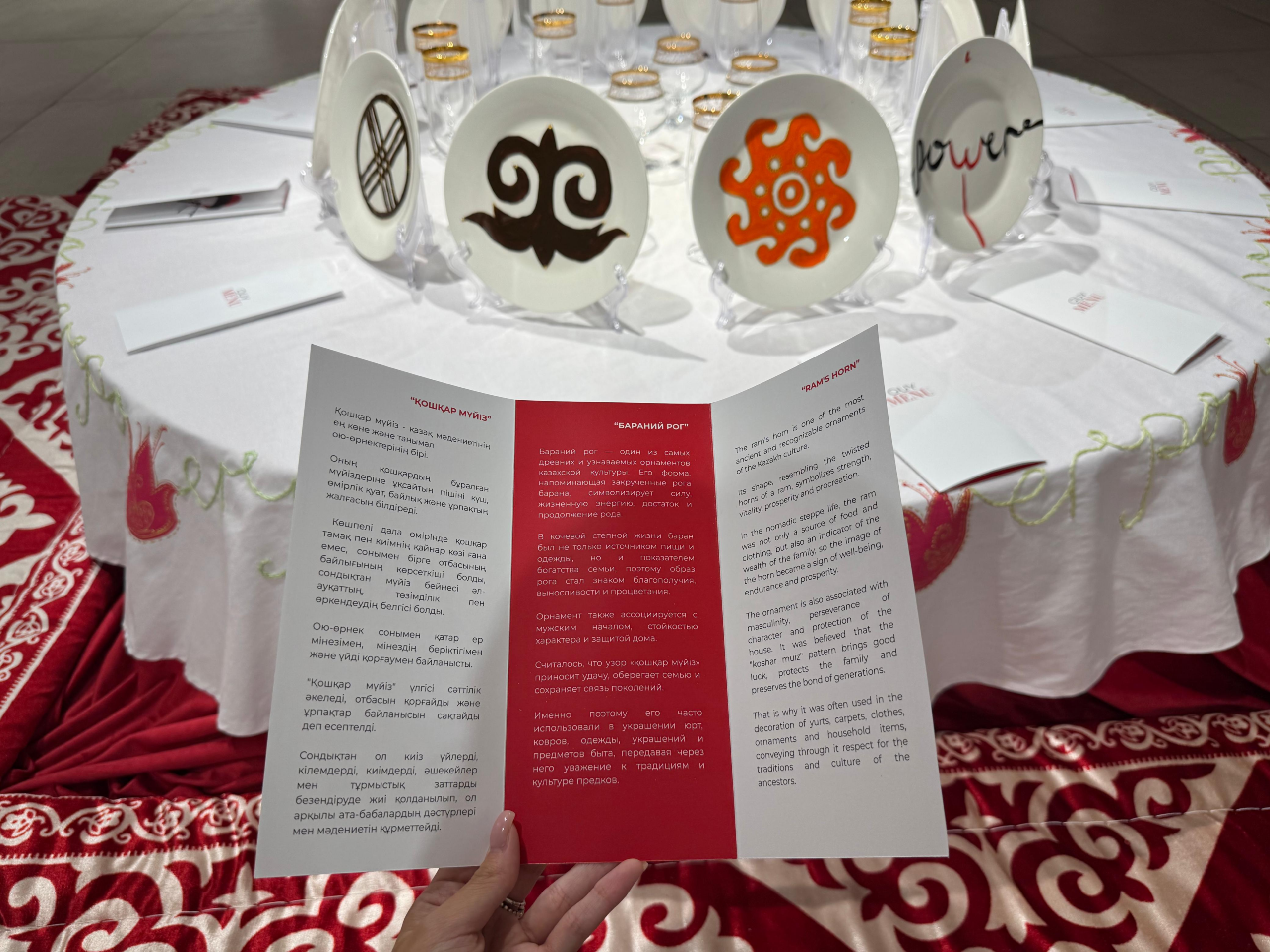
Instead of food, the plates display traditional and original ornaments, presented as a language of cultural memory. Photo credit: Ayana Birbayeva/The Astana Times
Traditional Kazakh ornaments now decorate everything from corporate branding to souvenirs and public buildings. Yet their original meanings as markers of lineage, status and relationships between people and nature have largely disappeared.
Nearby, the installation reveals layered X-ray-style images of family photographs. Individual portraits gradually dissolve into one another, reflecting the fragmented nature of memory and the difficulty of reconstructing personal histories from incomplete archives.
Images of the artist’s relatives become a metaphor for memory-fragmentary, incomplete, and requiring effort to be deciphered. By gazing into the faces of her ancestors, the artist attempts to bridge the distance between generations and restore a connection with her own family history.
Folk medicine meets Damien Hirst
One of the exhibition’s most playful works, Kazakh Pharmacy, references English artist Damien Hirst’s famous installation Pharmacy while translating it into a distinctly Kazakh context.
Instead of pharmaceutical products, shelves are filled with traditional remedies and symbols: adraspan used to ward off evil spirits, broth believed to restore strength, a sheep’s head sculpted from tail fat, and even a pill shaped like qazy horse sausage. The work explores the space where ritual, medicine and everyday knowledge overlap, suggesting that traditional healing practices endured precisely because they never separated the practical from the symbolic.
AQ YOURT ultimately rejects both romantic nostalgia and simplistic ideas of cultural revival. Instead, Yassuyeva proposes that tradition cannot be restored simply by reproducing familiar visual motifs. If culture is to remain alive, she suggests, it must once again become embodied experience rather than image.
The exhibition asks viewers to reconsider what Kazakhstan remembers about its nomadic past and what has quietly been forgotten, and to analyze whether those missing histories can ever truly be recovered.
AQ YOURT runs through Aug. 11 at Esentai Gallery, 77/8 Al-Farabi Avenue, Almaty. The gallery is open daily from 10 a.m. to 10 p.m., and admission is free.
