
ASTANA — When former patients line up for the Jüregımnıñ Jeñımpazy (a champion of my heart) charity run in Astana on Aug. 9, some of the doctors who treated them will be at the starting line too. For five surgeons working across cardiac, transplant, neonatal and pediatric care, the race offers a rare chance to see what happens after some of medicine’s most complex operations – when patients return to everyday life.
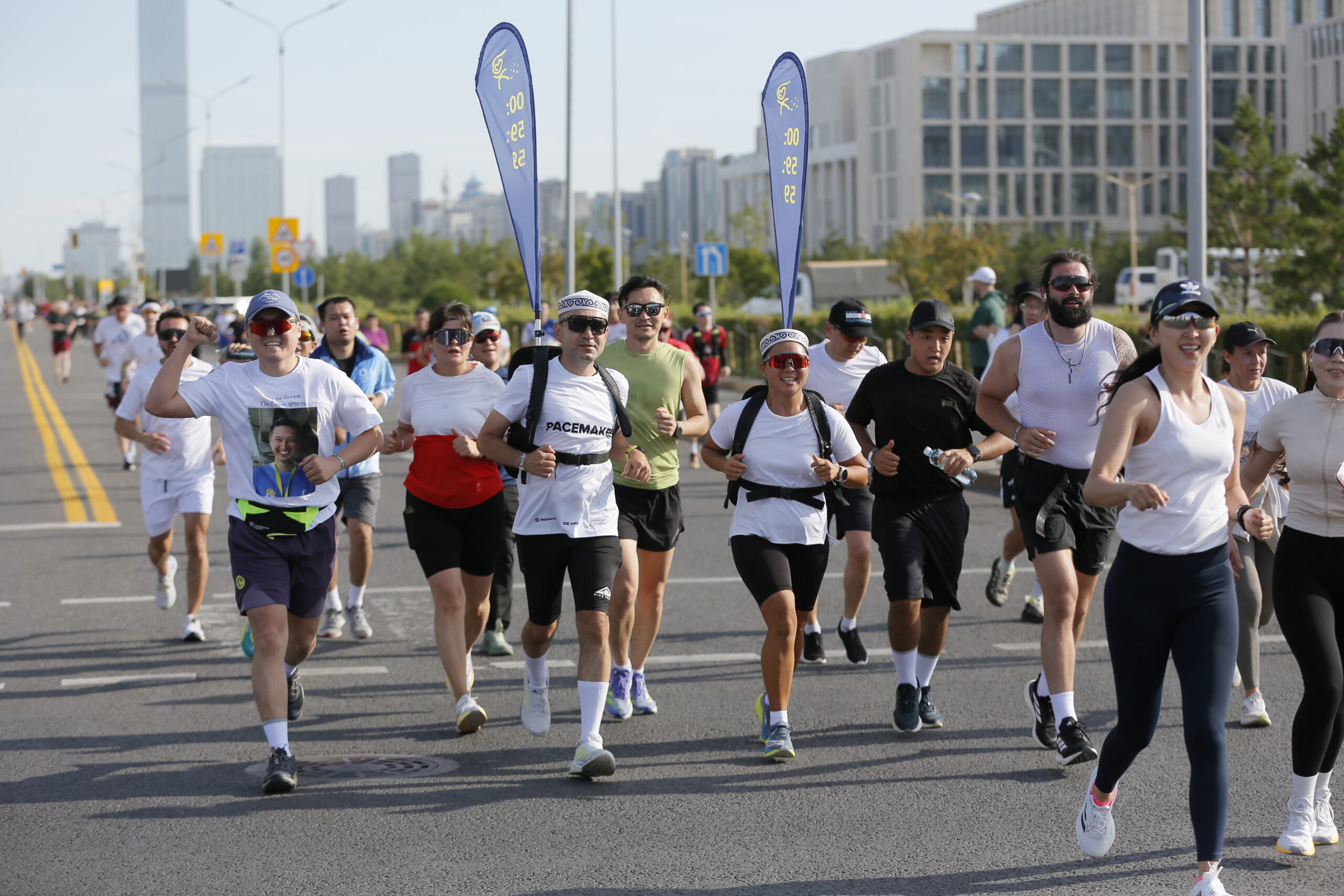
Astana to host Jüregımnıñ Jeñımpazy charity run on Aug. 9. Photo credit: Heart Center Foundation
Organized by the Heart Center Foundation (HCF), the annual event marks Kazakhstan’s first heart transplant, performed in August 2012, and raises awareness about organ donation and transplantation. This year, organizers expect more than 7,000 participants and visitors, with one, three, and 10-kilometer races.
The event comes as demand for transplantation remains high. According to HCF, 4,604 people, including 120 children, were on Kazakhstan’s transplant waiting list as of March 19. Transplants involving organs donated after death nearly tripled, from 23 in 2024 to 68 in 2025, yet 342 patients were unable to receive a transplant in time last year.
Behind the event are doctors whose work begins long before anyone reaches a starting line. They operate on premature newborns weighing only a few kilograms, perform and support complex transplant procedures, guide families through difficult decisions and, in some cases, know the experience of being a patient themselves.
Ahead of the race, five Astana surgeons spoke to The Astana Times about the experiences that have shaped them as doctors, and what it means to meet patients again when they are no longer in a hospital bed.
Seeing medicine from both sides
Cardiac surgeon Zhanna Rakish knows the doctor-patient relationship from both sides.
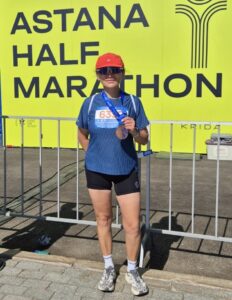
Cardiac surgeon Zhanna Rakish. Photo credit: personal archives
Having undergone kidney transplantation herself, she said becoming a patient changed the way she understood fear, uncertainty, and the trust people place in a medical team. Before her illness, she primarily saw disease as a problem that needed to be treated. Her own experience showed her what it means when life becomes organized around hospital visits, procedures and the hope of receiving a donor organ.
“For the team, an operation is a complex, well-practiced protocol; for me, it is always a kind of sacred act. I myself clearly remember that cold in the operating room, that feeling of fear of the unknown, and the boundless trust that you place in your colleagues. Therefore, every movement that I make here, everything I say to patients, comes with a clear understanding that in front of you is a person with hope that requires careful treatment. And something that was once given to me, I try to pass on to those people who come to me for help,” she told The Astana Times.
That memory, she said, now influences both her work in the operating room and the way she speaks to patients.
Last year, after Rakish completed the charity race, a parent approached her and said she had once treated their child. Following surgery, the family had been afraid to allow the child much physical activity and had treated the child, in Rakish’s words, “like a fragile vase.”
Seeing a doctor who had herself undergone transplantation complete the race helped change that perception. The parent told Rakish that her example had made the family less afraid of allowing their child to lead an active life.
“Those were very precious words, and from time to time I hear them again. They serve as a kind of support, a hope that none of this was in vain,” she said.
When the patient cannot speak
For neonatal and pediatric surgeon Zhenis Sakuov, some patients are only days old. Premature babies he operates on can weigh less than 2.5 kilograms, making precision essential throughout surgery and recovery.
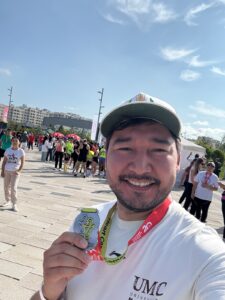
Neonatal and pediatric surgeon Zhenis Sakuov. Photo credit: personal archives
“Operating on newborns, of course, requires particular precision and endurance. These patients are the most vulnerable, because operating on newborn babies is difficult, and operating on premature babies is even more difficult. The operation itself is complex, the management of the postoperative period is complex, and they need specialized care after surgery. Only by having a good team can you achieve success in neonatal surgery,” he told The Astana Times.
A newborn cannot describe pain or symptoms, leaving doctors to rely on examinations, laboratory tests and imaging. At the same time, parents may be trying to understand a serious diagnosis shortly after the birth of their child.
“The most difficult thing in our work, of course, is the conversation with the parents,” said Sakuov.
He highlighted that he encourages families to have another close relative present during important conversations and to prepare questions in advance, so they can better process the information they receive.
Outside the hospital, running has become another space in which Sakuov encounters people differently. He is part of a UMC running community and regularly participates in road and trail races.
During one 42-kilometer marathon, he found himself running for about half an hour beside a stranger who began speaking openly about difficult periods in his life.
“This is probably one of the forms of psychotherapy, because when you run for a very long time, all the unnecessary doubts and thoughts move into the background, and only you and the road remain. There is a kind of clarity in your head,” he said.
Meeting children years later
Pediatric cardiac surgeon Tlektes Nashkenov also works with patients whose small size can make every movement critical.
“When I was just starting out, the most unexpected thing for me was how small our patients can be and how enormous the responsibility for their lives can be. Sometimes it is a newborn weighing only a few kilograms, and you need to perform an operation where literally every millimeter counts,” he told The Astana Times.
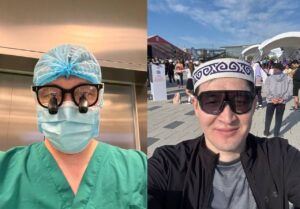
Pediatric cardiac surgeon Tlektes Nashkenov. Photo credit: personal archives
Nashkenov noted that with experience he came to understand pediatric cardiac surgery not only as a technical discipline but as a combination of teamwork, continuous learning and communication with families.
“Parents entrust us with what is most precious to them – the life of their child. For them, it is important not only how the operation will go, but also to understand what is happening, what risks there are, and what the prospects are. We do not only treat the child; we accompany the whole family,” said Nashkenov.
He also said Kazakhstan can now perform procedures that previously required families to seek treatment abroad. Improvements in intensive care, diagnostics, anesthesiology and technologies such as extracorporeal membrane oxygenation (ECMO) have expanded the options available for children with complex heart conditions.
Yet for Nashkenov, one of the clearest measures of success comes years after an operation.
“During treatment, we see a child at the most difficult moments of their life. And then, several years later, to see that child healthy, smiling, and running a marathon together with their parents – it is a very powerful emotion. It is the best confirmation that our work truly changes lives,” he said.
That long-term view of recovery is also what draws Nashkenov to the Aug. 9 race, which he plans to join himself. For him, meeting former patients at the starting line offers a chance to see them not as patients, but as children who have returned to active everyday life.
Different sides of the same surgeon
Cardiac surgeon Aigerim Kuzhakhmetova describes herself in the operating room as calm and focused. When a situation becomes critical, she tries to slow down mentally, assess the risks and think several steps ahead. Outside surgery, she says, her personality is noticeably different.
“In everyday life, on the contrary, I am more open and emotional. I love humor, active communication and movement. But these are not two different personalities,” she told The Astana Times.
For the past two years, that more playful side has appeared at the charity race, where Kuzhakhmetova has run dressed as Wonder Woman.
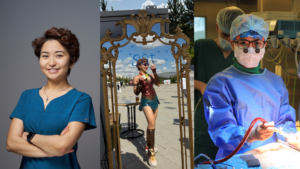
Cardiac surgeon Aigerim Kuzhakhmetova. Photo credit: personal archives
“Why did I choose her? Because Wonder Woman is the princess of the Amazons. And she was raised in a society of strong and independent women. For me, this is a parallel to what I do in the field of cardiac surgery. It might seem that this is a stereotypically male profession. But in fact, we have quite a lot of women who also work in surgical fields. And they can work on an equal level with men, be professionals, and show good results,” she said.
“When I was choosing an image for the run, I wanted to show that every person is a superhero. Every person who participates in this run is, in fact, a hero,” she added.
Her understanding of recovery is also shaped by patients she has seen regain abilities that illness had gradually taken away. Kuzhakhmetova recalled a woman under 40 who had severe respiratory failure before receiving a lung transplant. For several years, she depended on continuous oxygen and rarely left home. After transplantation and a long rehabilitation, Kuzhakhmetova later saw her walking through the hospital with her elderly parents.
What remained with the doctor was not only the patient’s recovery but her father’s reaction as he watched his daughter become independent again.
“We meet patients at one of the most difficult periods in their lives. And then at the starting line, we see them in a different role — as an active people, surrounded by their family and friends, with new plans and confidence in their own strength. I think that for every doctor this is a very important and inspiring moment, and it is also an indicator, a result of our work,” she said.
The challenge beyond the hospital
For cardiac surgeon Timur Lesbekov, transplantation also depends on what happens long before a patient reaches an operating room.
Having worked in the field since an earlier stage of its development in Kazakhstan, he remembers when donor coordination, organ retrieval and cooperation between medical teams in different regions required considerably more organizational effort.
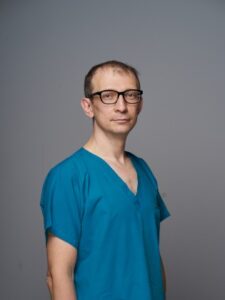
Сardiac surgeon Timur Lesbekov. Photo credit: UMC
Over time, those processes have become more established. Medical teams are more familiar with how quickly different services must work together once a potential donor process begins. At the same time, advances in organ preservation have reduced some of the logistical pressure created by Kazakhstan’s vast distances.
Despite these advances, he sees the main remaining obstacle as social rather than technical.
“The biggest difficulty is ourselves. I do not mean medical workers. I mean us as a society. The process is organized. We can work very quickly and effectively wherever in Kazakhstan a donor process is initiated. The main thing is for it to be initiated,” he said.
He does not see Jüregımnıñ Jeñımpazy as something that can directly solve the shortage of donor organs. Its role, he said, is to make transplantation and donation subjects that people are more prepared to understand and discuss with their families.
“It affects not only people’s awareness, it also affects whether a family begins to talk about donation. The decision we make can affect several lives in the future. And this is also a decision that everyone can make today,” he said.
For Lesbekov, the race also has a family history. His wife and children have supported the initiative since its earliest edition, when it began as a bicycle ride, and his daughter has volunteered with the foundation.
Their involvement has turned the event into a family tradition connected to a part of Lesbekov’s profession that can call him away from home without warning when a transplant process begins.
