
ASTANA – Kazakhstan’s employed population could increase by 1.9 million people by 2040, offering the country a significant demographic advantage, but harnessing that potential will depend on its ability to create more high-productivity jobs, according to preliminary findings from a labor market study by the Eurasian Fund for Stabilization and Development (EFSD).

Photo credit: Shutterstock
Presented at the Eurasian Development Bank’s Annual Meeting and Business Forum on June 26 in Almaty, the study looks at labor market trends in Kazakhstan, the Kyrgyz Republic, Tajikistan and Armenia.
According to Taras Tsukarev, head of the research department at the EFSD, labor markets play a critical role not only in allocating labor resources but also in maintaining macroeconomic stability and ensuring that the benefits of economic growth translate into higher living standards.
“Population growth contributes to economic growth if, and only if, it is accompanied by an expansion of productive employment, preferably high-productivity employment,” Tsukarev said.
Unlike many advanced economies facing population aging and labor shortages, Kazakhstan and other Central Asian countries continue to see their populations grow. According to the EFSD study, Kazakhstan’s total population increased by 22% between 2010 and 2024, while the working-age population grew by 11%. Researchers said these demographic trends create the potential for a demographic dividend, the economic gains associated with a growing labor force.
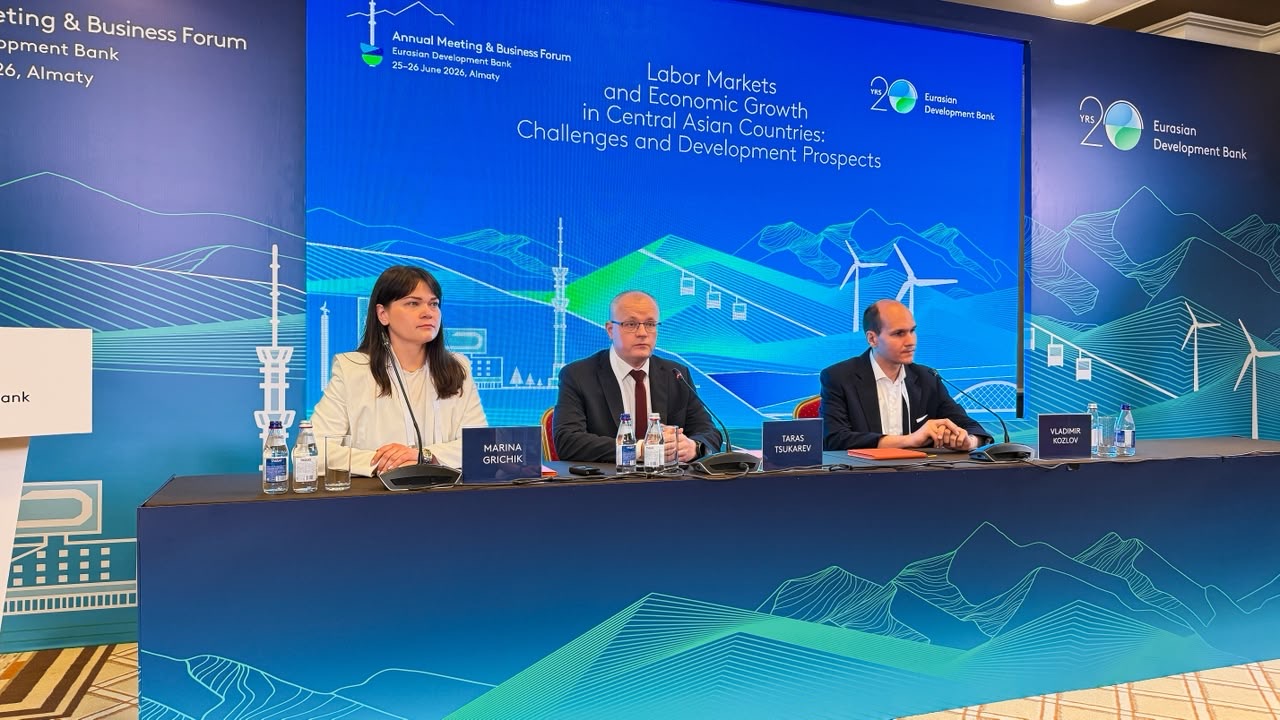
From L-R: Marina Grichik, Taras Tsukarev, Vladimir Kozlov. Photo credit: EFSD Press service
However, demographic trends alone are not enough to sustain long-term economic growth, the researchers said.
Marina Grichik, head of the macroeconomic analysis unit at the EFSD, said the study found a relatively weak link between economic growth and job creation across the region.
Over the past 15 years, Central Asian economies have recorded strong economic growth. Kazakhstan’s economy expanded by 66% during the period, yet employment grew at a significantly slower pace.
“Economic growth is not translating effectively into job creation,” Grichik said, noting that the gains from economic expansion were largely captured by those already employed through higher wages, while part of the region’s labor potential remained untapped.
The study also found that Kazakhstan recorded the strongest productivity gains from structural changes in the labor market among the countries analyzed.
Over the past 15 years, the share of employment in agriculture in Kazakhstan declined by 17 percentage points as workers increasingly moved into the services sector and corporate employment. According to the EFSD, labor reallocation between sectors accounted for more than one-quarter of the country’s overall productivity growth, the highest contribution among the countries included in the study.
Vladimir Kozlov, professor of economics at Nazarbayev University, said employment in Kazakhstan’s corporate sector increased by more than 1.3 million people between 2010 and 2024, while self-employment declined substantially.
According to Kozlov, Kazakhstan has experienced a more pronounced shift toward corporate employment than its regional peers, reflecting the country’s ongoing structural transformation.
At the same time, experts noted that many workers leaving agriculture have moved into the services sector rather than manufacturing. While services generally offer higher productivity than agriculture, not all service-sector jobs are highly productive, limiting the economy’s ability to fully capitalize on its demographic advantage.
The full study on labor markets in Central Asia will be presented on Oct. 29 at the EFSD International Economic Conference in Astana.
