
ALMATY – The Eurasian Development Bank (EDB) is expanding its role as a regional development institution, with member states highlighting its growing contribution to infrastructure, industrial modernization, energy, and regional connectivity during the plenary session Eurasia 2030+: Investments, Growth and New Opportunities at the EDB’s Annual Meeting on June 25. The discussion marked the bank’s 20th anniversary and the approval of its new 2027–2031 strategy.
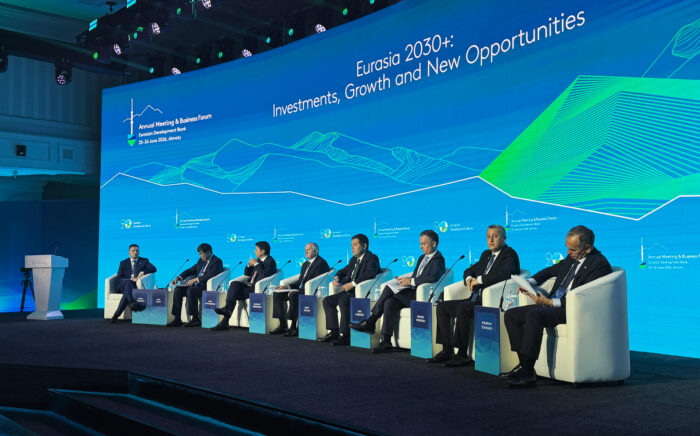
Podguzov noted that Kazakhstan is one of the best examples of how infrastructure investments create tangible benefits for citizens. Photo credit The Astana Times/Aida Dosbegren
Opening the session, EDB Management Board Chairman Nikolai Podguzov said the Eurasian region continues to demonstrate economic growth above global averages but stressed that sustaining this momentum will require technological modernization, stronger regional integration and investment focused on improving people’s well-being.
Kazakhstan: $10.8 billion invested in infrastructure
“Kazakhstan is one of the best examples of how infrastructure investments create tangible benefits for citizens. Since 2022, the EDB has invested $6.6 billion in the country. Airports financed by the bank now serve around 40% of all air passengers in Kazakhstan,” Podguzov said.
The EDB has been one of Kazakhstan’s largest international development partners, particularly in infrastructure, energy and industry. Between 2008 and 2025, it ranked as the country’s leading provider of non-sovereign financing among international financial institutions. Overall, the bank invested $10.8 billion in Kazakhstan’s economy, supporting the construction of 22 power plants, including 18 new renewable energy facilities and the expansion of four combined heat and power plants with a total capacity of 1.3 GW. EDB-backed projects also include two airports serving 12 million passengers annually and 1,700 kilometers of transport and pipeline infrastructure.
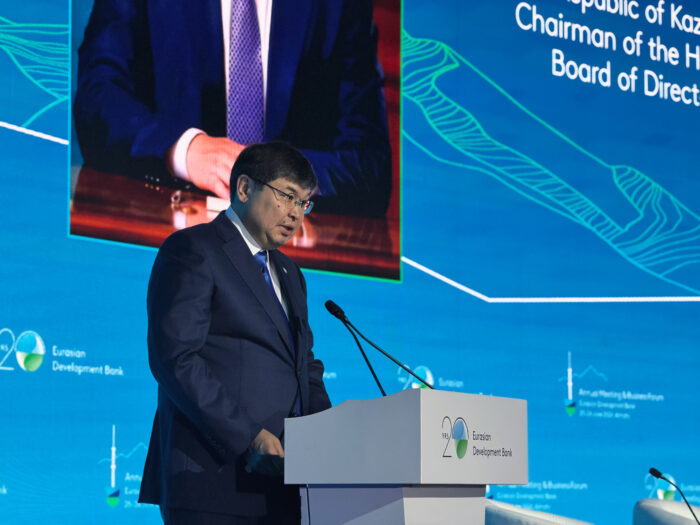
Kazakh Finance Minister Madi Takiyev said the country’s investment climate continues to strengthen. Photo credit The Astana Times/Aida Dosbegren
Kazakh Finance Minister Madi Takiyev said the country’s investment climate continues to strengthen. According to him, foreign direct investment reached a record $43.5 billion, while the government is implementing a new investment policy through 2030 to attract high-quality investment.
“The new Investment Policy Concept through 2030 is aimed at attracting quality investment. We are strengthening investor protection, introducing a special tax regime, and creating new growth centers such as Alatau City,” Takiyev said.
Among the reforms, Takiyev highlighted the establishment of a Committee for the Protection of Investors’ Rights under the Prosecutor General’s Office, the introduction of a new preferential tax regime for investors, the role of the Astana International Financial Centre operating under English common law principles, and support provided by Kazakh Invest.
Kazakhstan is also expanding its role as a regional logistics hub through the Middle Corridor and transport routes linking North-South and East-West trade. The minister added that the recently opened Alem.AI International Artificial Intelligence Center is intended to help position Kazakhstan as a regional AI leader by 2030.
Kyrgyzstan: EDB portfolio quadruples as growth tops 12%
The discussion also highlighted the EDB’s growing presence in the Kyrgyz Republic. Podguzov said the bank’s investment portfolio in the country has increased fourfold under the current strategy. Among its flagship projects is the construction of the country’s largest solar power plant with a capacity of 300 megawatts.
Kyrgyz Economy and Commerce Minister Bakyt Sydykov said the country has maintained one of the highest growth rates in the region despite global uncertainty. Between 2021 and 2025, Kyrgyzstan recorded average annual GDP growth of around 10%, while economic growth reached 12.2% during the first five months of 2026.
“Between 2021 and 2025, Kyrgyzstan’s average annual GDP growth reached around 10%, while growth in the first five months of 2026 stood at 12.2%,” Sydykov said.
According to him, the country’s development strategy through 2030 aims to sustain annual growth of 8–9% by focusing on four priorities: industrialization, transforming Kyrgyzstan into a regional logistics and trade hub, unlocking its hydropower potential, and developing sustainable tourism and agriculture. Only around 13% of the country’s hydropower resources are currently utilized, while several major infrastructure projects involving Kazakhstan, Uzbekistan and Tajikistan are already underway.
Sydykov emphasized that international development banks play a broader role than providing financing, acting as catalysts for structural reforms and regional integration. He noted that capital flows to projects with well-prepared plans, transparent procedures, experienced teams, and effective implementation mechanisms.
“Our goal (with EDB) is to make Eurasia a region where promising projects emerge more quickly, are developed to a higher standard, and secure financing at earlier stages,” he concluded.
Russia sees Eurasia as a growth platform
Turning to Russia, Podguzov noted that the country ranks fourth globally in GDP at purchasing power parity, providing a large market, industrial base and technological capacity for the region. He added that EDB-financed transport projects are strengthening regional connectivity. Last year alone, highways built with EDB support recorded 158 million trips, accounting for 25% of all journeys on Russia’s toll roads.
Russian Deputy Finance Minister Ivan Chebeskov said Eurasia has entered a period of profound structural transformation as global trade routes, technology and capital flows continue to change. While global growth persists, he said it has become less stable and increasingly concentrated in a limited number of sectors.
“We are living through a unique period of structural transformation. Over the past five years, the combined GDP of the EDB member states has grown one and a half times, significantly outpacing the global average,” Chebeskov said.
He said that regions capable of developing their own growth models will be best positioned for the future. The combined economy of the bank’s member states has now exceeded $600 billion, while recording growth of approximately 6.5% this year.
Uzbekistan: new member targets $2 Billion in EDB investment
Another major milestone discussed during the session was Uzbekistan’s accession to the EDB. Uzbekistan joined the bank in 2025, while the EDB opened its representative office in Tashkent in 2026. Podguzov said EDB investments in the country are expected to reach $1.5–2 billion in the medium term. The bank has already approved its first projects worth hundreds of millions of dollars and is preparing additional financing.
Khurram Teshabayev, deputy minister of investment, industry and trade of Uzbekistan, said cooperation with Eurasian Economic Union (EAEU) countries has become one of the fastest-growing components of Uzbekistan’s foreign economic policy. The portfolio of joint investment projects involving companies from EAEU member states currently exceeds $50 billion.
“The greatest economic benefits are expected to come from interregional cooperation, which combines resources, markets and expertise while creating common production and logistics chains. Over the past five years, Uzbekistan has attracted more than $19 billion in green energy investments and commissioned over 17 gigawatts of new generating capacity,” Teshabayev said.
Trade has also expanded rapidly, with turnover increasing from $9 billion to $20 billion over the past five years. Today, nearly one-quarter of Uzbekistan’s trade is conducted with EAEU member states.
Teshabayev said Uzbekistan sees four priority areas for cooperation with the EDB: strengthening regional transport connectivity, expanding industrial cooperation and value-added manufacturing, investing in green energy, and accelerating digital transformation. Priorities include renewable energy, energy storage systems and electricity grid modernization.
He also highlighted the Kambarata-1 hydropower project, being implemented jointly with Kazakhstan and Kyrgyzstan, as an example of regional cooperation open to further financing.
Looking ahead, participants agreed that future economic growth in Eurasia will depend on deeper regional cooperation, modern infrastructure, industrial integration, digital technologies and the ability to prepare bankable investment projects. Speakers emphasized that the EDB’s future role extends beyond financing, positioning the institution as a platform that combines capital, expertise and regional partnerships to support long-term development across Eurasia.
