
ASTANA — As geopolitical disruptions continue to reshape global trade routes, Kazakhstan is emerging as a critical link between Asia and Europe. For French rail giant Alstom, which has invested more than 200 million euros (US$228 million) in the country over the past 15 years, the growing significance of the Middle Corridor validates a long-term vision shared with Kazakhstan’s leadership years before the route became a strategic necessity.
In an interview with The Astana Times, Martin Vaujour, President for Africa, Middle East and Central Asia at Alstom, and Jérôme Boyet, Managing Director for Western and Central Asia, discussed the future of the Middle Corridor, Kazakhstan’s role in global supply chains, AI in rail transport, and the company’s next chapter in the country.
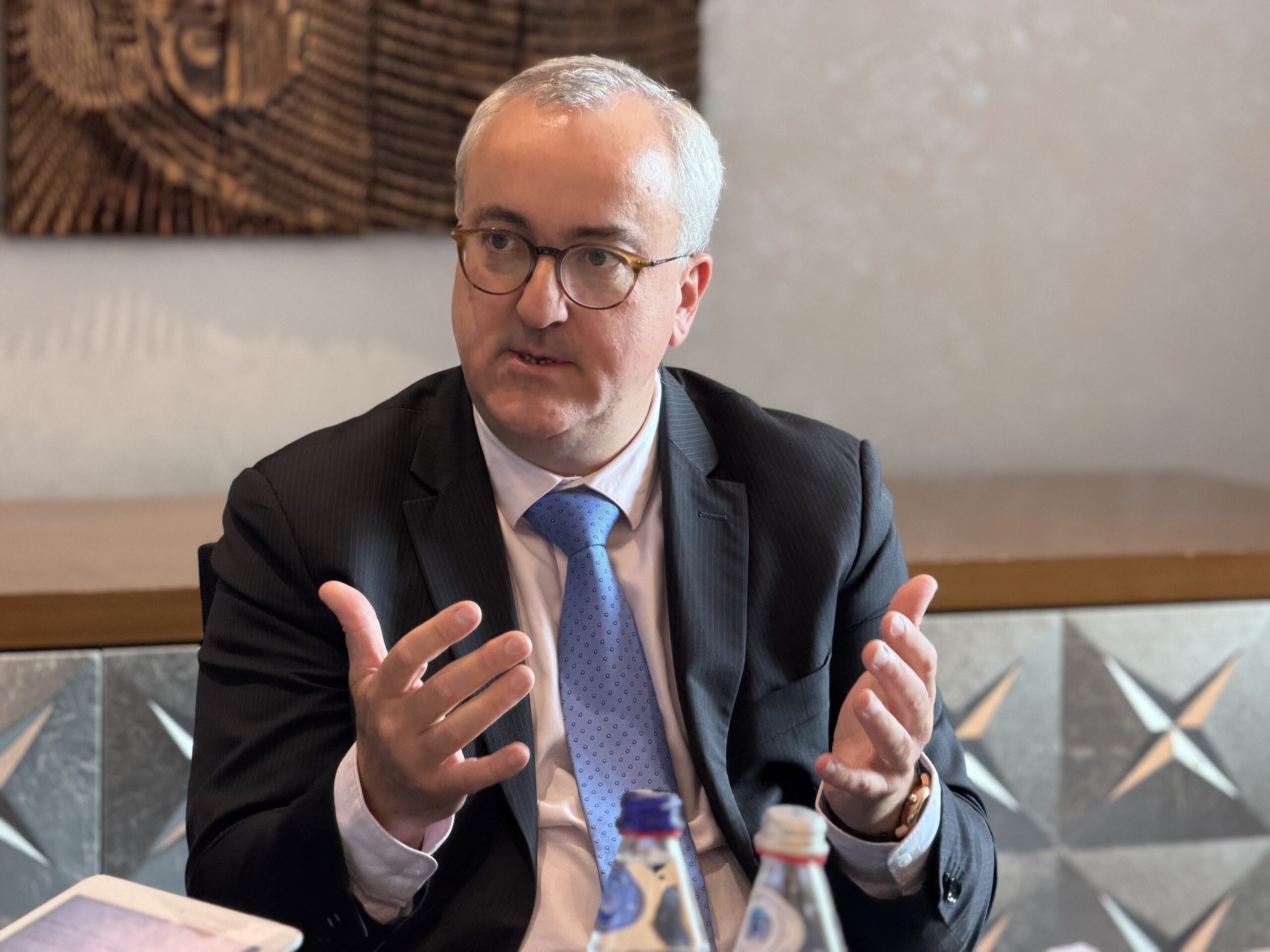
Martin Vaujour, President for Africa, Middle East and Central Asia at Alstom. Photo credit: The Astana Times/ Nargiz Raimbekova
A corridor whose time has come
For decades, maritime transport dominated trade flows between China and Europe. Yet recent geopolitical tensions and disruptions in global shipping have renewed attention on overland alternatives.
“In just a few words, more than 96% of the freight from China to Europe is going by sea. Only about 4% is going through rail,” said Vaujour.
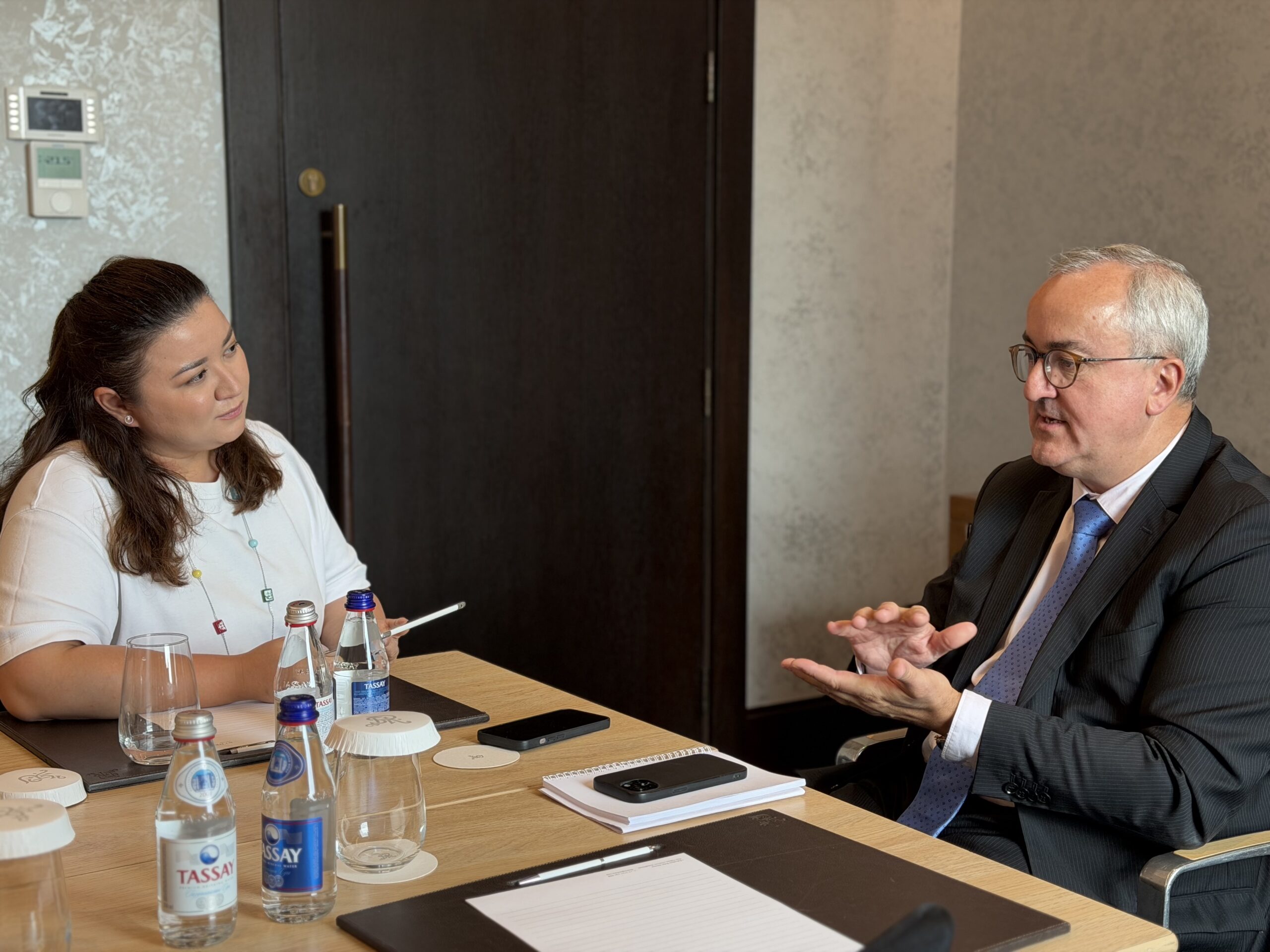
Vaujour told Aida Haidar that Kazakhstan was ahead of the curve in recognizing the Middle Corridor’s rising role in global trade. Photo credit: The Astana Times/ Nargiz Raimbekova
Historically, rail freight moved either through northern routes crossing Russia or through the Middle Corridor via Kazakhstan, the Caspian Sea, the South Caucasus and Türkiye. Today, however, changing geopolitical realities are altering the equation.
“The cost of freight by sea and the cost of insurance has increased dramatically. The time to get the goods from China to Europe is much longer because they have to go all the way around Africa. So the appetite for the rail solution through the Middle Corridor is multiplied,” he said.
What Vaujour finds particularly remarkable is that Kazakhstan anticipated this trend long before it became evident to many international observers.
“It is incredible to see the vision that the Kazakhstan government had already 15 or 20 years ago, saying we should be part of this and build a reliable solution for the Middle Corridor,” he said.
Today, that strategy is paying off. According to reporting by The Astana Times, cargo volumes along the Middle Corridor have surged in recent years, with transit traffic through Kazakhstan increasing severalfold since 2022 as shippers seek alternatives to traditional routes. Vaujour expects freight volumes moving through Kazakhstan to continue increasing as demand for the Middle Corridor grows, positioning the country at the center of one of Eurasia’s most important transport corridors.
Building the hardware of Eurasian connectivity
Alstom’s contribution to the corridor extends far beyond supplying locomotives. Still, rolling stock remains one of the most visible components of the partnership. The company has already manufactured more than 200 electric locomotives for Kazakhstan. Among them is the KZ8 freight locomotive, designed primarily for heavy cargo such as coal and iron ore. The next generation is already underway. In December 2025, Alstom signed a contract for 205 KZ6 electric locomotives. Unlike the KZ8, the new model is specifically designed for container transportation, precisely the type of freight expected to drive growth along the Middle Corridor.
“The KZ8 was more for big freight trains like iron ore and coal. KZ6 will be more for containers. Typically for the Middle Corridor,” said Vaujour.
Testing and certification are expected in 2028, with commercial operations beginning in 2029. The locomotive project comes at a time when Kazakhstan Temir Zholy (KTZ) is expanding its international footprint through logistics hubs, port infrastructure and more than 800 kilometers of new railway lines. But locomotives are only part of the picture. Another strategic area is signaling, the digital systems that manage railway traffic and ensure safety both on tracks and onboard trains. While signaling represents around 20% of Alstom’s global business, Kazakhstan is only now becoming a focus market.
“We have invested to homologate our solution. It is now ready and we hope to penetrate this market with KTZ,” Vaujour said.
Vaujour said Alstom hopes to expand its signaling business in Kazakhstan while developing local engineering expertise around the technology.
From Kazakhstan to the region
The partnership has evolved far beyond a traditional supplier-customer relationship. During President Kassym-Jomart Tokayev’s recent visit to Brussels, Alstom was recognized as a reliable and long-term partner of Kazakhstan. According to Vaujour, the relationship has become a model not only for Central Asia but globally.
“We see the partnership with Kazakhstan as really a role model, not only in the region but globally,” he said.
The figures illustrate the scale of Alstom’s commitment. The company has invested more than 200 million euros (US$228 million) in Kazakhstan, creating its largest industrial footprint in Central Asia and the Caucasus. It employs more than 1,300 people in the country, with 96% of its workforce being local.
“We have trained thousands of people along the way and we will continue to do so,” Vaujour said.
Increasingly, Kazakhstan is becoming more than a domestic production center. Alstom already uses its Kazakh operations to serve neighboring markets, including Azerbaijan and Ukraine, and hopes to expand further into Georgia. The company’s broader ambition is even more significant.
“Tomorrow and the day after tomorrow, I hope we can also support the European market with our efficient base in Kazakhstan,” said Vaujour.
According to him, local teams have reached levels of quality, competence and efficiency that position Kazakhstan as a potential export platform for wider regional and European markets.
AI moves from buzzword to railway operations
AI is already deeply embedded in daily operations of Alstom. According to Vaujour, one of the most mature applications is predictive maintenance, where algorithms monitor equipment performance and identify issues before failures occur. Through Alstom’s HealthHub platform, freight operations in Kazakhstan have been monitored since 2021, while passenger services joined the system in 2025. The results are substantial. More than 200 parameters are monitored in real time, generating over 2,000 predictive alerts. According to the company, these systems have helped prevent 130 operational incidents and enabled the development of 76 predictive algorithms in Kazakhstan.
Looking ahead, AI could also accelerate the design and validation of locomotives and signaling systems, reducing development cycles and improving efficiency. At the same time, digitalization brings new risks. One of the most pressing concerns for rail operators worldwide is cybersecurity. To address these threats, Alstom has developed cybersecurity solutions in partnership with major technology companies including Airbus and Cylus, integrating cyber resilience directly into railway systems and signaling infrastructure. In 2025, the company also opened a Signaling Competence Center in Astana to train Kazakh engineers and connect local expertise with Alstom’s global innovation network.
Building the next generation of leaders
Beyond locomotives, digitalization and infrastructure, Alstom is also focusing on another long-term investment in Kazakhstan: people. Ahead of the Foreign Investors Council, Vaujour met with a group of Alstom’s female employees in Kazakhstan, many of whom occupy middle-management positions and do not regularly interact with the company’s senior leadership. According to Boyet, the objective was straightforward — to listen.
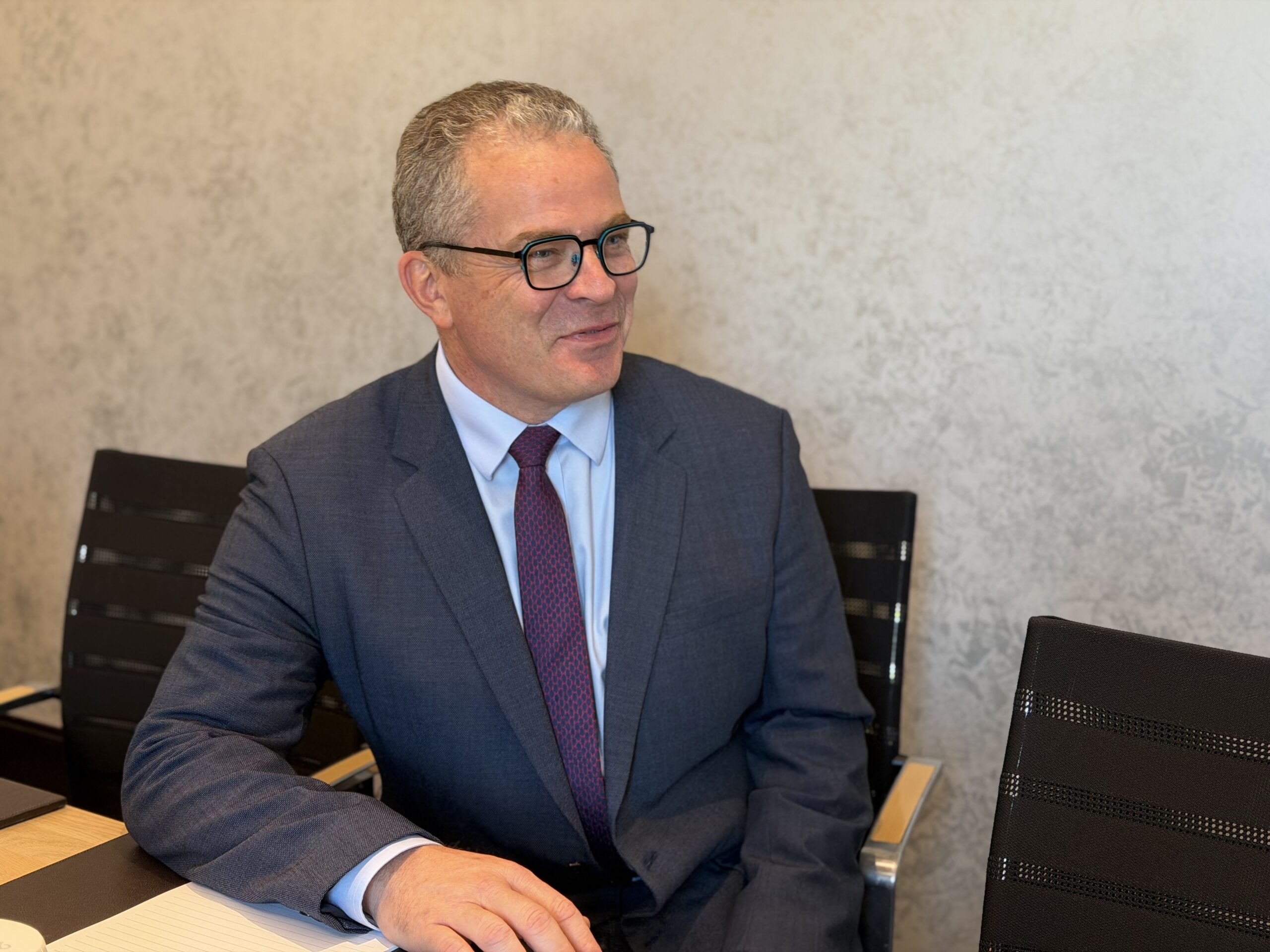
Jérôme Boyet, Managing Director for Western and Central Asia at Alstom. Photo credit: The Astana Times/ Nargiz Raimbekova
“It was intentionally what I would call middle management. People who are not on a regular basis meeting Martin. The point was really to help those women first have the contact and second be listening to them on why and how we can bring them up in the organization and make them stay,” he said.
The meeting also highlighted a challenge that extends well beyond Kazakhstan and affects the transportation industry globally: attracting and retaining women in a sector traditionally dominated by engineers and industrial professions.
“We have two challenges: the first challenge is that we lose a lot of women in our day-to-day activity because of life and because women’s lives are often not compatible with the work environment. The second challenge is that we are in a very industrial, very male-dominated, very engineer-dominated environment,” Boyet explained.
He noted that the issue begins long before recruitment, with women still underrepresented in engineering schools worldwide. As a result, Alstom has made diversity and inclusion programs a priority across its global operations.
“This is not specific to Kazakhstan. This is a challenge we have everywhere,” he said.
One example the company frequently highlights is its managing director in the United Arab Emirates, who leads operations in another traditionally male-dominated environment.
“We need to demonstrate to our local Kazakh women that you can be at the regional head and be a woman as well,” Boyet said.
For Vaujour, one of the key takeaways from the meeting was the persistence of self-imposed barriers.
“The general feeling was that they don’t dare. They think they are limited. Two of the ladies said, ‘I cannot do.’ Why? I said, ‘Just do it,’” he said.
The company’s goal, he added, is not simply to increase representation but to encourage talented employees to pursue leadership positions, gain international experience and eventually shape the organization’s future.
Decarbonization and the future of rail
Rail transportation is increasingly viewed as a critical tool in global decarbonization efforts. According to Vaujour, transportation accounts for roughly 25-27% of global carbon emissions, making it one of the largest sources of greenhouse gases worldwide.
“Mobility is one of the biggest CO2 emission sectors in the world globally and probably the one which has made the least progress over the last five to ten years,” he said.
Alstom focuses exclusively on electric traction systems, which offer significant environmental advantages compared to road and air transport. However, as both executives noted, the environmental impact ultimately depends on how electricity itself is generated. Kazakhstan still relies heavily on coal-powered electricity, but even under these conditions, electric rail already delivers meaningful emissions reductions. Boyet provided a striking comparison.
“To move one ton over one kilometer in the Kazakh context, we are at eight grams of CO2 emissions with electric rail. With a diesel locomotive, we are at 20 grams. With a truck, we are at 100 grams,” he said.
At the same time, Kazakhstan is expanding renewable energy generation through solar and wind projects while pursuing plans for nuclear power development. As freight volumes along the Middle Corridor continue to increase, both executives believe that the electrification of additional railway lines is the natural next step.
