
ASTANA — Kazakhstan has approved a comprehensive two-year plan to preserve and promote its cultural heritage under the auspices of the United Nations Educational, Scientific and Cultural Organization (UNESCO) and the Islamic World Educational, Scientific and Cultural Organization (ISESCO), the Prime Minister’s press service reported on March 31.
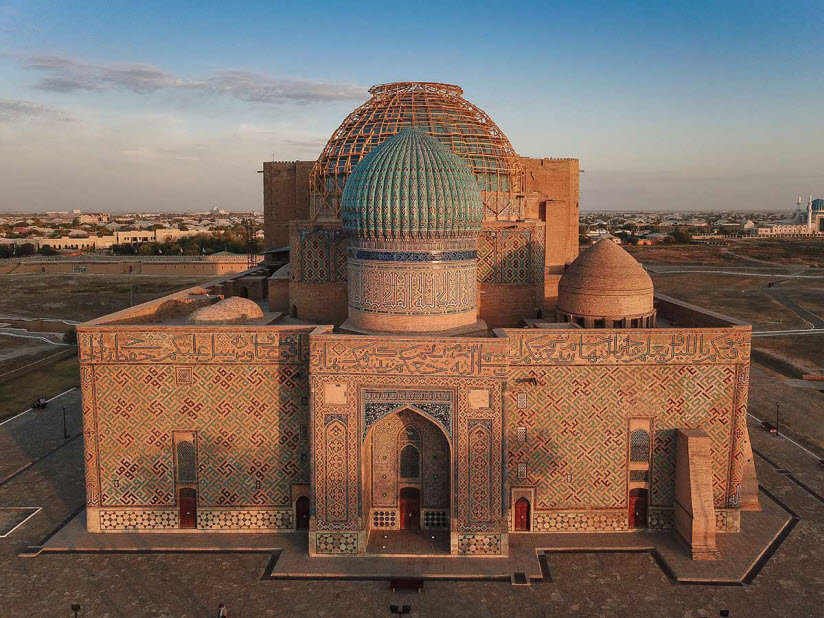
The Khoja Ahmed Yasawi mausoleum. Photo credit: Kazakhtourism
The resolution, signed by Prime Minister Olzhas Bektenov, sets out concrete measures to safeguard historical and cultural monuments, support intangible heritage, train specialists and expand Kazakhstan’s participation in international initiatives.
The plan prioritizes improving the protection of World Heritage sites, promoting Kazakhstan’s cultural assets globally, strengthening expert and educational capacity, and increasing public engagement in heritage preservation.
It is structured around three key areas: preserving and promoting tangible cultural heritage, supporting the intangible cultural traditions of the Kazakh people, and advancing UNESCO’s Memory of the World program.
The officials plan to introduce systematic monitoring of internationally significant sites, develop methodological guidelines for managing UNESCO World Heritage properties, and expand Kazakhstan’s tentative list of cultural sites for future nominations.
International cooperation is another central component. Kazakhstan will hold interagency and expert consultations on a potential nomination of the Silk Roads: Caspian–Volga Corridor and continue work on the multinational nomination of Alpamysh Batyr, with Azerbaijan, Türkiye, Uzbekistan and Turkmenistan, for inclusion in UNESCO’s Representative List of the Intangible Cultural Heritage of Humanity.
The government also aims to join ICCROM (International Centre for the Study of the Preservation and Restoration of Cultural Property), a move expected to strengthen professional collaboration and introduce modern conservation practices.
Capacity building is a major focus. At least 30 experts will receive annual training under the UNESCO Convention for the Safeguarding of Intangible Cultural Heritage. The International Educational Corporation will also develop conceptual and design projects for monument preservation as part of undergraduate and graduate programs. Special attention will be given to endangered traditions, including the construction and decoration of the Kazakh yurt, traditional carpet weaving and terme, a traditional Kazakh oral poetic and musical genre, in several regions.
Kazakhstan is currently represented in UNESCO’s Memory of the World International Register by four documentary heritage items, said Kümis Seitova, director of the National Academic Library, in comments to Kazinform. These include materials related to Khoja Ahmed Yasawi, the Nevada–Semipalatinsk anti-nuclear movement, documentary heritage linked to the Aral Sea and Khandar Shezhire, which was inscribed last year.
New nominations have been submitted to the international register, including documentary heritage related to the works of Abai Kunanbayev and materials on the first Kazakh opera, Kyz Zhibek. Kazakhstan is also participating in UNESCO’s regional register for Central Asia and the Asia-Pacific, with submissions including runic inscriptions on the Issyk bowl and documents related to Mashhur Zhusup Kopeyev.
In 2025, Kazakhstan approved its first national Memory of the World register, which currently includes 79 items and is expected to expand to 500, according to Seitova, out of roughly 6,000 documentary heritage objects nationwide.
Future UNESCO nominations will be drawn from this national list. Under UNESCO rules, each country may submit one nomination to the international and regional registers every two years. The results of regional applications are expected in the first half of 2026, while international submissions will be reviewed the following year.
Kazakhstan is currently home to six UNESCO World Heritage Sites, including the Mausoleum of Khoja Ahmed Yasawi, the Petroglyphs of Tamgaly, and transnational properties such as the Silk Roads: Chang’an–Tianshan Corridor and the Western Tien-Shan. The government increasingly views UNESCO recognition not only as a preservation tool, but also as a strategic lever to boost tourism and elevate the country’s cultural profile globally.
