
ASTANA — The unprecedented gathering of the leaders of the United States (U.S.), China and Russia projected an image of great-power diplomacy. The image was striking: Donald Trump, Xi Jinping and Vladimir Putin sitting at the same table in China, the leaders of the world’s three biggest nuclear powers convening in an unprecedented trilateral meeting. The summit in Shenzhen on Nov. 19, held on the sidelines of the Asia-Pacific Economic Cooperation (APEC) meetings, carried unmistakable symbolism and inevitably revived comparisons to the Yalta Conference of 1945, when Allied leaders discussed the postwar order.
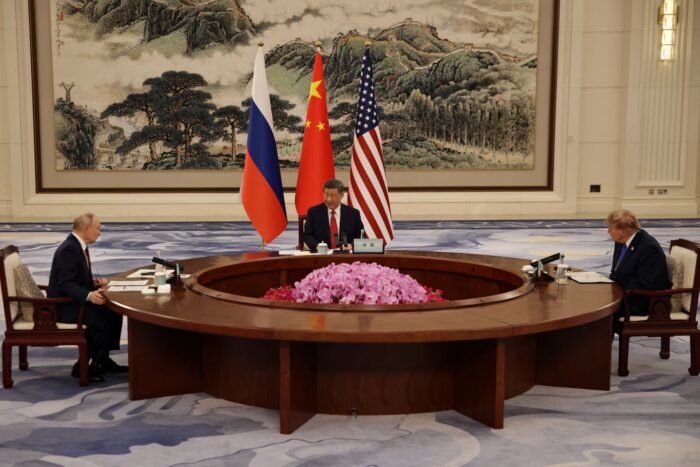
China’s President Xi Jinping (C), US President Donald Trump (R) and Russia’s President Vladimir Putin (L) hold a trilateral meeting on the sidelines of the Asia-Pacific Economic Cooperation (APEC) China Summit in Shenzhen, Guangdong province, China, 19 November 2026. ANDRES MARTINEZ CASARES/Pool via REUTERS
Trump declared they were “really making history,” while Xi spoke of peace when major powers live in harmony. Yet the summit produced little concrete progress on the conflicts and disagreements that brought the leaders together. The three issued a symbolic declaration reaffirming that nuclear war must never be fought and agreed to pursue dialogue on reducing nuclear risks, but announced no arms-control negotiations or breakthroughs on Ukraine, Iran, trade or other major disputes. The spectacle was historic. Its substance was considerably more modest.
The distinction matters for Central Asia, a region positioned between Russia and China, increasingly connected to global trade routes, and working to maintain relationships with the U.S., Europe and other partners. If the meeting offered a glimpse of a world managed by its biggest powers, did it signal a shift in the international system or simply demonstrate how difficult it remains for them to agree? For Kazakhstan and its neighbors, the answer may lie less in what the three leaders agreed on than in what their meeting reveals about the limits and opportunities of great-power politics.
No new geopolitical bargain
Temur Umarov, a fellow at the Carnegie Russia Eurasia Center whose research focuses on Central Asian foreign and domestic policies and China’s relations with Russia and the region, sees little evidence that the summit represents a fundamental geopolitical shift.

For countries like Kazakhstan or other Central Asian countries, it doesn’t necessarily mean that it’s a bad period. It actually provides a lot of ground for maneuver, Umarov said.
“I don’t think that we’re living in times of major geopolitical shift. I don’t think that this trilateral summit has started a new chapter in the history of global politics,” Umarov said in a comment to The Astana Times.
Rather than a breakthrough, he sees the gathering as largely symbolic, with its limited outcomes reflecting the current state of international relations. He said that the fact that the leaders could agree only on broad, formal principles speaks to how difficult it is to reconcile their competing interests.
The summit was always unlikely to produce a major agreement, Umarov said, given the state of international politics and the differences among the three powers.
But he cautioned against interpreting this uncertainty as necessarily negative for countries caught between competing powers.
“For countries like Kazakhstan or other Central Asian countries, or other regions that are in between these countries that are in rivalry or in confrontation, it doesn’t necessarily mean that it’s a bad period or dark times. It actually provides a lot of ground for maneuver,” Umarov said.
That space, he noted, can open opportunities for deeper cooperation with different partners: provided regional governments can translate the attention they receive into tangible benefits.
Central Asian governments, accustomed to navigating competing interests, have become adept at multilateral diplomacy. The region’s growing international visibility is no accident, Umarov said, as countries seek to turn current geopolitical momentum into something more concrete. The challenge, however, is to convert diplomatic access into economic partnerships, investment, connectivity and political leverage, rather than simply enjoy a moment in the global spotlight.
The danger of being placed on someone else’s map
Ken Moriyasu, a senior fellow at the Hudson Institute focusing on Greater Asia, takes a more cautionary view of what a great-power arrangement could mean for countries across Eurasia. Moriyasu notes that Washington should be careful about institutionalizing a trilateral format with Beijing and Moscow, warning that the U.S. could find itself negotiating from a structurally disadvantaged position.
“I do not believe President Donald Trump went to China to divide the world into spheres of influence with Xi Jinping and Vladimir Putin,” Moriyasu said in a comment to The Astana Times.

Moriyasu identifies Kazakhstan, Uzbekistan, Azerbaijan among strategically positioned countries whose interests include preserving their autonomy.
He believes Trump was pursuing specific objectives, including nuclear arms reductions, and hoping for a diplomatic breakthrough. But the underlying problem, Moriyasu said, is that China and Russia share a strategic interest in challenging U.S. global leadership, potentially putting Washington in a two-against-one position.
Instead, he advocates elevating the Board of Peace as a diplomatic platform where the U.S. could work with countries that seek greater engagement with Washington while maintaining independence amid great-power competition. He identifies Kazakhstan, Uzbekistan, Azerbaijan, Armenia, Türkiye, Pakistan, Mongolia and Hungary among strategically positioned countries whose interests include preserving their autonomy.
His argument carries a warning for Kazakhstan and the wider region: a world organized around spheres of influence could narrow the space for independent foreign policy. In such a scenario, Kazakhstan could risk being viewed through the prism of Russia’s traditional influence or China’s expanding continental reach, rather than as a sovereign actor pursuing its own priorities.
That is precisely the outcome Astana’s balanced and constructive diplomacy is designed to avoid.
