
ASTANA — Washington’s new campaign to isolate Iran is putting Central Asia’s growing trade and transport links with Tehran under pressure. The dilemma was underscored in September, when the first 55-container train carrying Chinese goods was dispatched toward Iran through Kazakhstan, Uzbekistan and Turkmenistan, highlighting the commercial potential of a route increasingly exposed to sanctions risks.
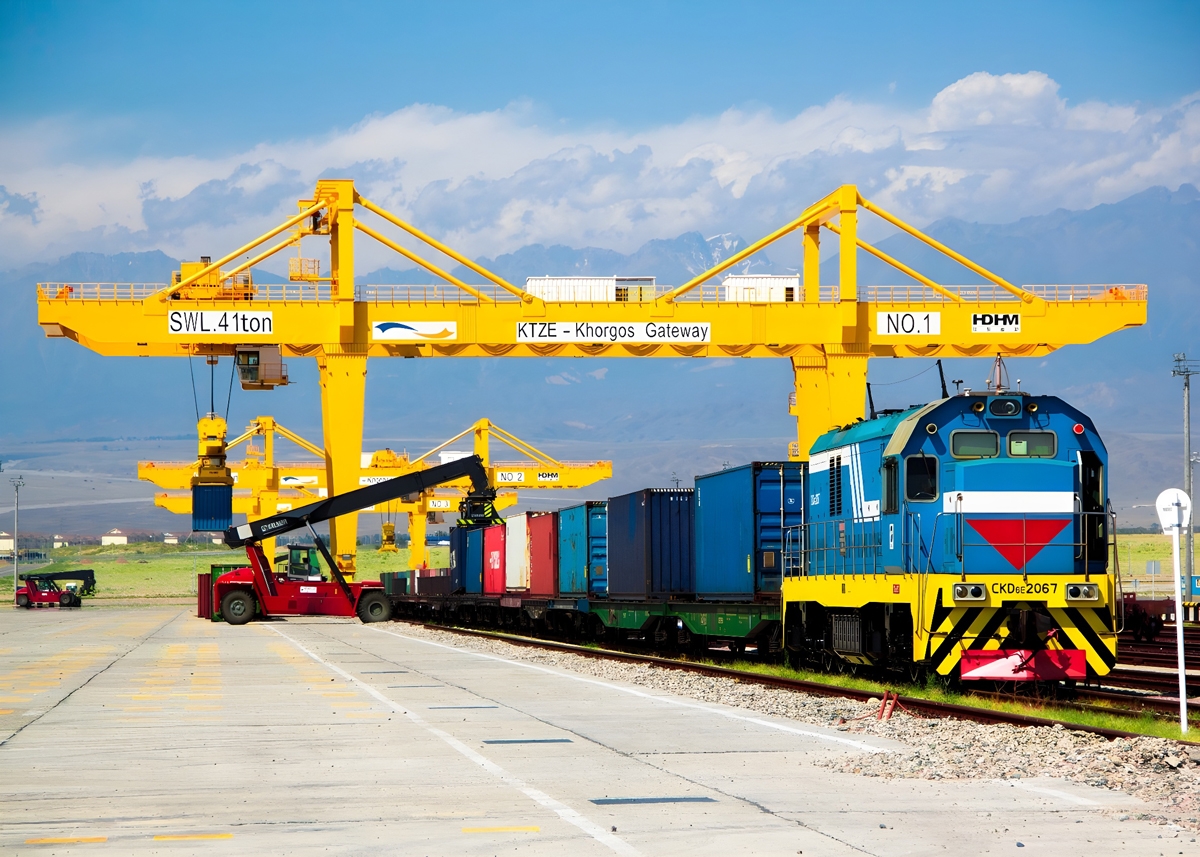
Photo: gov.kz
On Aug. 24, the United States (U.S.) Department of the Treasury launched Operation Economic Outcast at President Donald Trump’s direction, targeting Iran’s financial networks and economic partners. As the campaign expands, Central Asian governments and businesses face a difficult question: how to preserve access to strategically important trade routes without jeopardizing their financial and commercial ties with the United States.
The campaign soon acquired a broader diplomatic dimension. On Sept. 2, Axios reported that Secretary of State Marco Rubio had instructed U.S. embassies to deliver diplomatic démarches to host governments, demanding that they “immediately and systematically” sever trade relations with Iran. According to U.S. officials cited by Axios, special instructions were sent to several Central Asian capitals, including demands to close branches of Iranian Bank Melli and Bank Saderat, which Washington links to the Islamic Revolutionary Guard Corps (IRGC).
The U.S. Treasury also warned that entities facilitating financial transactions or sanctions evasion on behalf of Iran could lose access to the U.S. financial system. On Oct. 1, Washington expanded the campaign to Iran’s automotive and railway sectors, authorizing sanctions against individuals and entities operating in those industries. The move is particularly significant for regional connectivity, as rail transport has become an increasingly important part of Iran’s efforts to maintain economic links with neighboring countries.
Although these measures do not automatically prohibit every shipment transiting Iranian territory, they increase the potential exposure of foreign banks, insurers, logistics companies and other businesses dealing with Iranian entities.
Why Iran matters to Central Asia
For Central Asian countries, Iran is more than a neighboring trading partner. It provides landlocked economies with access to the Persian Gulf and the Gulf of Oman through ports such as Bandar Abbas and Chabahar, opening alternative routes to international markets. Iran’s interest in Central Asia is equally strategic. Tehran views the region as a gateway to the markets of China and Russia and an opportunity to ease its long-standing economic and diplomatic isolation. Developing transport links, including the North-South corridor and the Kazakhstan-Turkmenistan-Iran railway, has become an important part of this strategy.
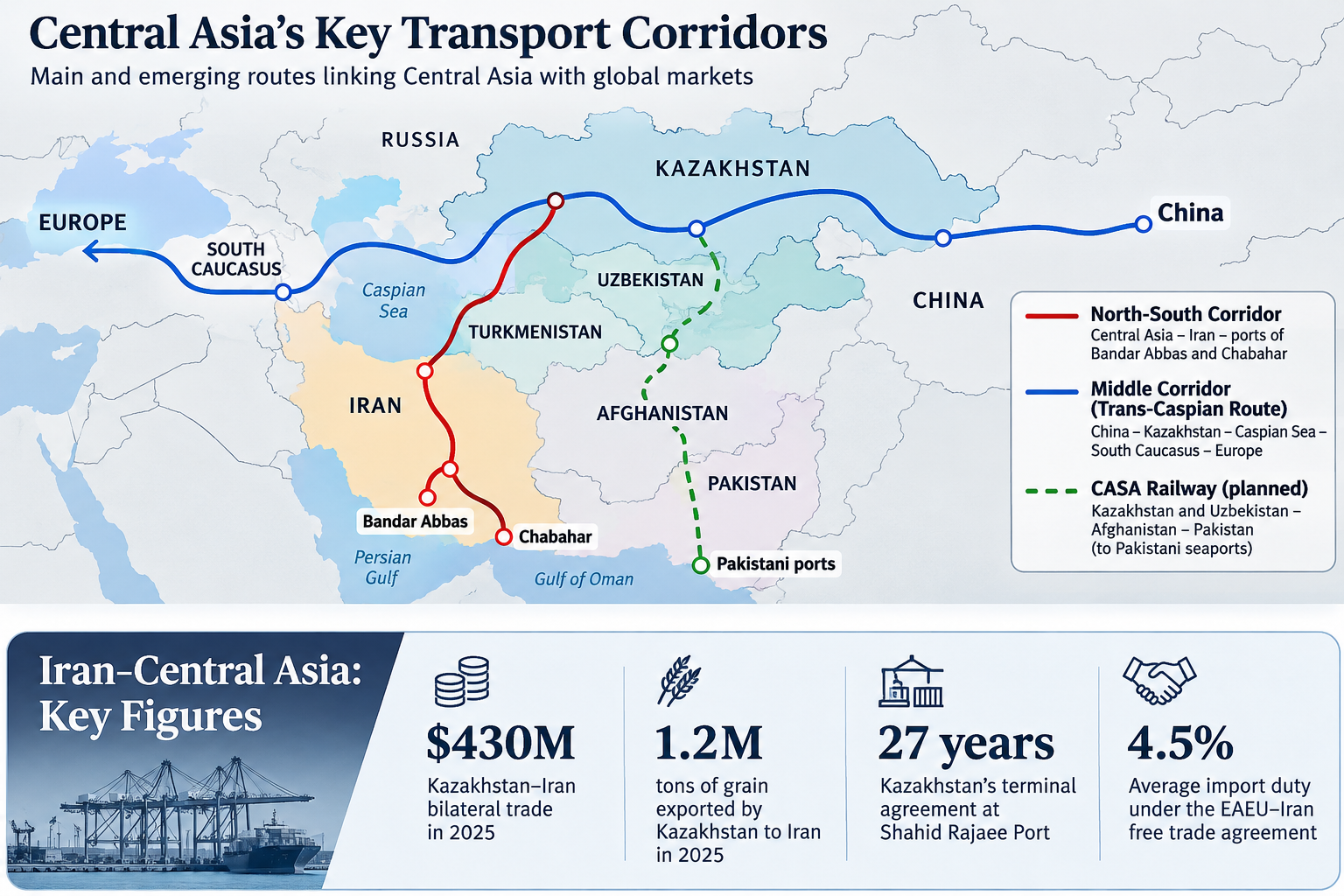
Infographic generated by The Astana Times using AI, based on information in this article.
Kazakhstan has been particularly active in developing this southern direction. On June 28, Kazakhstan and Iran signed a 27-year Build-Operate-Transfer agreement for a Kazakh transport and logistics terminal at Shahid Rajaee Port in Bandar Abbas. The agreement includes a two-year construction period followed by 25 years of operation, with commercial operations expected to begin in the third year. The project is part of Kazakhstan’s efforts to strengthen the International North-South Transport Corridor and diversify export routes beyond traditional connections through Russia and China.
Trade figures also illustrate the economic importance of the Iranian market. According to Kazakhstan’s Ministry of National Economy, freight transportation along the North-South corridor increased 12% in 2025, reaching 3.5 million tons. Trade turnover between Kazakhstan and Iran grew 26.4% to $430.2 million over the same period.
Tehran sees Central Asia as a long-term strategic partner
For Tehran, strengthening these connections is part of a longer-term strategic orientation toward Eurasia, not simply a response to Western sanctions. Mohammad Hossein Masoumzadeh, senior researcher at the Governance & Policy Think Tank (GPTT) in Tehran, described Iran’s engagement with Central Asia as a strategic priority rather than a temporary adjustment to geopolitical pressure.

Mohammad Hossein Masoumzadeh, senior researcher at the Governance & Policy Think Tank (GPTT).Photo credit: Personal archive
“Iran’s approach toward Central Asia is not merely a tactical or temporary reaction to the intensification of Western sanctions; rather, it is part of a fundamental, strategic, and long-term pivot toward Eurasia and a neighborhood-first policy,” he said.
Masoumzadeh highlighted railway connections through the Sarakhs and Incheh Borun border crossings, which link Iran with Central Asian railway networks. Although the countries use different railway gauges, specialized bogie-exchange facilities at border terminals help facilitate cargo movement between networks.
He also pointed to the potential of maritime connections across the Caspian Sea. Iran’s northern ports, including Amirabad and Anzali, and Kazakhstan’s ports of Aktau and Kuryk could form part of a multimodal transport network connecting Central Asian economies with Iran’s southern ports and international shipping routes. The new China-Iran railway connection is another example of this growing connectivity. Masoumzadeh described the September shipment as a significant step toward developing alternative Eurasian trade routes.
“The launch of the container train from China to Iran passing through Kazakhstan, Uzbekistan, and Turkmenistan is a tangible manifestation of the revival of the New Silk Road,” he said.
He added that the route “certainly has the potential to become a regular and commercially viable trade corridor.”
Its main advantages, according to Masoumzadeh, include shorter transit times compared with traditional maritime routes, as well as an alternative to international waterways facing geopolitical tensions and rising insurance and shipping costs. However, he acknowledged that the threat of U.S. secondary sanctions poses a serious challenge for private businesses and logistics companies in transit countries.
“The experience of recent years has shown that when tangible economic interests and the political will of governments are aligned, innovative solutions emerge to manage these risks,” he said.
To maintain regional participation, Masoumzadeh proposed independent financial and banking mechanisms, including settlements in national currencies, barter systems and regional clearinghouses. He also highlighted the potential of joint regional transport companies and logistics consortiums to distribute commercial risks among participating countries.
Harmonizing customs tariffs, digitalizing border processes and removing infrastructure bottlenecks would also be essential to making the corridor commercially competitive. However, alternative payment arrangements cannot automatically shield companies from U.S. sanctions. Transactions involving designated entities or targeted sectors may still carry risks regardless of the currency used.
Secondary sanctions could reshape regional calculations
Pressure on Iran could have consequences well beyond its borders, particularly for countries that have invested in transport routes through Iranian territory. Dr. Dania Arayssi, assistant director of the New Lines Institute for Strategy and Policy, said Operation Economic Outcast was making commercial engagement with Iran considerably riskier for Central Asian countries.

Arayssi said Operation Economic Outcast was making commercial engagement with Iran considerably riskier for Central Asian countries.
photo credit: New Lines Institute for Strategy and Policy website
The pressure comes as Kazakhstan and Uzbekistan have been expanding their economic and transport links with Tehran. Banks and major companies are likely to reduce their exposure to Iran to protect access to the dollar-based financial system, while governments may seek to avoid an open rupture in relations with Tehran.
Arayssi said the campaign could fundamentally reshape Central Asia’s long-standing multi-vector foreign policy, forcing regional governments to make more difficult geopolitical choices. She also identified Uzbekistan as particularly exposed because it relies on Iranian transit routes. According to her estimate, around 60% of Uzbekistan’s transit to European and Turkish markets passes through Iran.
“Washington’s pressure does undermine the region’s connectivity plans, because an alternative corridor can itself become a source of geopolitical risk,” she said.
At the same time, Arayssi noted that Central Asian countries cannot simply abandon Iranian routes because they offer access to ports on the Persian Gulf and the Gulf of Oman. She expects Kazakhstan and Uzbekistan to pursue a cautious balancing strategy rather than immediately terminate their economic projects with Iran.
“They’ll keep Iran projects alive on paper and show the U.S. they are complying through tighter banking checks,” she said, adding that governments could also seek exemptions from Washington while investing more heavily in alternative routes, including the Middle Corridor across the Caspian Sea and the Trans-Afghan railway.
Alternative routes offer options, but not immediate replacements
The Middle Corridor, officially known as the Trans-Caspian International Transport Route, connects China and Central Asia with the South Caucasus and Europe through the Caspian Sea. Its growing importance reflects the region’s efforts to diversify trade routes and reduce dependence on traditional transport networks. According to the Organization for Economic Cooperation and Development (OECD), cargo volumes along the corridor increased 62% in 2024 to reach 4.5 million tons. However, infrastructure constraints, port capacity, vessel availability and coordination between countries continue to affect its competitiveness.
Another potential alternative is the Central Asia-South Asia (CASA) railway project, which would connect Kazakhstan and Uzbekistan with Afghanistan and Pakistan, providing access to Pakistani seaports. On Oct. 1, Kazakhstan, Uzbekistan and the United Arab Emirates signed a memorandum of understanding to explore the project. The parties plan to conduct technical and economic studies and assess the feasibility of the required railway infrastructure. The initiative remains at the planning stage. Both routes could expand Central Asia’s access to international markets, but they cannot immediately replace the commercial and geographical advantages offered by Iranian ports.
For Kazakhstan, Uzbekistan and Turkmenistan, the challenge is therefore not simply whether to maintain trade with Iran, but how to preserve access to strategically important markets and ports while limiting their companies’ and financial institutions’ exposure to measures that could affect their broader international economic relationships. How successfully regional governments navigate the expanding reach of economic sanctions will be an important factor in determining the future of these connectivity plans.
