
ASTANA – Kazakhstan attracted most of Central Asia’s announced cross-border research and development (R&D) and high-tech investment projects in 2025. Yet the region accounted for just 0.4% of the global total, highlighting the distance between its growing ambitions in technology and its relatively limited role in international innovation networks.

Photo credit: Shutterstock
The figures also point to a broader challenge for Kazakhstan: attracting foreign companies and increasing research expenditure are important steps, but they do not automatically translate into domestic technological development.
According to the World Intellectual Property Organization (WIPO), companies announced 5,970 greenfield R&D and high-tech investment projects outside their home economies in 2025. These included plans to establish research laboratories, design and testing centers, semiconductor and pharmaceutical plants, and software and IT operations. The projects represented approximately one-third of all greenfield investment projects announced worldwide.
Investment was concentrated in a relatively small number of destinations. The 10 leading economies attracted 58% of the projects, with the United States, India and the United Arab Emirates among the largest recipients.
Central Asia remained on the periphery of these flows. Kazakhstan attracted 18 announced projects with planned investment of $3.4 billion, according to the figures cited in the regional breakdown. Uzbekistan received five projects worth $410 million, while Tajikistan recorded one project worth $260 million. The dataset recorded no projects for Kyrgyzstan.
Together, the four countries accounted for 24 projects, or approximately 0.4% of the global total. Kazakhstan represented 75% of the region’s project count and 84% of its announced investment value.
From attracting investment to building an innovation ecosystem
WIPO places Kazakhstan and Uzbekistan in the “nascent investors” category in its classification of economies based on inbound and outbound R&D and high-tech investment announcements.
The framework distinguishes four groups: global investment hubs, which are active in both attracting and sending projects abroad; investment magnets, which receive more projects than their companies announce overseas; outward investment leaders, whose companies invest more abroad than they receive at home; and nascent investors, which remain below the world average in both directions.
The classification suggests that Kazakhstan has yet to become a significant participant in international networks of research and high-tech production. Its position as Central Asia’s largest recipient does not necessarily mean that its domestic companies are developing a comparable presence abroad or that the country has established a strong innovation ecosystem.
Several projects announced in Kazakhstan in 2025 illustrate efforts to attract investment in technology-related sectors. These include Chinese company SUTO Kazakhstan’s plans to produce chips and electronic components in Semei, Yesil Technology’s proposed industrial drone production facility and research center in Astana, and Indian MSN Group’s plans for pharmaceutical manufacturing.
Singapore-based GK Hyperscale also announced plans to build two data centers, with a stated investment of $1.5 billion. However, the inclusion of these individual projects in WIPO’s dataset should be confirmed against the underlying FDI Markets database. Not every project described as high-tech or technologically advanced necessarily falls within the indicator’s methodology.
Research spending is rising, but commercial results remain limited
Kazakhstan’s ability to benefit from high-tech investment also depends on the strength of its domestic research base.
According to the Bureau of National Statistics, expenditure on research and development reached 261.4 billion tenge (US$588.8 million) in 2025, increasing 19% from the previous year. Engineering and technology accounted for 86.3 billion tenge (US$194.4 million), while natural sciences received 85.2 billion tenge (US$191.9 million). Nearly 28,300 people were engaged in research and development, and 434 organizations conducted research activities.
However, higher spending in monetary terms does not necessarily mean that research is becoming a larger part of the economy. The Supreme Audit Chamber reported that science expenditure accounted for approximately 0.16% of GDP in 2025, remaining well below the 1% benchmark cited in its findings.
The audit also raised questions about how effectively public funding translates into commercial outcomes. Of 141 completed projects examined, only 38, or 27%, generated consistent sales over a three-year period. Another 103 failed to achieve their planned production or sales targets.
The structure of science funding presents another challenge. The government’s share increased from 55% in 2022 to 82% in 2025, while auditors cited weak business demand for domestic research as one reason for limited private-sector participation.
The gap between scientific potential and commercial application
The Global Innovation Index (GII) 2026 provides another perspective on the country’s innovation performance. Kazakhstan improved its overall position from 81st to 73rd among 139 economies. However, its results remain uneven across different indicators.
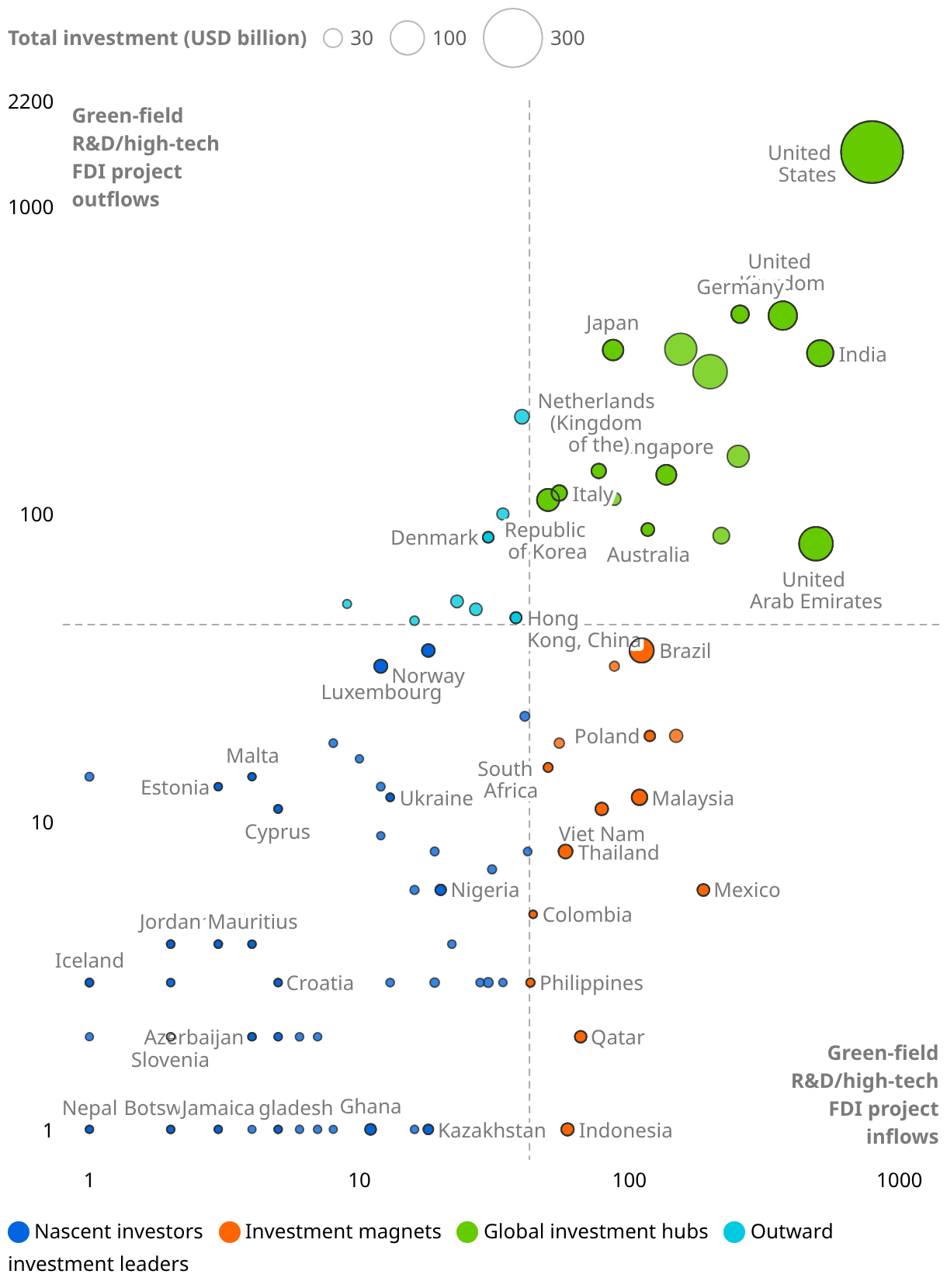
Bubble size is proportional to total announced capital investment (USD billion). Both axes are on a logarithmic scale. Dashed lines mark the average number of inbound and outbound project announcements across the 139 GII economies. Economies above both means are global investment hubs; those above the mean on inflows only are investment magnets; on outflows only, outward investment leaders; below both, nascent investors. Source: WIPO, Global Innovation Index 2026, based on FT Locations, fDi Markets.
The country ranked 27th in the share of high-tech exports, but 108th in university-industry R&D collaboration. This contrast points to a gap between participation in high-tech trade and the strength of domestic links between scientific institutions and businesses.
Making foreign investment work for the domestic economy
Yernar Serik, an analyst specializing in trade and investment policy and author of the Telegram channel TradeReport, noted that investment quality matters as much as its volume.
“The main question for Central Asia is not only how much investment it attracts, but also the quality of that investment. We are accustomed to measuring investment policy in billions of dollars and the number of agreements signed. However, the technological impact is determined by how much new expertise, research, engineering development and production chains remain within the country. Otherwise, even large-scale investment may do little to change the technological structure of the economy,” he wrote on his Telegram channel.
The new WIPO indicator provides a useful way to assess where companies intend to establish innovation-related capacity and which economies are becoming more integrated into these networks. It also highlights the difference between attracting investment and becoming a source of international investment oneself.
