
ASTANA — Kazakhstan must build a digital economy, President Kassym-Jomart Tokayev said in his state-of-the-nation address on Oct. 28, calling for broader use of AI in industry and agriculture, modernized geological exploration and a shift from digital consumption to technology-driven production.
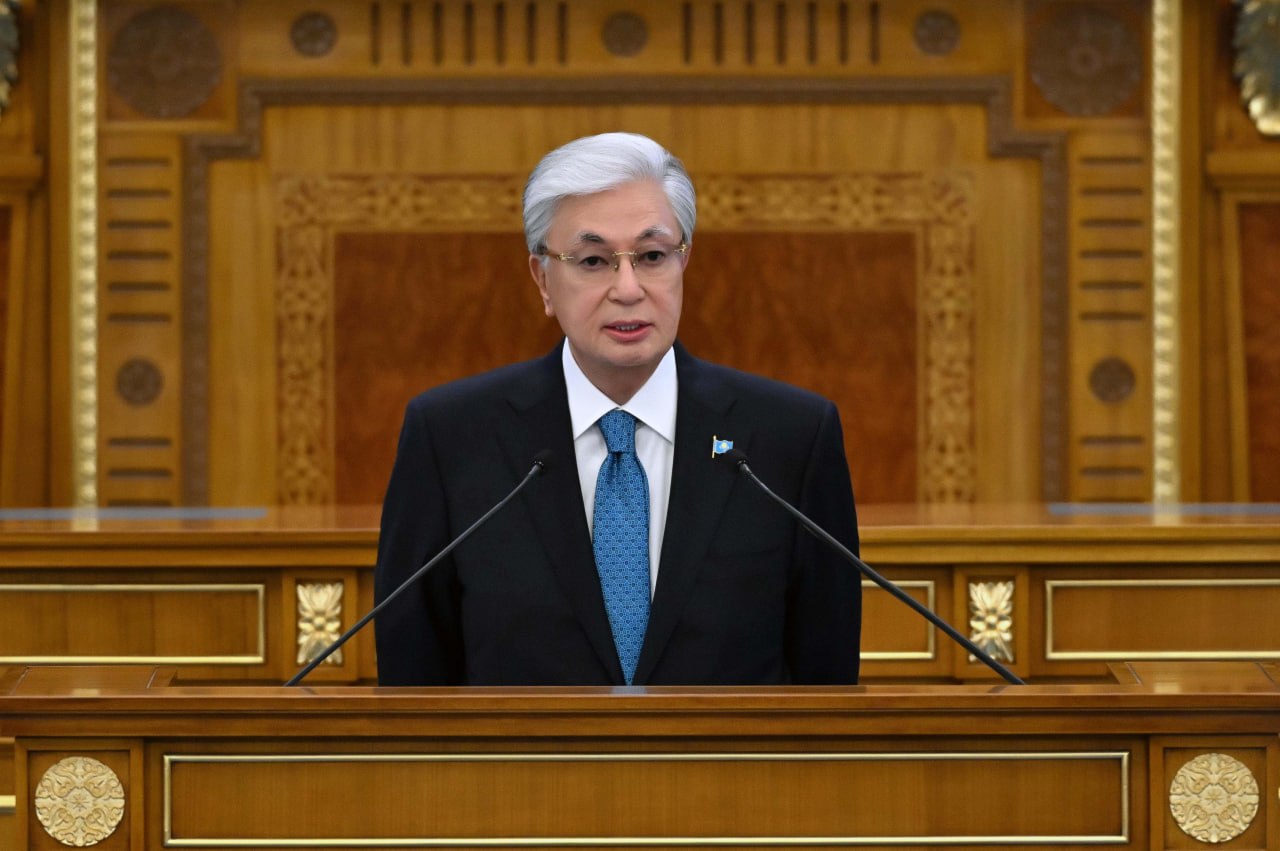
Photo credit: Akorda.
Tokayev said Kazakhstan had begun building infrastructure for its Digital Qazaqstan strategy, including launching two supercomputers, preparing to commission a third by the end of the year, and laying a fiber-optic trunk line across the Caspian Sea. Data centers are also under construction.
However, he acknowledged that the country still had to demonstrate results in digitalization, with the process sometimes reduced to automating existing procedures or purchasing expensive software without a clear understanding of its practical benefits.
“We must be realistic in assessing our capabilities and use the best that new technologies can offer for the well-being of our people,” Tokayev said.
He said Kazakhstan had only begun commercializing AI, asset tokenization, blockchain technologies and digital platform ecosystems. The government must develop a program to apply digital technologies across the economy.
“Our goal is to build a truly people-centered digital economy,” Tokayev said.
From digital consumption to digital work
Tokayev called for a shift in how people use digital technologies, noting that internet access should enable economic activity and employment rather than serve primarily as a space for consumption and entertainment.
“In public consciousness, the internet should be perceived not only as a space for consumption and entertainment, but also as a virtual territory for creation and work,” he said.
He said smartphones should become effective working tools rather than expensive distractions. The government is expected to establish a simplified legal regime for digital employment by the end of the year. Tokayev also stressed that access to digital opportunities should not depend on where people live.
“Our citizens, whether living in rural areas or cities, must learn to use smartphones as tools for earning a legitimate income,” he said.
To support this goal, the government should combine existing state business support measures with the capabilities of private marketplaces, banks, logistics companies and digital services. Beyond loans and subsidies, entrepreneurs need additional digital tools to produce and sell goods.
Next year, the government and the business community should launch pilot digital development projects in several regions to help rural producers market their products, with successful practices subsequently expanded nationwide. Tokayev also called for fully realizing the potential of asset tokenization, or transferring assets into the digital environment.
AI and the next phase of industrial development
Tokayev linked digital transformation to a broader push for industrial and technological development, including the modernization of geological exploration and the management of critical minerals. He said Kazakhstan needed to fundamentally change its approach to geological exploration, saying that outdated methods would not deliver the desired results.
“Today, we must recognize geology as a high-tech industry. It is extremely important for us to comprehensively study the country’s subsoil using advanced technologies and ensure transparency and accessibility of data. We should actively attract private investment in the search for and exploration of new deposits,” Tokayev said.
He called for a national system to manage critical metal reserves, supported by mechanisms for long-term financing of mining projects. The government should also consider off-take contracts to guarantee demand for products made by domestic enterprises in the sector.
Tokayev said Kazakhstan should consider establishing a national stockpile of nonferrous and rare earth metals and integrate the country into global production chains. He called on the government to build strategic partnerships with developed countries in this field.
At the same time, he warned against uncoordinated industrial investment that could create unnecessary competition for existing domestic producers. Tokayev cited Qarmet, an operating metallurgical enterprise, and plans to establish similar facilities in three other regions as an example, questioning whether the market would be able to absorb their output.
He said each region needed to identify its own priorities, while the government should strengthen coordination to prevent fragmented decisions and excessive dependence on a single industry or enterprise. Regional development should extend beyond core industries to encompass education, applied science, logistics, services, related manufacturing and technological entrepreneurship.
“There is confidence that the People’s Construction initiative will help create such a system in every region or, in modern terms, an ecosystem,” Tokayev said.
AI in agriculture
Tokayev also called for accelerating agriculture’s technological modernization, including increasing domestic production of advanced tractors and combine harvesters.
He cited a recent visit to Astana by NVIDIA CEO Jensen Huang, who, according to Tokayev, said it was time to introduce AI technologies into Kazakhstan’s agriculture.
“In my view, this is a very timely proposal. We must begin implementing it as soon as possible,” Tokayev said.
According to him, adopting these technologies could strengthen Kazakhstan’s role in global food security.
“If our country overcomes this threshold, then, undoubtedly, in the event of a global food shortage, or the threat of world hunger, Eurasia could become one of the key centers for supplying food to the world,” he said.
Kazakhstan had extensive agricultural land near major water sources, and using these areas for irrigated farming could increase yields of traditional crops by 2 to 2.5 times.
President Tokayev called for applying advanced water-saving and agrochemical technologies when developing new agricultural land, noting that the country’s performance in this area remained low.
Digital tools should also be used to improve the accounting and management of water resources, enabling better-informed decisions when planning new industrial facilities. Tokayev called on the government to complete the National Water Resources Information System as soon as possible.
2027 as the year of nationwide construction drive
Tokayev said Kazakhstan’s next stage of development should combine an AI-based digital economy with investment in physical infrastructure. He proposed declaring the coming year the Year of Nationwide Large-Scale Construction, building on the current Year of Digitalization and Artificial Intelligence.
The initiative should include building and renovating civilian infrastructure in regional centers, districts and smaller settlements, including roads, airports, railway stations, health care facilities and rehabilitation centers for children with special needs.
Tokayev also called for new creative centers, sports complexes, libraries and scientific centers across the regions, while maintaining housing construction as a priority.
“Thus, our common, nationwide response to the approaching era of artificial intelligence is to build, and build again!” he said.
Tokayev said the initiative was intended to improve living standards and create opportunities for future generations.
“The Constitution defines improving the well-being of the people as a strategic priority of the state. I want to emphasize that all these initiatives are aimed at the benefit of the country and, above all, at securing the future of the younger generation,” he said.
