
Every year, as Kazakhstan marks Republic Day on Oct. 25, we return to a moment in our history that is easy to describe in legal terms but harder to appreciate in its broader meaning. On Oct. 25, 1990, the Declaration of State Sovereignty of the Kazakh Soviet Socialist Republic laid the foundations for the country’s future statehood, establishing principles of territorial integrity, political self-determination and national identity that would become central to independent Kazakhstan.
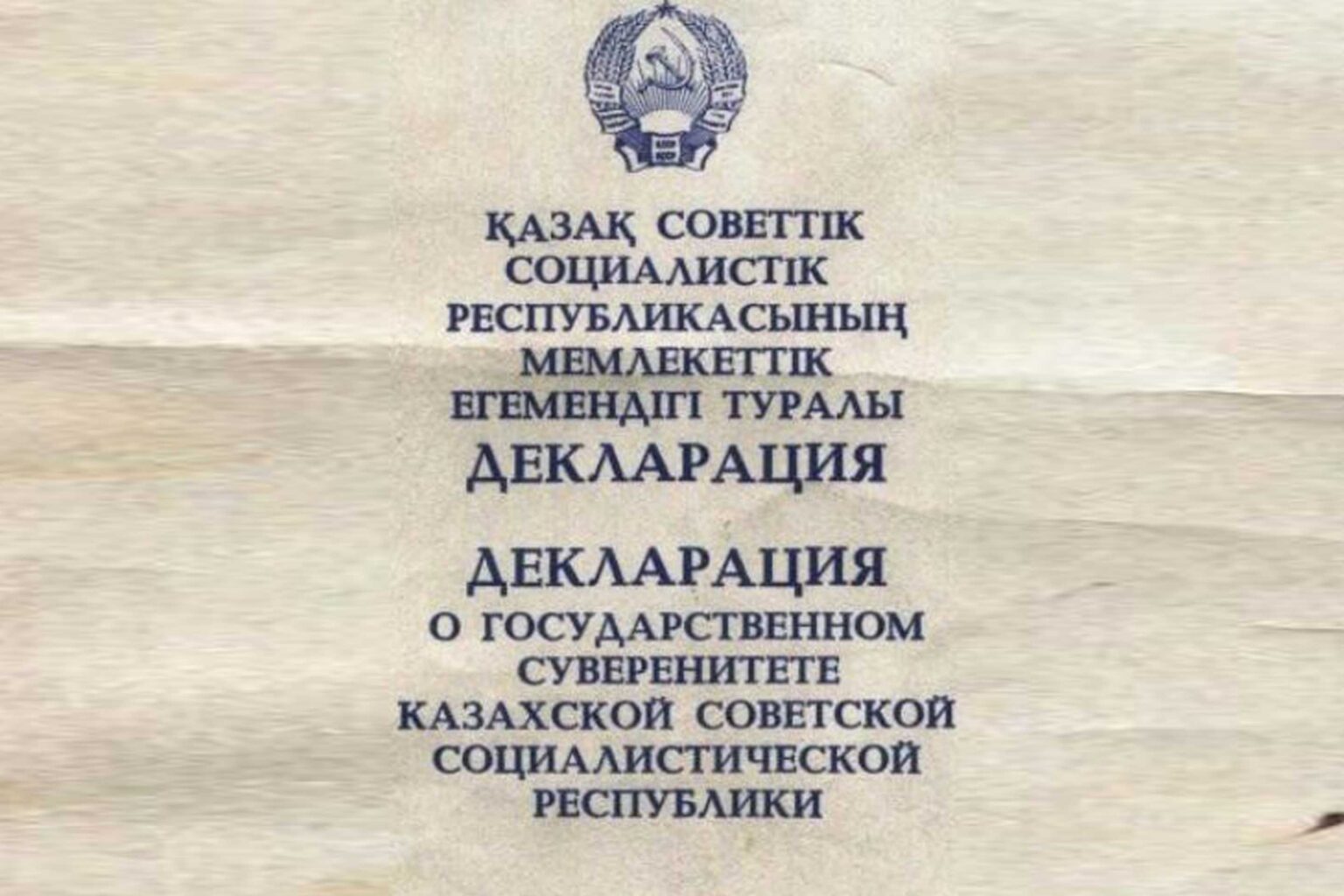
The cover of the Declaration on the State Sovereignty of the Kazakh SSR.
Yet this date’s significance extends beyond the document itself. It invites us to consider what it means to be a republic, not simply as a form of government, but as a country whose future cannot be separated from the people who inhabit it.
In June 2022, at the first meeting of the National Kurultai in Ulytau, President Kassym-Jomart Tokayev proposed restoring its status as a national holiday. Parliament passed the relevant amendments on Sept. 29, 2022, and the country celebrated Republic Day again that October.
For much of Kazakhstan’s post-independence history, the story of the state was closely tied to the figure of its first president. This made sense in a country undergoing profound political and economic transformation, where building new institutions and seeking stability became defining priorities. But a state is larger than any individual’s political career, however consequential that career may be. Leaders come and go, political narratives change, and the durability of a country ultimately depends on its institutions, shared values and the strength of its civic life.
Seen in this light, the return of Republic Day means more than restoring a holiday. It brings the idea of the republic itself back into focus: the country as a shared political space, rather than an extension of any one person’s legacy. Perhaps Tokayev was guided by precisely this understanding when he proposed restoring the holiday, recognizing that the idea of statehood must ultimately rest on something greater than the legacy of an individual leader. A republic derives its strength not from any one political figure’s permanence, but from the people who sustain it, the institutions they build and their commitment to a common future.
This also carries deeper historical resonance. The steppe that shaped Kazakh society was vast, and survival across it required more than individual strength. Communities depended on agreements, customary law, mutual obligations and an understanding that disputes had to be resolved within a shared social order. These traditions should not be romanticized as a history without conflict or inequality, but they do remind us that collective life has always required rules, negotiation and an ability to find common ground.
Modern Kazakhstan is, of course, a very different society. Its citizens live in cities and villages, work in a highly connected economy, participate in institutions and increasingly engage with the world beyond their borders. Yet the underlying question remains familiar: what holds a community together, and what makes its members feel that the place they inhabit is genuinely theirs?
Patriotism is often expressed through symbols, ceremonies and declarations of loyalty, but its more meaningful test lies in everyday choices. It is reflected in whether we respect the law when doing otherwise would be easier, whether we demand accountability from public institutions, whether we treat public property as something we share rather than something that belongs to nobody, and whether we contribute to the communities in which we live. It also requires us to recognize that we cannot delegate the country’s future entirely to the government, just as we cannot simply blame those in power for every problem.
This does not diminish the role of the state. On the contrary, public institutions must create the conditions for citizens to participate meaningfully, exercise their rights and see that their voices matter. The relationship between the state and society cannot be one-sided: a government may set priorities and introduce reforms, but their success depends in large part on whether people trust institutions, take part in public life and believe that their actions can make a difference.
Republic Day also reminds us that sovereignty has a geographical dimension. Kazakhstan’s territory, stretching across the steppe and connecting different parts of Eurasia, is not merely a feature on a map or an economic asset. It is the space within which a political community can determine its own future. Preserving that sovereignty requires capable institutions and sound strategic decisions, as well as a shared sense of belonging and an understanding of what is at stake when the country’s long-term interests are discussed.
National identity, meanwhile, should not be understood as something fixed or inherited without question. It is shaped by the way we understand our history, preserve our cultural heritage, relate to one another and imagine the country we want to leave to the next generation. It can accommodate different backgrounds, languages and experiences without losing its central commitment to a common future.
Perhaps this is the most important meaning of Republic Day today. The 1990 declaration marked a decisive step toward sovereignty, but the work of building a country did not end with independence, nor can any single generation or political leader complete it. Statehood endures through functioning institutions, communities that support one another, and citizens who understand that the country’s future is not something that happens to them, but something they help shape. On Oct. 25, we celebrate not only a defining moment in Kazakhstan’s journey toward independence, but also the idea that this country belongs to all of us.
