
ASTANA – Kazakhstan and international partners are stepping up efforts to address falling Caspian Sea levels, biodiversity loss and pollution, as Aktau hosted a high-level dialogue on Oct. 5 that also launched a Japan-funded monitoring and water management project.
The Caspian Sea has been shrinking for decades, raising concerns over biodiversity, coastal communities, infrastructure and economic activity across the five littoral states. Kazakhstan, which has the sea’s longest coastline, has increasingly sought regional and international cooperation as scientists warn that climate change and declining river inflows could accelerate the retreat.
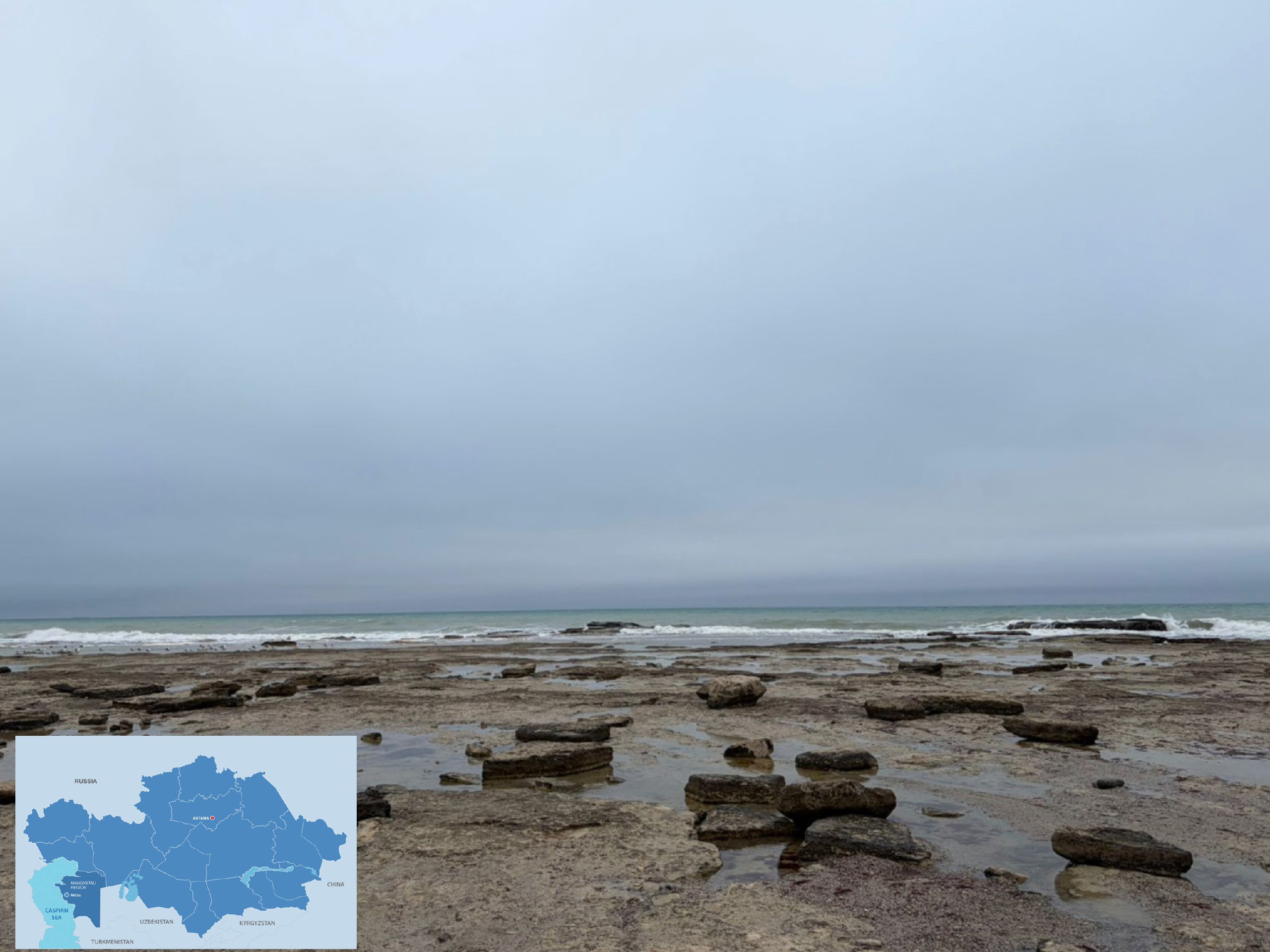
The water level of the Caspian Sea along Kazakhstan’s coastline continues to decline. Photo credit: Tengrinews. Click to see the map in full size. The map is designed by The Astana Times.
Organized by the United Nations Development Programme in Kazakhstan with the Ministry of Ecology and Natural Resources and the Mangystau Region akimat (administration), the dialogue brought together government institutions, diplomats, international organizations, scientists, civil society and the private sector.
The participants discussed changes in the Caspian Sea’s water balance, geological risks, pollution, marine litter, biodiversity conservation and the circular economy, the UNDP reported.
Minister of Ecology and Natural Resources Alibek Kuantyrov emphasized the need for coordinated action to address the Caspian Sea’s environmental challenges.
“For Kazakhstan, the Caspian Sea is a vital part of the country’s environmental, social and economic development, a source of livelihoods for coastal communities, and a space connecting five states. That is why Kazakhstan has consistently advocated moving from discussions of individual environmental challenges towards systemic and coordinated action,” said Kuantyrov.
Japan-funded project to strengthen Caspian Sea monitoring
The Japan-funded project will support joint research involving experts from Caspian countries and establish a regional scientific coordination platform for exchanging data and expertise. It will also strengthen Kazakhstan’s capacity to monitor the Northern Caspian Sea, including through upgraded monitoring and laboratory equipment and professional training.
The project will help improve monitoring of sea level, river discharge, water temperature and salinity, and evaporation. The data, combined with meteorological, bathymetric and satellite observations, will support improved models and projections of Caspian Sea level changes and related risks.
Japanese Ambassador to Kazakhstan Yasumasa Iijima highlighted Japan’s expertise in water resources management, disaster risk reduction and environmental protection.
“The project will focus on two main areas: establishing a platform to strengthen cooperation among the Caspian littoral states, and advancing scientific monitoring, transboundary data exchange, dialogue and joint action. Japan has extensive experience and expertise in water resources management, disaster risk reduction and environmental protection,” he said.
The event was the first held under the Friends of the Caspian initiative, which aims to bring together Caspian states, international organizations, financial institutions, donors, scientists and civil society around the shared goal of preserving the Caspian Sea.
The initiative is expected to be presented to international partners on the sidelines of the UN Climate Conference in Antalya, Türkiye, in November.
