
ALMATY – Kazakhstan and China should move from individual investment projects toward integrated production ecosystems, President Kassym-Jomart Tokayev said Sept. 25 at the Kazakhstan-China Investment Forum in Almaty, outlining transport, industry, critical minerals, digitalization and agriculture as key areas for deeper cooperation.
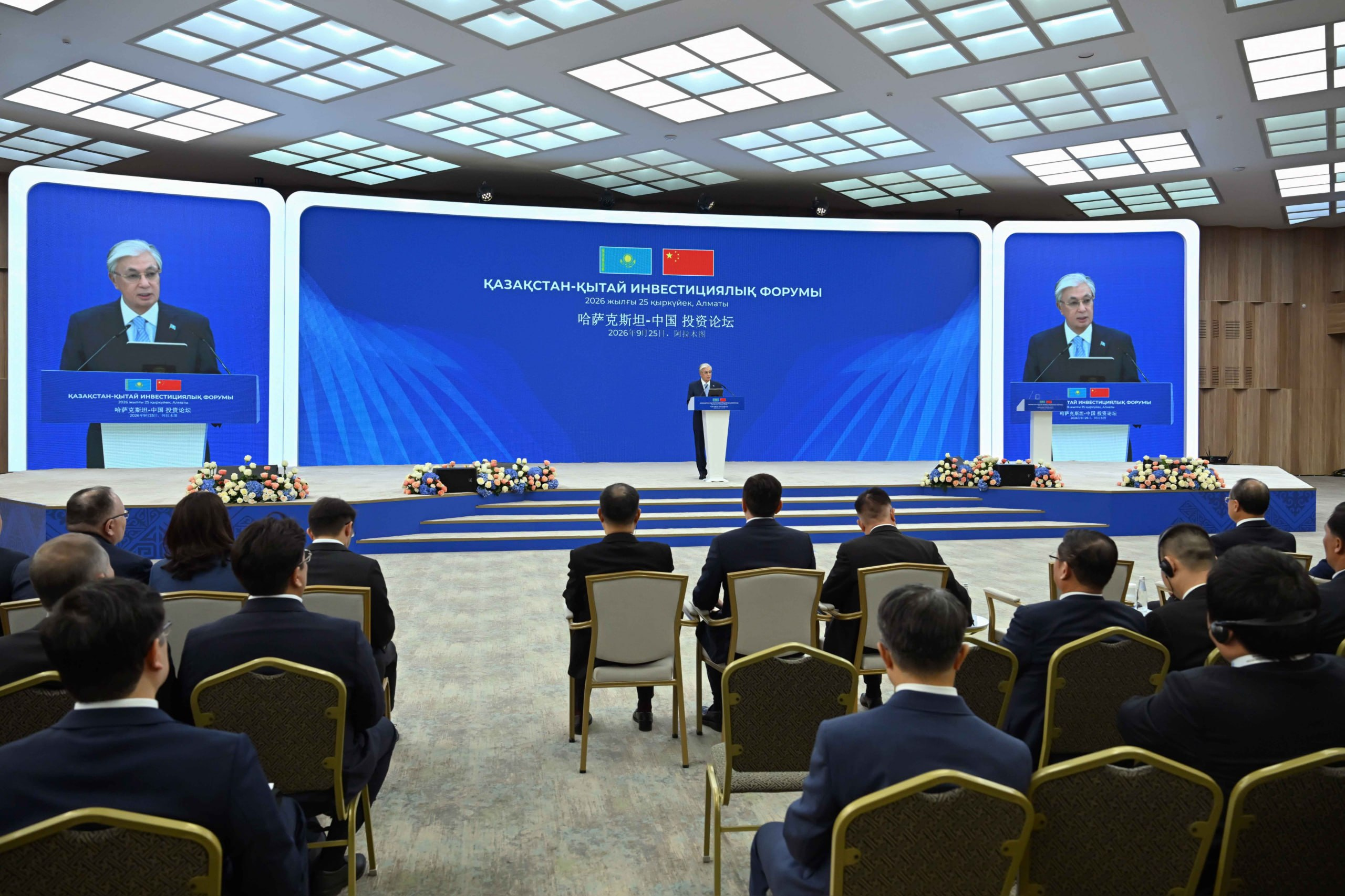
President Kassym-Jomart Tokayev attended a Sept. 25 Kazakhstan-China Investment Forum in Almaty, outlining transport, industry, critical minerals, digitalization and agriculture as key areas for deeper cooperation. Photo credit: Akorda.
More than 600 delegates, including Chinese corporations, Kazakh businesses, government bodies and development institutions, took part in the forum. Participants also observed a minute of silence in memory of the service members who died in the Mangystau Region.
Opening the forum, Tokayev said that Chinese investment in Kazakhstan has exceeded $29 billion, while more than 9,000 enterprises with Chinese participation operate in the country. The two governments are working to increase bilateral trade to $100 billion.
“China is the main trading partner of Kazakhstan. Following the results of last year, trade turnover approached a record level of $50 billion,” Tokayev said.
He noted that the ratification of the agreement on the promotion and mutual protection of investments had strengthened the legal foundation for cooperation, while the visa-free regime was helping expand business ties.
“Under conditions of profound transformation of the global economy, Kazakhstan and China are capable of offering a modern and effective model of constructive cooperation based on mutual trust, openness and common long-term interests,” Tokayev said.
Middle Corridor remains a strategic priority
Transport and logistics featured prominently in Tokayev’s address as Kazakhstan seeks to strengthen its role between Chinese and European markets.
“Together with international partners, we are increasing railway capacity, expanding highways and seaports, developing cargo aviation and border infrastructure. From Lianyungang to Aktau, a network of logistics hubs has been formed, connecting the Chinese coast with the Caspian Sea,” he said.
“A new important link in the logistics network will be the Kazakh-Chinese terminal in Chengdu, where the General Consulate of Kazakhstan is planned to open. We consider the development of the Middle Corridor, which is forming a modern configuration of transport links between Asia and Europe, a priority task,” Tokayev added.
Wang Haiyan, deputy director of the Institute of Russian and Eurasian Studies and director of the Center for Kazakhstan Studies at East China Normal University, said transport and logistics remain among the areas of greatest interest to Chinese investors.
“More than half of overland transportation between China and Europe passes through Kazakhstan,” Wang said in an interview with The Astana Times, highlighting that the third cross-border railway and infrastructure supporting the Middle Corridor could further strengthen Kazakhstan’s position as a logistics hub.
From individual projects to production ecosystems
Tokayev said industrial cooperation already includes a portfolio of 260 major joint projects worth more than $62 billion.
“Together with Chinese enterprises, an automotive cluster is developing in Almaty, silicon production is being created in the Karagandy Region, and projects are being implemented in metallurgy, petrochemicals and energy-storage systems,” he said.
He also highlighted projects by Lihua, Fufeng and Dalian Hesheng Holdings involving cotton-textile production and the deep processing of corn and grain.
“This is a good foundation for moving our partnership to a new level – from implementing individual investment projects to forming full-fledged production ecosystems with joint access to the markets of Central Asian countries, the Eurasian Economic Union, the South Caucasus and Europe,” Tokayev said.
He proposed launching the Kazakh-Chinese program “Common History Destiny. Designed and Made in Both China and Kazakhstan,” with the government tasked with forming a pool of promising projects together with Chinese partners.
Wang said the shift reflects growing Chinese interest in moving beyond raw-material acquisition toward processing and deeper industrial value chains.
Critical minerals and digitalization open new opportunities
Tokayev identified the mining and metallurgical complex as another priority, noting Kazakhstan’s reserves of uranium, copper, gold, coal, critical minerals and rare-earth metals. Tokayev also highlighted digitalization, smart cities and satellite technologies.
“Kazakhstan is open to cooperation with all leading technological centers of the world,” he said.
Wang identified digital infrastructure and artificial intelligence as emerging areas for investment, including smart cities, intelligent transport, 5G and 6G infrastructure and digital logistics. She also pointed to renewable energy and water-saving agricultural technologies as areas with further potential.
Forum proposed as annual investment dialogue
Tokayev said the forum should become a permanent platform for direct interaction between the two countries’ business communities.
“I propose holding it annually in September under the name Almaty Investment Dialogue Kazakhstan–China,” he said.
Around 300 companies are participating in the forum, including investors already operating in Kazakhstan and those planning to enter the market.
The forum underscores Kazakhstan’s effort to turn its growing economic ties with China into deeper industrial, technological and logistics cooperation, with joint production and access to wider Eurasian markets becoming an increasingly important focus.
Ten agreements signed during the forum
In the presence of Tokayev, representatives exchanged 10 signed agreements covering industrial production, renewable energy, investment financing, automotive manufacturing and urban development.
Among them are agreements on an electrolytic aluminum plant and an accompanying wind power facility in the Abai Region, a 450-megawatt portfolio of wind power projects in the Akmola Region, and the joint development of an energy project involving Samruk-Energy, China Energy Overseas Investment and SANY Renewable Energy.
Other agreements provide for the creation of a specialized investment fund at the Astana International Financial Center, financing arrangements between Development Bank of Kazakhstan and China Construction Bank’s Astana branch, as well as projects in automotive manufacturing, chemical production and real estate.
