
ASTANA – Kazakhstan’s energy security is increasingly tied to diversified supply routes, modern electricity infrastructure and deeper regional connectivity, while green hydrogen could open a new industrial opportunity if the country can turn its resource potential into commercially viable projects, experts said at the third Regional Central Asian and European Decarbonization Forum on Sept. 16.
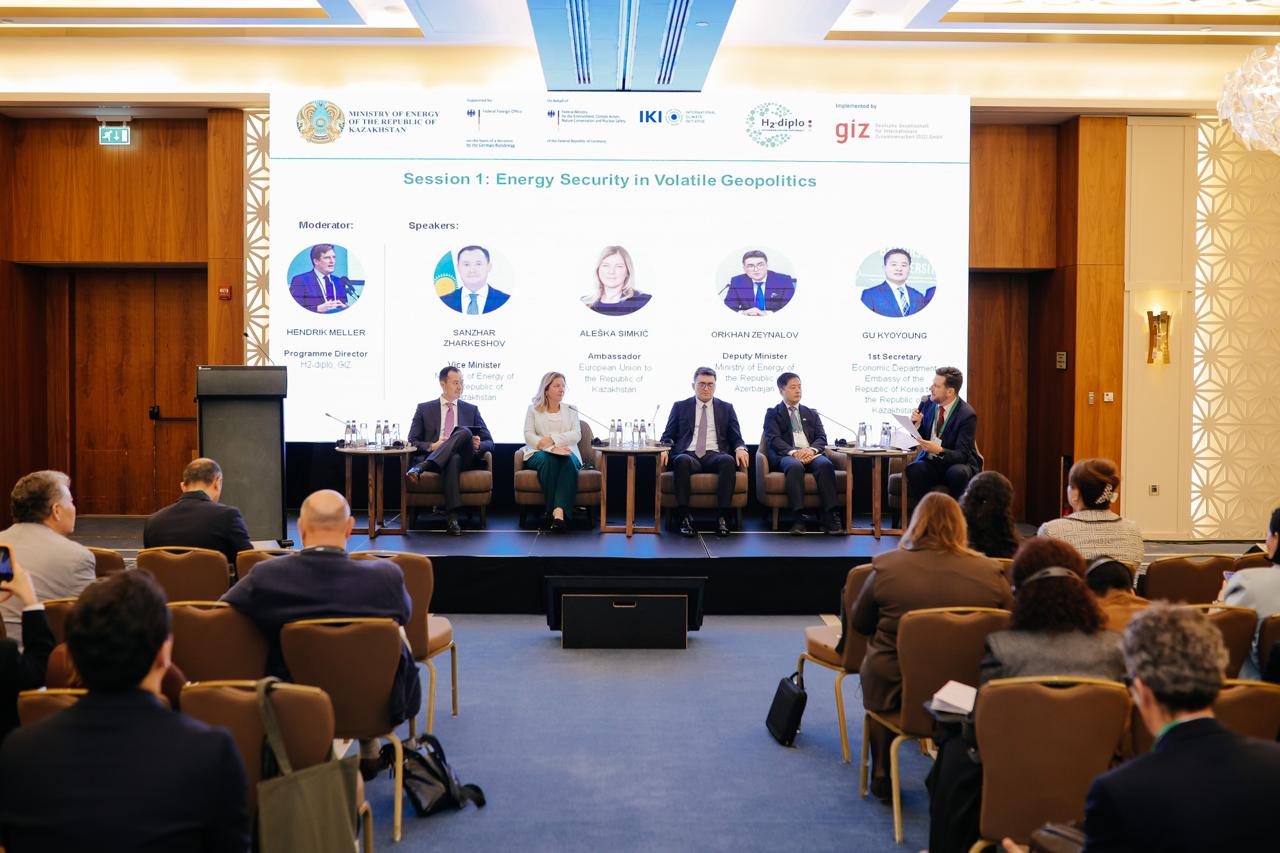
Photo credit: Kairzhan Sagyndyk
The Energy Security in Volatile Geopolitics panel highlighted a fundamental shift in what energy security means. For Kazakhstan, it is no longer only about securing sufficient supplies of oil and gas, but also about developing multiple energy sources, strengthening electricity networks and creating alternative routes to regional and international markets.
“Dependency on single routes is not a good thing,” said Sanzhar Zharkeshov, deputy Energy Minister of Kazakhstan, stressing the need to diversify energy routes while expanding alternative electricity sources.
The country is pursuing nuclear power alongside renewable energy. At the same time, expanding renewables requires greater flexibility in the electricity system. Zharkeshov said Kazakhstan’s new legislation requires renewable energy projects to include battery storage.
“You can’t count on natural gas forever for balancing and manoeuvring power. We have to have a reliable battery storage system,” he said.
This highlights a key challenge for the energy transition: adding generation capacity alone is not enough. Transmission networks, storage and regional interconnections will determine how effectively new electricity can be integrated and delivered.
Building the infrastructure before demand peaks
Azerbaijan’s Deputy Minister of Energy Orkhan Zeynalov said stronger electricity links between Central Asia, Azerbaijan and Europe could provide additional resilience and flexibility.
He said that regional infrastructure should be developed with future demand in mind rather than based solely on current volumes, comparing energy connections with highways that need to be built ahead of traffic growth.
“Tomorrow, the biggest risk is not having this infrastructure,” Zeynalov said.
Plans for a green energy corridor linking Kazakhstan, Uzbekistan and Azerbaijan are part of this emerging regional approach. Greater interconnection could allow countries with different renewable-generation patterns to exchange electricity and provide additional routes to European markets.
The discussion also linked the growth of artificial intelligence to a potentially sharp increase in electricity demand. Zharkeshov said this could change the economics of different energy technologies, making it less relevant to view them as competing alternatives and more important to develop them in parallel. He argued that stronger demand could, in turn, help improve the economic case for hydrogen.
“There will be no battle between the energy sources. We’ll have to throw everything at it so that we can meet the demand. And that will drive the economic feasibility of hydrogen as an energy source,” he said.
Green hydrogen: from strategy to a market
Green hydrogen illustrates both Kazakhstan’s potential and the challenges of developing new energy technologies.
Zharkeshov identified metallurgy, chemicals, ammonia production and refining as potential applications, notably in sectors that are difficult to decarbonize. However, he acknowledged that production costs remain a major obstacle.
“One of the challenges we’re seeing in hydrogen is the price, the break-even price,” he said.
Kazakhstan has significant wind and solar potential that could support renewable hydrogen production. But the next question is whether this potential can be converted into projects with buyers and viable business models.

Hendrik Meller, program director of H2-diplo at the German Society for International Cooperation. Photo credit: Kairzhan Sagyndyk
Hendrik Meller, program director of H2-diplo at the German Society for International Cooperation (GIZ), told The Astana Times that the clearest milestone over the next five years would be an operating or near-operating project with a committed buyer.
“In five years it would be great to have a project in operation or close to operation, producing green hydrogen, with a clear offtake customer to cater to,” Meller said.
He suggested that Kazakhstan could initially focus on domestic applications rather than relying entirely on exports, including replacing grey hydrogen at refineries and using green hydrogen in fertilizer production. Other applications, such as green steel and sustainable aviation or maritime fuels, could develop as the market matures.
Meller said the immediate practical step is to engage with project developers and technology providers to advance existing hydrogen projects and determine where they can secure an offtake agreement.
“I think that’s something where we have to bring businesses together,” he said.
Critical raw materials add another opportunity
For the European Union, Kazakhstan’s importance extends beyond energy to critical raw materials, connectivity and industrial processing.

EU Ambassador to Kazakhstan Aleška Simkić. Photo credit: Kairzhan Sagyndyk
EU Ambassador to Kazakhstan Aleška Simkić stressed that developing new technologies requires a long-term investment perspective.
“We have to invest now in order to have long-term benefits, even though it’s not commercially viable,” she said.
Simkić noted that 21 of the 34 critical raw materials the EU identified as important for its green transition are present in Kazakhstan. But she emphasized that cooperation should move beyond extraction.
“We actually want the processing and technologies to be here, locally managed and dealt with,” she said.
This could allow Kazakhstan to capture more value from its mineral resources while helping Europe diversify supply chains.
Taken together, the discussion suggests that Kazakhstan’s energy advantage will depend less on the scale of its resources alone and more on its ability to connect them to modern infrastructure, regional markets and higher-value industries.
The key indicators to watch will be progress on electricity interconnections, battery storage, grid modernization, critical-minerals processing and, particularly, the emergence of a green hydrogen project with a real buyer. If those elements begin to materialize, Kazakhstan’s energy transition could move from a collection of strategies and potential projects towards a more integrated regional energy and industrial model.
