
ASTANA — The latest PISA 2025 results reveal a tension likely to grow more important in the years ahead: how can a country prepare young people for an economy shaped by AI without allowing technology to displace the foundational skills that make knowledge useful in the first place? For Kazakhstan, the question is particularly relevant. The country has made significant progress in digital readiness, but those advances have not yet translated into the level of reading, mathematics, science and problem-solving performance that Kazakhstan needs.

Photo credit: ult.kz
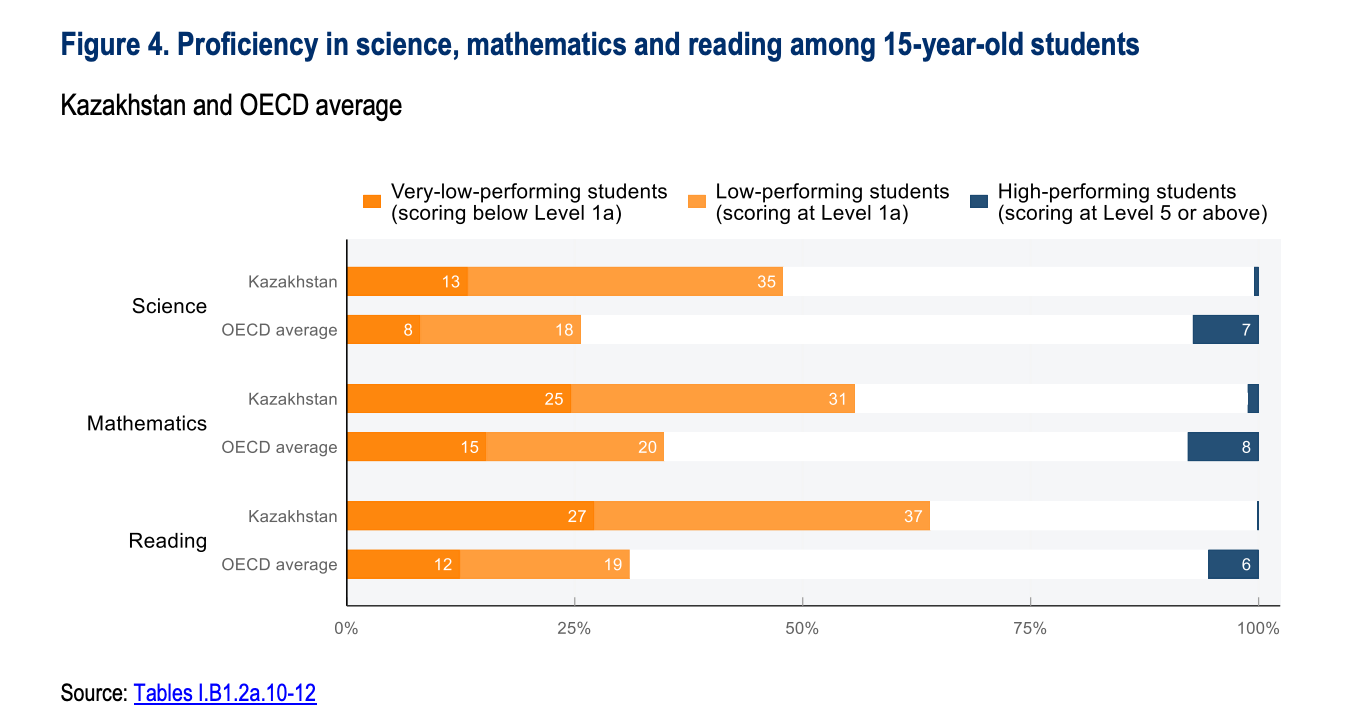
The country scored 385 points in reading in PISA 2025, compared with an OECD average of 461. Its mathematics score was 414, against 463 for the OECD, while science stood at 420 versus 482. In the new computational problem-solving assessment, Kazakhstan scored 449 compared with an OECD average of 500. Mathematics declined by 12 points from the 2022 assessment, while reading remained broadly unchanged. The results are based on 22,680 students from 643 schools, representing around 324,600 15-year-olds nationwide.
The mathematics results are difficult to overlook. Kazakhstan remains far behind the strongest-performing education systems, with B-S-J-Z (China) at 612 points, Singapore at 563, Macao at 549, Chinese Taipei at 546 and Japan at 525. At the same time, Kazakhstan is part of a broader international trend: mathematics performance has declined across many education systems. Across the OECD, the average mathematics score fell by nine points between 2022 and 2025, while the decline over the longer 2015–2025 period was 22 points
The PISA paradox
Reading, however, raises a different and perhaps deeper question because it concerns the very capacity students need in order to make sense of all those other sources of information.

Andreas Schleicher, OECD Director for Education and Skills and head of the PISA program.
Andreas Schleicher, OECD Director for Education and Skills and head of the PISA program, describes the latest findings on AI and education as “somewhat sobering,” noting that the students who perform best academically tend, as a rule, to use AI less often.
“Reading has always been the foundation of all other skills, so this is particularly important. What worries me most is the decline in those reading skills that are becoming increasingly important in the age of AI: the ability to compare information from different sources, distinguish facts from opinions and navigate ambiguous information,” he said.
That distinction matters. Reading is not simply the ability to understand the words on a page. It is the ability to follow an argument, recognize its assumptions, weigh evidence and decide whether one interpretation is more convincing than another. Those are precisely the kinds of tasks that become more, not less, important when people are surrounded by an enormous volume of machine-generated information.
Schleicher says the problem is not only that reading habits are changing, but that the quality of engagement with information may be changing as well.
“Young people have started to read faster, but at the same time less accurately. Of course, this cannot be called a healthy trend. Perhaps new technologies place fewer demands on young people in terms of critical thinking, making sense of information, comparing it and critically evaluating it. They increasingly become consumers of already prepared knowledge. Unfortunately, these changes in behavior are also reflected in learning outcomes,” he said.
Kazakhstan’s results illustrate why this matters. Only 36% of Kazakh students reached at least Level 2 proficiency in reading, compared with 69% across the OECD. At the higher end, almost no students in Kazakhstan reached Level 5 or above, compared with 6% across the OECD. Reading remained broadly unchanged from 2022, but stability at a comparatively low level is not necessarily reassuring, particularly when the skill itself underpins performance across other subjects.
At the same time, Kazakhstan does not fit a simple narrative of technological backwardness. Forty-seven percent of Kazakh students report using AI chatbots at least weekly to support their learning, close to the OECD average of 45.5%. More than 80% say they have learned at school how to assess AI-generated information, compared with 62.6% across the OECD, while around 85% attend schools with subject-specific guidelines on using digital devices. This combination of relatively strong digital preparedness and weaker foundational performance is one of the most interesting features of Kazakhstan’s PISA results.

Saqib Raza.
Saqib Raza, a PhD scholar in education and an MSc graduate in Educational Leadership in Higher Education from Nazarbayev University Graduate School of Education, notes that the country should not read the results simply as a verdict of failure.
“These numbers matter. In an age when access to generative AI is becoming almost universal, the central educational question is no longer whether students can use AI. It is whether they can question it, verify it and use it without surrendering their own judgement,” Raza said.
His assessment of reading, however, is more pointed. According to him, digital competence cannot compensate for weak comprehension.
“AI literacy without strong foundational literacy risks becoming technological fluency without intellectual depth,” he said.
That may be the central paradox for education in the AI era. A generation can become increasingly comfortable with technology while becoming less comfortable with the slower, more demanding process of understanding something for itself.
When AI makes answers easy
The consequences extend beyond the classroom. A student who cannot follow a complicated argument will have difficulty evaluating an AI-generated explanation. A future engineer who cannot distinguish evidence from assertion may struggle to assess technical information. A policymaker who relies entirely on summaries becomes increasingly dependent on whoever produced the summary. And a citizen who cannot compare competing accounts becomes more vulnerable to simplified narratives and manipulation.
This is why reading should not be treated merely as a cultural preference, something desirable for educated people but secondary to the supposedly more practical skills of the digital economy. The PISA results suggest almost the opposite: reading is becoming a form of intellectual infrastructure.
Raza emphasizes that the answer is not to retreat from technological transformation.
“This should not lead Kazakhstan to slow its digital transformation. It suggests the opposite, the country now needs to deepen it. The next phase should move from measuring access and adoption towards measuring what technology actually contributes to learning. AI should increasingly be used to strengthen reasoning, feedback, inquiry and personalized support rather than simply to generate answers. Teacher development should focus not only on how to operate new tools, but on designing learning tasks in which students must explain, defend, verify and improve what AI produces,” he notes.
That is a more useful way of thinking about the role of technology in education. The question is not whether schools should use AI, because reality has already largely settled that debate. The question is whether the technology helps students become more capable thinkers, or simply makes it easier for them to avoid thinking.
Schleicher makes the same point through a much simpler analogy: “it is impossible to become physically strong simply by watching sports training.”
“To become stronger, you have to exercise yourself. In the same way, students do not become smarter simply by consuming ready-made content. They become smarter when they make their own effort,” he said.
Some of the effort removed by technology is precisely the effort through which learning occurs: reading a difficult passage twice, staying with an unfamiliar argument, discovering that two sources contradict each other, trying to formulate a response without assistance, or realizing that an apparently convincing answer does not withstand closer examination. This is also where reading and mathematics become part of the same conversation.
Gazis Abishev, a political analyst, commenting on the PISA results, focuses on Kazakhstan’s 414-point mathematics score and the 12-point decline from 2022 as a serious warning. He acknowledges the broader international context, including the effects of the pandemic and the increasing presence of mobile phones and neural networks, as well as Kazakhstan’s relatively large rural population.
“Of course, on average mathematics has declined in many countries. Children were affected by the pandemic lockdown, plus the active penetration of mobile phones and neural networks. Kazakhstan also has a larger rural population. It is easier to educate children in urban lyceums in Singapore. But nevertheless, a gap of one and a half hundred points is a fairly serious problem,” Abishev wrote on his Telegram channel.
He gave a blunt prescription: “Mathematics, mathematics, mathematics. More mathematics at all levels.” But he also calls for “the cult of reading”: accessible books, the promotion of literature, debates, essay competitions and a stronger intellectual culture.
The two recommendations are not as far apart as they may appear. Both math and reading depend on sustained attention, and both are increasingly challenged by an information environment built around speed, convenience and constant novelty.
The cost of losing attention
That is why the renewed discussion about reading in Kazakhstan matters beyond the education sector. In May 2026, President Kassym-Jomart Tokayev signed a decree on measures to develop a reading culture and form a “reading nation,” making the development of reading culture and the formation of a reading nation a priority of state policy in culture, education and innovation. The document also calls for new library formats, wider access to books and a national concept to promote reading culture in the age of AI.
There is something timely about that agenda. Reading is being elevated as a national priority precisely as technology makes it easier to generate, summarize and redistribute written information. In that environment, the scarce resource may no longer be access to text but the ability to stay with it long enough to understand it.
This does not mean Kazakhstan should choose books over technology, or classrooms over digital tools. Its own PISA results point to a more demanding conclusion: the country needs both, but it must ensure that technological progress strengthens rather than substitutes for foundational learning.
“At the same time, reading and mathematical reasoning should remain at the centre of the reform agenda. These are not skills from a pre-digital age. They are the foundations that allow students to navigate an AI-rich one,” said Raza.
That may be the clearest way to read the PISA results. Kazakhstan does not need to retreat from the digital future. It needs to make sure that the children entering that future have enough intellectual depth to navigate it.
A reading nation is not simply a nation of people who read more books. It is a society that has developed the habit of paying attention to an argument long enough to understand it, to evidence long enough to test it, and to another person’s point of view long enough to consider that it might contain something the first answer did not.
In an age when machines can increasingly process information for us, attention may be one of the most valuable human advantages left.
