
ASTANA – Central Asia’s best defense against challenging and fragmenting global order lies not in choosing a geopolitical camp but in deeper regional coordination, diversified partnerships and stronger international rules, top experts said during an Aug. 31 discussion in Astana.
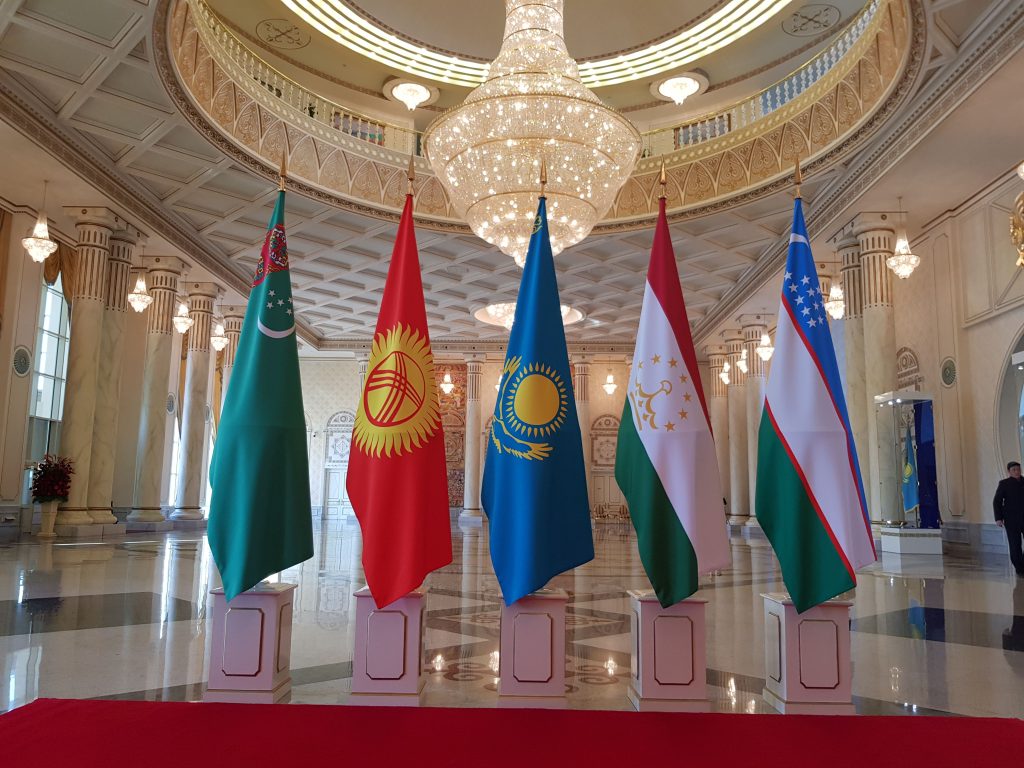
Photo credit: Georgi Gotev
The five Central Asian states are unlikely to become a separate pole in the emerging global order. However, their geography, resources and growing cooperation give them an opportunity to shape how that order operates provided they can turn regional coordination into lasting institutions and economic resilience.
The expert discussion brought together Nargiza Murataliyeva, an associate professor at the American University of Central Asia in Bishkek, Dauren Aben, deputy director of the Kazakhstan Institute for Strategic Studies and Akram Umarov, first vice rector of the University of World Economy and Diplomacy in Uzbekistan. The panel followed the launch of German political analyst Marc Saxer’s book, “Geopolitical Conflict in the Wolf World: Great Power Competition and the Illiberal Revolt against the Liberal Order.” Saxer uses the term “wolf world” to describe a fragmented international system in which institutions are weakening, geopolitical competition is intensifying and power increasingly determines outcomes.
For Central Asia, that challenge is particularly notable. The region sits between Russia and China, borders Afghanistan and is surrounded by ongoing conflicts. It also depends heavily on external markets, infrastructure and technology. At the same time, demand for its critical minerals, uranium, energy resources and transit routes has increased its strategic value.
Stronger regional agency
The experts emphasized that Central Asia should no longer be viewed merely as an arena in which outside powers compete or an object of the so-called great game that many Western experts use extensively.
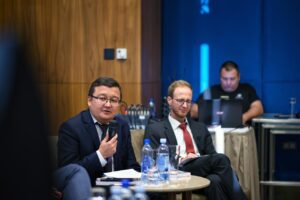
Dauren Aben (in the left). Photo credit: FES
“For a long time, we have been considered through the prism of great-power rivalry: who has the greatest influence, whether China is replacing Russia and so on,” Aben said. “All of these are legitimate questions, but they are increasingly insufficient.”
Murataliyeva stressed that discussions about Central Asia did not put the region at the forefront. Some experts referred to it as a “buffer,” a “transit zone,” or a “place things pass through on the way somewhere more important.” Murataliyeva said that vocabulary has become obsolete as the five countries develop greater regional agency.
Since 2018, the consultative meetings of Central Asian heads of state, with the latest held in Cholpon-Ata in July, have created a form of cooperation distinct from conventional regional organizations. It can further serve as a model for other regions throughout the world.
“The five states have built something that doesn’t look like any existing regional organization. There is no supranational authority, no binding laws, no court, no commission, no pooled sovereignty. Decisions are made by consensus among presidents, and implementation is voluntary,” she said.
The results are tangible. Murataliyeva pointed to the reopening of borders, settlement of long-standing border disputes and the growing intraregional trade. This format has also made the region’s voice stronger and made it more recognizable to outside partners as a single negotiating counterpart.
“This is a part that other regions might learn from,” she added.
Umarov said the enhanced regional coordination is a natural response to the changing world order.
“And our task is to make sure this regional coordination will bring necessary strategic resilience to the region, because I believe our development is inevitably linked to each other,” he said.
Strategic philosophy
Aben sees regionalism as an instrument of strategic autonomy. Rather than seeking isolation or alignment with one power, Central Asian states are trying to preserve the widest possible range of choices. He stressed the region’s vast experience in “strategic balancing.”
“We want good relations with Russia, but we do not want to be absorbed into the Russian sphere of influence. We want to deepen strategic partnerships, especially with China, but we do not want to become an exclusive zone of influence of China,” Aben said.
The region also wants strong ties with the United States and Europe without becoming another front in geopolitical confrontation, he added. Central Asian states are simultaneously expanding connections with South Asia, the Middle East and the broader Islamic world.
“Our determination is not to choose a camp, but to enlarge the space in which choices remain possible,” Aben said. “It is not just tactical hedging. It is our strategic philosophy.”
Regionalism faces limits
According to Murataliyeva, the region’s flexible model also has clear vulnerabilities.

Nargiz Murataliyeva. Photo credit: FES
“First of all, this model runs on personal trust between a specific group of leaders. It has no mechanism for resolving a dispute if the trust fails, and no institutional memory to survive a difficult succession,” she said.
The five states also remain competitors in several areas. Each seeks to become a regional transport hub, manufacturing center or gateway between Europe and Asia. “Soft regionalism is excellent at removing friction. It hasn’t yet been tested on a genuine conflict of interest, in fact,” said the expert.
Security cooperation is similarly fragmented. Central Asian countries participate in overlapping and sometimes competing arrangements, including the Collective Security Treaty Organization, the Shanghai Cooperation Organisation, C5+1 platforms and bilateral or trilateral mechanisms covering Afghanistan, water and energy.
“As a result, Central Asian security can be understood as networked and institutionally fragmented, rather than organized around a single regional security provider or institutional framework,” she explained.
However, Murataliyeva suggested this fragmented structure can be both a weakness and a potential form of adaptation. Rather than relying on a single security provider, states can work through different networks depending on the issue. The question, she said, is whether Central Asia can develop a meaningful regional security agency without creating a unified security architecture.
Multivectorism under pressure
The experts warned that the space for Central Asia’s traditional multivector diplomacy is narrowing.
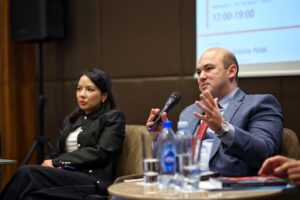
Nargiz Murataliyeva and Akram Umarov. Photo credit: FES
“What is also becoming challenging for the region, we talk a lot about this multilateral policies, non-alignment, but the space for this multilateralism is shrinking, and we are coming to the politics where there are no ideal choices, so you have to balance, but still this balancing is very steep and very fragile in some aspects,” said Umarov.
In the past, the region could balance relations among external partners that were not in direct confrontation with one another. That is no longer the case. Russia’s confrontation with the West and the deepening strategic rivalry between the United States and China make that balancing act more costly.
“Multivector foreign policy has changed character, in fact, because classical multivectorism was balanced among partners who were not fighting each other. The vectors are in open conflict now,” said Murataliyeva.
The region has an interest not simply in the emergence of multiple centers of power but in preserving rules that protect sovereignty and territorial integrity. According to her, the Central Asian agency depends on major powers continuing to compete without allowing that competition to escalate into direct conflict.
According to Aben, Central Asia needs an order that offers “sovereignty without being isolated, connectivity without being overly dependent and cooperation without the need to choose alliances.” The region already practices a version of this model through overlapping partnerships.
“We cooperate with China on infrastructure. We want to cooperate with Europe on connectivity, critical raw materials. We cooperated extensively with the United States on nuclear security and non-proliferation, and we want to continue this cooperation with Russia on trade and transport,” he said.
“We cannot prevent the wolves from competing,” he said, referring to the central premise of Marc Saxer’s book. “Our task as middle and small powers is to ensure that this competition is not organized according to the logic of the wolves.”
Weakening institutions raise the stakes
Umarov said the erosion of universal international institutions poses a particular threat to small and middle powers, which have traditionally relied on international law and multilateral organizations to protect their interests.
“It is quite obvious that usually small and medium powers rely on international norms, rely on international institutions to secure their interests and to promote their interests and to make sure that these interests are taken into account. But in a world where no one is quite serious about norms and taking them very simply, this is a big challenge for us,” he explained.
A world in which several powerful leaders can make agreements behind closed doors and impose them on others would leave smaller states with little influence over decisions affecting their security and development, he said.
The rise of selective coalitions and the weakening of universal multilateralism are therefore deeply concerning for Central Asia, Umarov said. Since independence, the region’s states have joined numerous international organizations partly to reinforce their sovereignty and secure platforms from which to advance their interests.
According to Aben, the objective is not to preserve the old order unchanged. Central Asian states have also experienced its double standards and unequal distribution of influence. Instead, the region needs rules that constrain power rather than serve as instruments of power politics.
Umarov called on Central Asian countries to become more active defenders of international law while also proposing reforms to existing institutions and developing regional norms of their own.
“We need to be proactive, not reactive to the changes in the world,” he said.
Connectivity
Geography is becoming an asset as well. “The world looks at us as a landlocked space between Russia and China, close to Afghanistan, rich in energy, critical minerals, located along the Silk Way,” said Aben.
“All of this, of course, is true, and all of this can produce vulnerability, but it also makes us strategically relevant,” he added.
Disruption of traditional routes and supply chains has also drawn increased interest to Central Asia as a continental bridge between China, Europe, Russia, South Asia and the Middle East.
Umarov rejected the idea that Uzbekistan’s double landlocked status should define it primarily as isolated. He believes that assumption overlooks the region’s historic position along the Silk Road and its growing relevance as maritime trade routes become more vulnerable. “This continental connectivity is very important,” he said.
Murataliyeva also noted that making the region a strong connectivity hub will remain largely rhetorical if governments do not address physical and economic constraints.
“For instance, mismatched rail gauges, customs delays, thin processing capacity. The corridor agenda only pays off if it is paired with an industrial agenda,” she said.
The experts agreed that Central Asia cannot eliminate the pressures created by its location or prevent larger powers from competing. However, it can reduce the risks by strengthening regional trust, building economic and technological capacity and acting collectively where interests converge.
“Geography and resources make this region a pivot. Only people and wise policy can make it a strong player,” Murataliyeva said.
