
ASTANA – As artificial intelligence becomes increasingly integrated into business and government processes, human expertise remains critical to ensuring effective decision-making, experts said at an Aug. 26 panel discussion at Nazarbayev University.
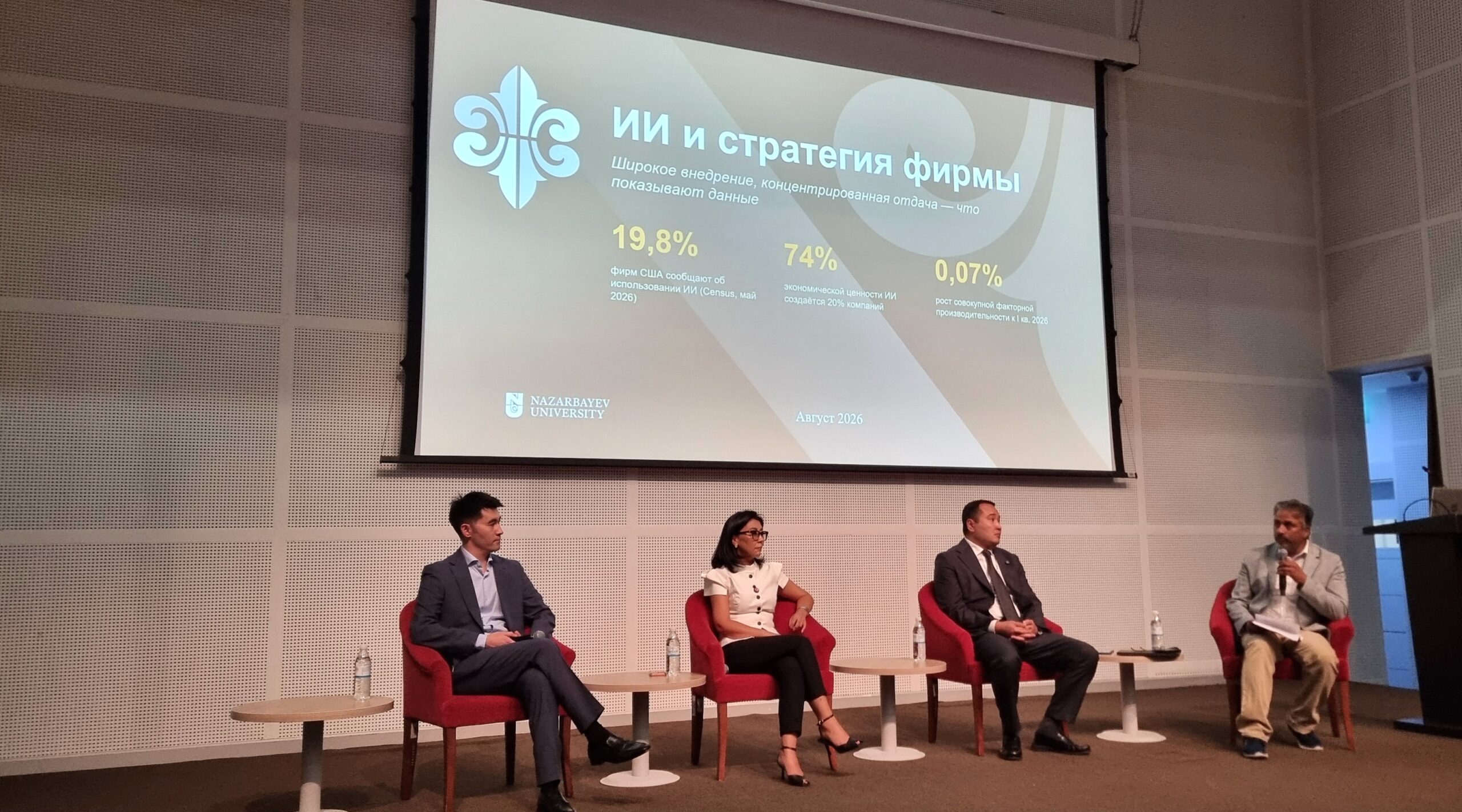
From left: Bektemir Ysmailov, Malika Toleubekova, Demeu Seitzhanov and Subramanian Venkat. Photo credit: The Astana Times/ Aiman Nakispekova
The discussion focused on the challenges of digital transformation and the skills and competencies that are becoming increasingly important as AI reshapes the workplace.
Bektemir Ysmailov, an assistant professor at Nazarbayev University’s Graduate School of Business, said AI is increasingly taking over coding and other routine tasks, making human expertise even more important in evaluating and verifying AI-generated results.

During panel discussion on Aug.26, Ysmailov highlighted AI can perform many tasks, but it still requires human verification. Photo credit: The Astana Times/ Aiman Nakispekova
“Although AI has blurred the line between people with programming experience and those without it, expertise will become a key skill. AI can perform many tasks, but it still requires human verification,” Ysmailov said.
Drawing on his experience, Ysmailov noted that AI tools have significantly reduced the time he spends on manual work, including coding and data analysis. Tasks such as data cleaning, which previously required considerable time, can now be automated.
According to Subramanian Venkat, vice dean for research at Nazarbayev University, AI tools are becoming widely available, but their ability to generate value varies significantly among companies. He stressed that AI should be viewed as a capability rather than a resource.
“Everyone has access to AI now. You have it, I have it, every organization has it. So it is not a resource that belongs to a particular company. It is a common resource. What matters most is how capable we are of using AI,” Venkat said.
Venkat cited data showing that 19.8% of U.S. firms report using AI, while the benefits of adoption remain unevenly distributed.
“At the firm level, only about 20% of companies appear to capture roughly 75% of the efficiency gains, while the remaining 80% either see little benefit or are not using AI effectively,” he said, adding that the overall productivity increase remains limited.
According to Venkat, AI adoption is concentrated in sectors such as information technology, finance, insurance and retail. Medium-sized and large companies are also more likely to use AI, while adoption among very small firms, particularly those with four or fewer employees, remains below 20%.
Infrastructure and connectivity
The discussion comes as Kazakhstan continues its broader digital transformation. On Aug. 26, the government approved an action plan to implement the Digital Qazaqstan strategy through 2029. The plan brings together measures to transform public services, support businesses and the economy, and modernize public administration. It aims to move beyond individual digital services toward digital systems across entire sectors, with AI and real-time data increasingly integrated into decision-making.
However, for that transformation to succeed, technology should be supported by the infrastructure needed to deploy it at scale, said Malika Toleubekova, managing director for financial control and risks at Kazakhtelecom, the country’s largest telecommunications company.
Toleubekova noted that Kazakhtelecom is undergoing a major transformation focused on AI, digitalization and IT. She identified three key elements required for AI adoption: infrastructure, connectivity and data.
“Any company will likely face the need to introduce AI in the near future. For AI to work, the first thing needed is infrastructure such as hardware, capacity, GPUs and everything on which AI systems and assistants are deployed. The second element is connectivity. Without internet access, nothing will work. The third is data, which will ultimately be integrated into AI models,” she explained.
Kazakhtelecom is developing a large-scale data center in Ekibastuz as part of the efforts to strengthen the country’s digital infrastructure. The company is also working on the Trans-Caspian Fiber Optic Cable project, which will provide an alternative international connectivity route between Kazakhstan and Azerbaijan.
“If we previously received internet traffic mainly through Russia, we are now developing a route that will run under the Caspian Sea, through Georgia and Türkiye and onward to Europe. This means we will no longer depend solely on routes through Russia. The new route will also shorten the connection by almost 4,000 kilometers,” Toleubekova said.
Kazakhstan completed the most technically challenging stage of the project on Aug. 5, when the submarine cable reached the country’s Caspian coast. The cable, laid between Aktau and Sumgait, will directly connect the digital infrastructure of Kazakhstan and Azerbaijan.
AI is changing jobs, not simply replacing them
As digital infrastructure expands, companies are also confronting a different challenge: how AI will reshape the workforce. Toleubekova emphasized that while infrastructure is essential for AI adoption, it is not sufficient on its own. The ability to use the technology effectively, as well as employees’ expertise in making decisions based on AI-generated information, will be equally important.
She described how AI-driven automation is changing jobs within Kazakhtelecom without eliminating the need for employees. She cited the company’s 100-person Center for Work Orders, where processes such as creating and processing work orders have been automated.
“The issue has become one of expertise: What do we do with this data? How do we analyze and measure it? You solve one task, and another task emerges,” Toleubekova said.
Rather than eliminating the workforce, automation has shifted employees toward roles requiring greater expertise and problem-solving.
“They are now experts in solving issues that go beyond ordinary routine work. We are retraining these people and looking at where they can contribute next,” Toleubekova said.
This shift also raises new questions about how companies measure employee performance when AI reduces the time needed to complete tasks. The discussion also considered who should ultimately bear responsibility for decisions made with the assistance of AI.
“Many questions are emerging. But one thing is clear. Humans are still making decisions. I think that is something we will not be able to transfer to AI. Human expertise will remain at the forefront,” Toleubekova said.
