
ALMATY – The final Aug. 19 televised debate before Kazakhstan’s Aug. 23 Kurultai elections showed that the country’s seven political parties are entering the vote with competing policy priorities. Still, voters largely share an understanding of the main concerns, shifting the campaign debate from identifying problems to competing over who offers the most convincing solutions.
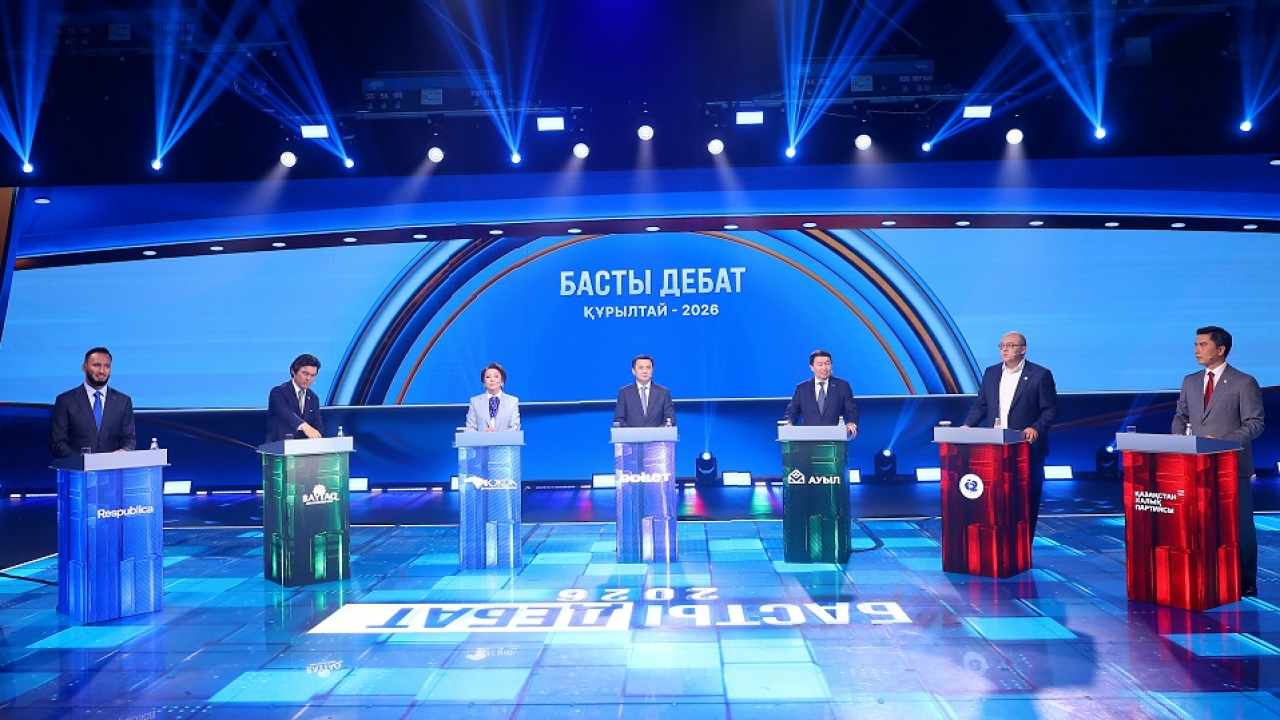
Photo credit: 24kz
The Aug. 19 debate focused on economic growth and citizens’ well-being, bringing together leaders of Respublica, Baitaq, Aq Zhol, Adilet, Auyl, the Nationwide Social Democratic Party and the People’s Party of Kazakhstan.
The discussion marked one of the campaign’s final major events before the silence period. While party leaders spent the campaign meeting voters, workers and professional communities across the regions, the debate brought their competing approaches onto a single national platform.
Beyond determining which parties will receive the 145 seats in the new Kurultai, the vote will provide an early test of how Kazakhstan’s new political system shapes party competition, representation and legislative politics.
Under the proportional representation system, election results determine the number of mandates each party receives, with seats distributed among parties that secure at least 5% of the vote. Parties independently form their candidate lists, but their autonomy operates within the requirements set by electoral law.
The Constitution also guarantees the autonomy of public associations and prohibits unlawful state interference in their activities. At the same time, candidates, party lists and their registration remain subject to statutory requirements and procedures.
In other words, parties decide whom to nominate, while voters determine how many mandates each party receives. The system is therefore designed to balance electoral regulation with political parties’ organizational autonomy.
Different solutions to largely shared concerns
The debate demonstrated that the parties are responding to many of the same public concerns: rising prices, household incomes, employment, regional inequality and the future direction of economic growth.
The differences lay primarily in their proposed solutions. Taken together, the debate suggested that competition is shifting less toward disagreement over which problems matter and more toward competing economic and political approaches to solving them.
The four-round format also allowed voters to see how parties defended their positions when challenged directly. In the second round, leaders questioned one another on issues ranging from rural development and support for entrepreneurs to the financing of social initiatives and the economic justification for party proposals.
Viewers submitted more than 59,000 questions through a QR code and a contact center, including questions from Kazakh citizens abroad. The broadcaster selected fourteen for the broadcast, with two questions for each party.
Commenting on the election process, political analyst Gaziz Abishev suggested that party programs should also be viewed beyond their immediate electoral appeal. Their importance can be assessed through the ideas they contribute to wider public and policymaking discussions.
“Programs can be analyzed from the perspective of their contribution to the broader public political and internal bureaucratic discussion about different approaches. That is, what ideas parties introduce to the bureaucracy that generates draft policy decisions, and how effectively they can defend those ideas in the public sphere,” Abishev wrote in his Telegram channel.
From this perspective, the campaign is also a competition over which policy ideas gain greater visibility and political support.
A vote that will shape a new legislature
The Aug. 23 election will be Kazakhstan’s first vote for the new Kurultai, with voters electing 145 deputies for five-year terms. The election results will determine how many mandates each party receives, and seats can be distributed only among candidates on party lists registered in advance. Parties that reach the 5% threshold will be eligible to receive mandates based on the election results.
The system therefore divides responsibility: voters determine a party’s electoral strength and, consequently, the number of mandates it receives, while parties are accountable to the electorate for the composition of the pre-registered lists from which those mandates are filled.
Rassul Kospanov, a senior researcher at the Center for Regional Analysis at the National Analytical Center, told the Astana Times that the transition to a single legislative chamber could also change the internal balance of political influence. The composition of the new legislature could therefore matter not only for the number of seats individual parties win, but also for how political leadership develops within the new institutional structure.
That makes the final days of the campaign particularly significant. Presidential elections can center public attention on individual candidates, while the Kurultai vote requires parties to convince voters that their programs offer meaningful answers to broader economic and social concerns.
The final debate showed that Kazakhstan’s seven parties have developed different priorities and policy instruments, even where they identify similar challenges. The election will now test whether voters respond more strongly to promises of market-driven growth, stronger social protections, rural development, environmental priorities, greater state oversight or other competing visions presented during the campaign.
