
ASTANA – From canyons and chalk-white cliffs to underground mosques and windswept Caspian shores, Kazakhstan’s Mangystau Region offers some of the country’s most striking landscapes and a growing draw for summer travelers seeking culture, adventure and the unexpected.
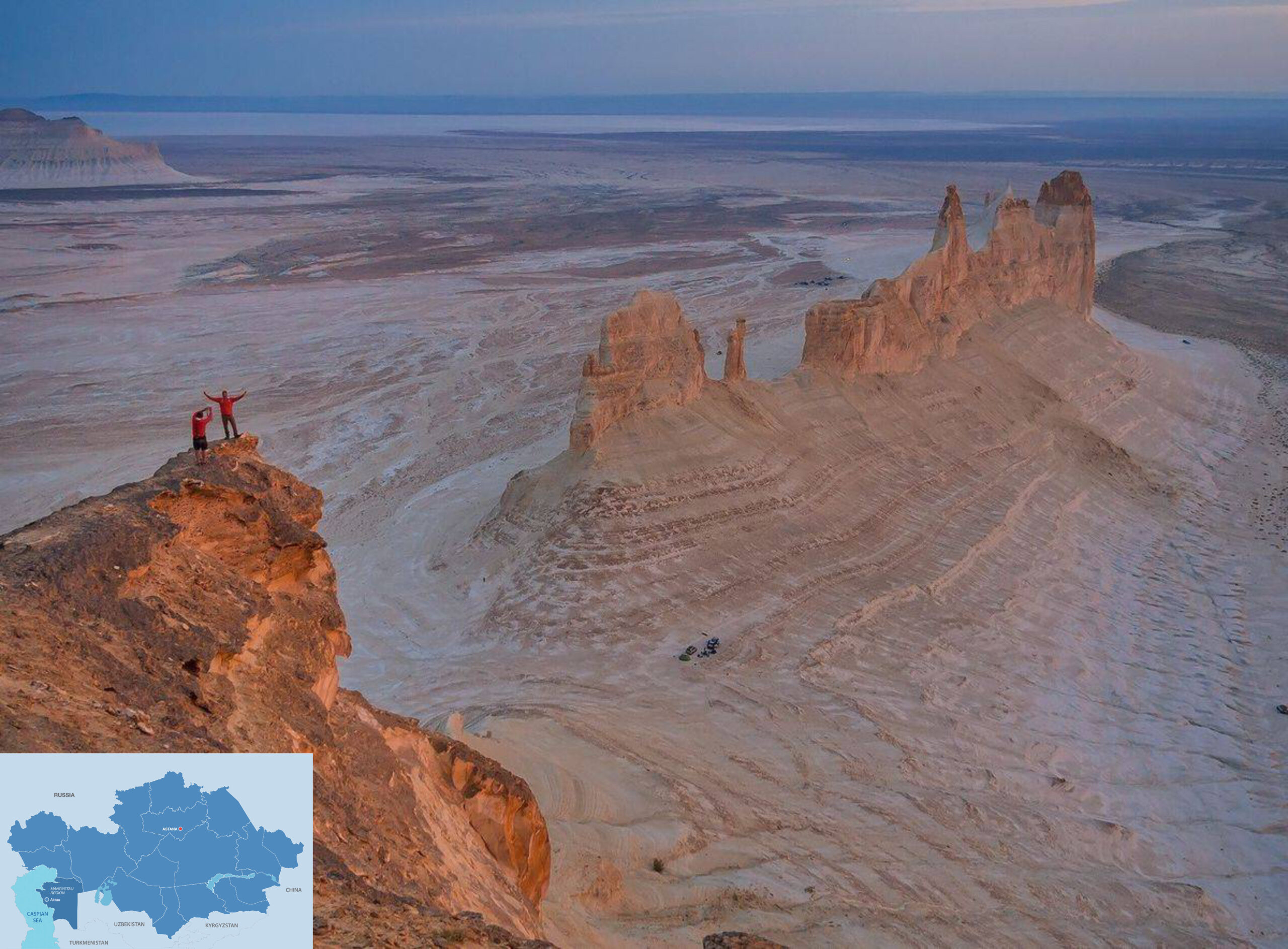
The journey to Bozzhyra is as much an adventure as the destination itself. Located approximately 300 kilometers from the coastal city of Aktau, Bozzhyra is tucked deep within Kazakhstan’s Mangystau region. Photo credit: visitmangystau.kz Click to see the map in full size. The map is designed by The Astana Times.
Stretching from the shores of the Caspian Sea to the vast Ustyurt Plateau, Mangystau is home to some of Kazakhstan’s most distinctive geological formations. Much of the region was submerged beneath the ancient Tethys Ocean millions of years ago, leaving behind chalk cliffs, colorful canyons, salt flats and fossil-rich landscapes that continue to attract geologists, photographers and adventure travelers from around the world.
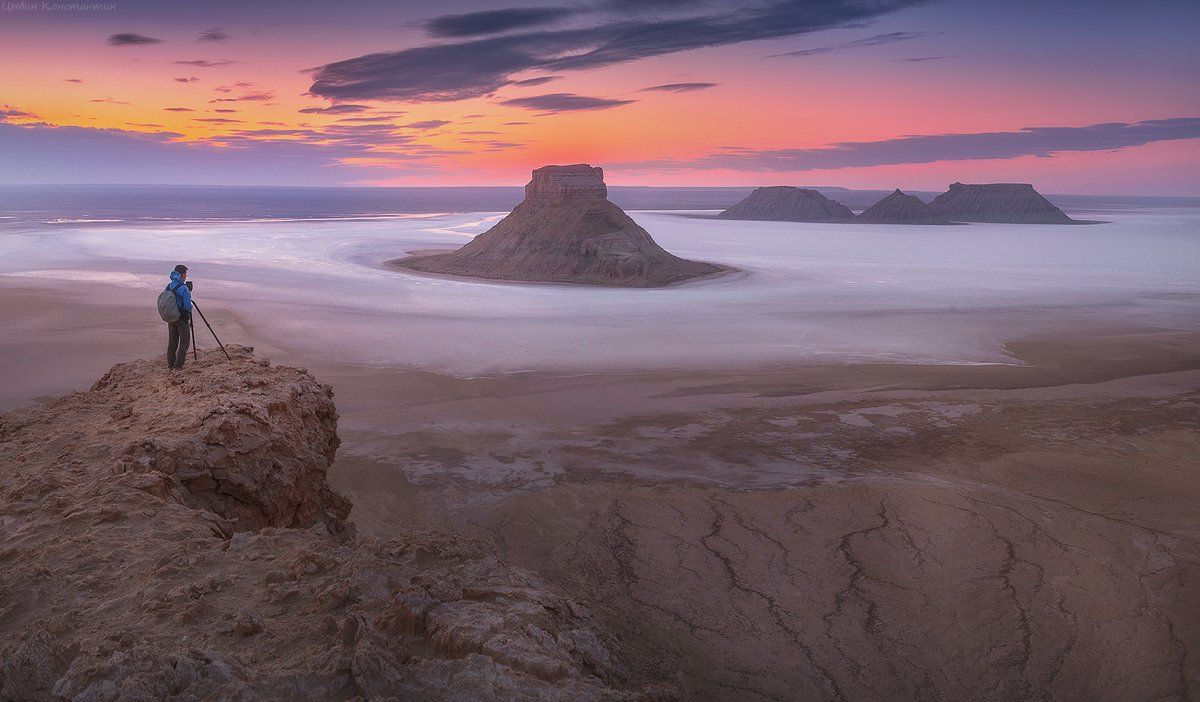
Ustyurt State Nature Reserve. Photo credit: Konstantin Tsybin/visitmangystau.kz
Leading the list is Bozzhyra, one of Kazakhstan’s best-known natural landmarks. Located on the Ustyurt Plateau around 300 kilometers from Aktau, the valley is famous for its towering white limestone cliffs and dramatic rock formations shaped by millions of years of erosion. Visitors can explore panoramic viewpoints, hike through the surrounding terrain or join off-road jeep expeditions to experience one of Central Asia’s most spectacular desert landscapes.
Another geological wonder is Torysh, commonly known as the Valley of Balls. Hundreds of perfectly rounded stone spheres, some measuring several meters in diameter, are scattered across the steppe. Scientists believe the formations developed naturally through the cementation of mineral sediments, although local folklore has long surrounded the mysterious stones with legends.
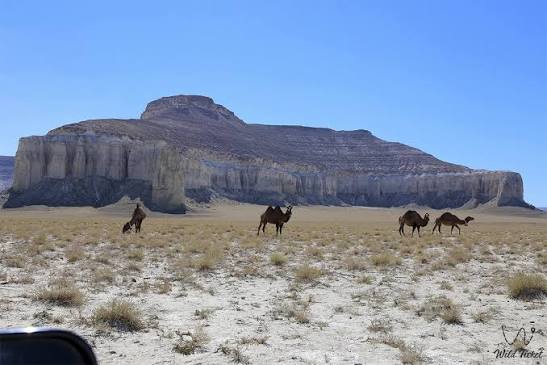
The Airakty–Shomanai Mountains. Photo credit: wildticketasia.com
The Airakty–Shomanai Mountains, often nicknamed the Valley of Castles, feature weathered cliffs and rock towers that resemble ancient fortresses. The mountains were formed from limestone deposits on the floor of the ancient Tethys Ocean some 40 million years ago. Tectonic shifts later pushed the terrain upward as the sea retreated, exposing layers of rock that wind and rain gradually shaped into the striking formations seen today. The site is particularly popular among photographers and travelers seeking panoramic views of Mangystau’s rugged terrain.
For those looking to explore more remote landscapes, the Karynzharyk Depression offers one of the region’s most striking panoramas. Its lowest point lies around 75 meters below sea level. At its heart is the Kenderli salt flat, which dries into a cracked white plain in summer but can turn into a mirror-like expanse after rainfall. The area is especially popular for camping, jeep tours and sunrise or sunset photography.
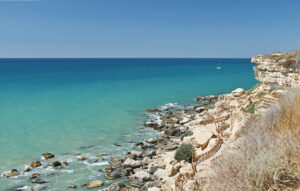
Caspian Sea. Photo credit: Shutterstock
Nature lovers can also visit Tamshaly, a small oasis where freshwater springs trickle down rocky cliffs, creating lush vegetation in the middle of the arid steppe. It is located on the Tupkaragan Peninsula near Fort Shevchenko, around 130 kilometres from Aktau. The shaded gorge provides a welcome retreat from the summer heat and has become a favorite destination for picnics, short hikes and family outings.
The Mangystau Region is also Kazakhstan’s gateway to the Caspian Sea. The beaches of Aktau attract thousands of visitors every summer with sandy shores, modern resorts and a wide range of recreational activities, including swimming, boating, jet skiing and paddleboarding. The city’s waterfront promenade has become one of the country’s most popular seaside leisure destinations.
Alongside its natural attractions, the region is home to important cultural and religious heritage sites. The Beket-Ata Underground Mosque, carved into limestone in the 18th century, remains one of Kazakhstan’s most significant pilgrimage destinations. Built by the revered Sufi scholar Beket-Ata, the mosque welcomes thousands of pilgrims and tourists annually who come to learn about the country’s spiritual traditions while admiring the unique underground architecture.
Among the Mangystau Region’s most recognizable geological monuments is Bokty Mountain, whose nearly symmetrical conical shape resembles a giant yurt rising from the surrounding plains. The 165-meter-high isolated formation also resembles a pyramid from one angle and an overturned ship from another. Located in Mangystau Region’s Karakiya District, Bokty is a state-protected natural monument. The nearest city Zhanaozen is around 90 kilometers away, while the mountain lies roughly 20 kilometers from the unpaved road linking Zhanaozen with the Beket-Ata mosque. Layers of red, yellow and white sedimentary rock create striking patterns that become especially vivid during sunrise and sunset, making the mountain a favorite stop for photographers.
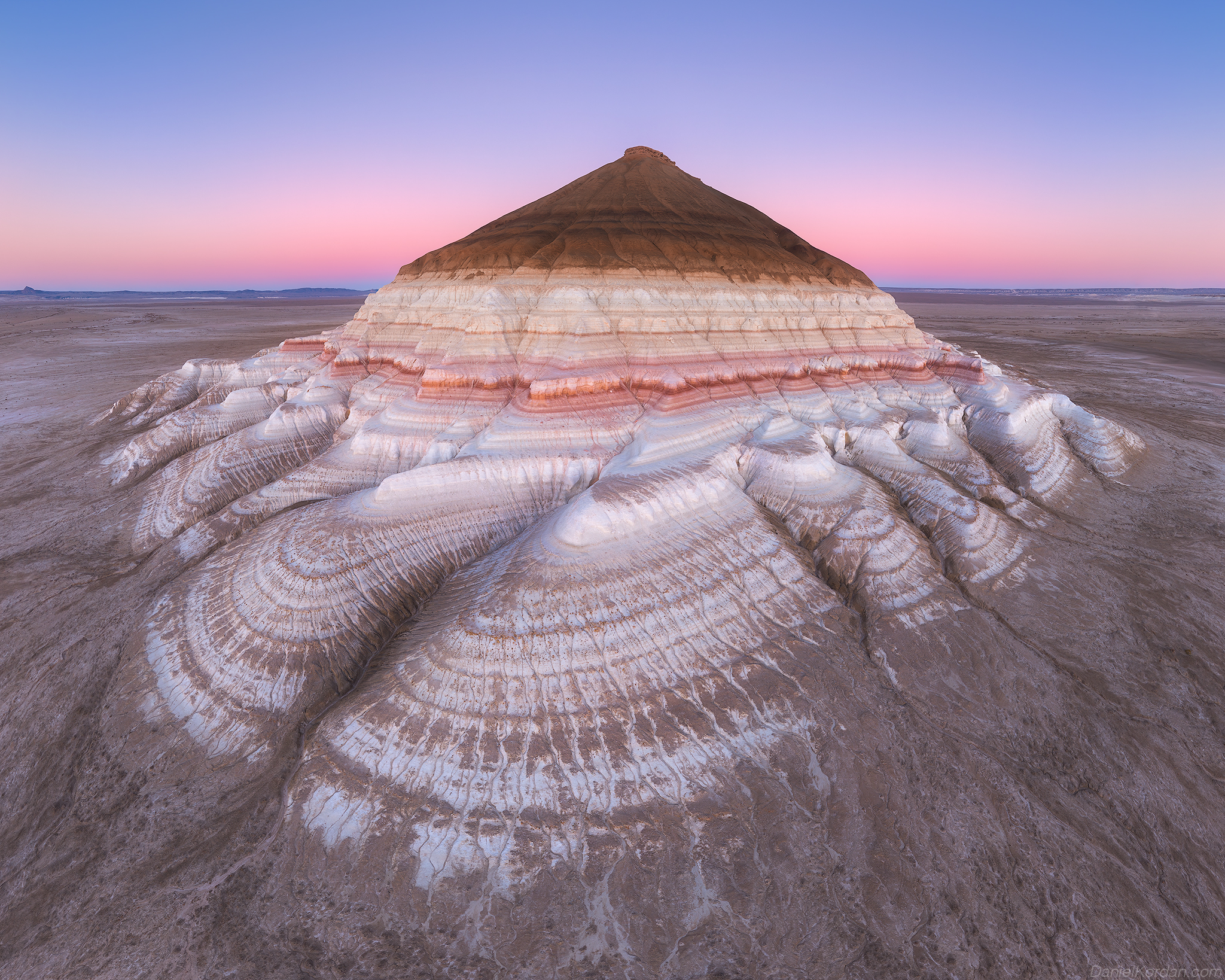
Kyzylkup (Tiramisu) Canyon. Photo credit: Daniel Kordan.
The region’s spectacular scenery continues at Tuzbair, a vast salt flat bordered by towering white chalk escarpments, located around 270 kilometers northeast of Aktau. Formed when the ancient Tethys Ocean retreated millions of years ago, Tuzbair offers visitors dramatic landscapes unlike anywhere else in Kazakhstan. Off-road expeditions, eco-tourism, camping and landscape photography are among the area’s most popular activities.
Completing the list is Kyzylkup, widely known as the Tiramisu Canyon because of its distinctive layers of red, white and golden sedimentary rock that resemble the famous Italian dessert. It is located around 20 kilometers from Bozzhyra and right near the Bokty Mountains. The colorful hills, created through millions of years of geological processes, have become one of the country’s most photographed natural attractions and are increasingly featured in international travel publications. The site is located around 300 kilometers from Aktau. Much of the route follows paved roads, but the section beyond Zhanaozen is unpaved and can be loose or slippery.
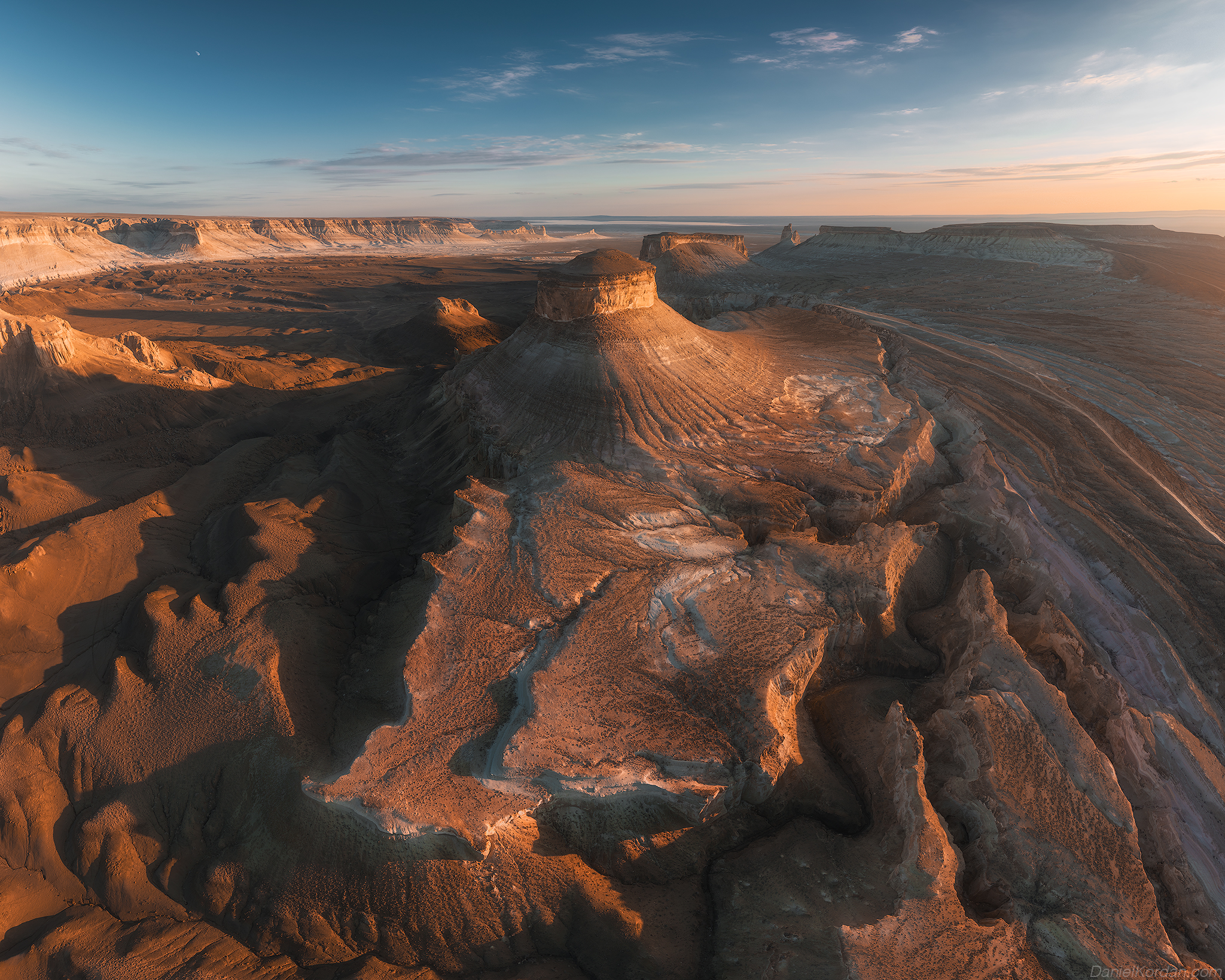
Photo credit: Daniel Kordan.
With its combination of spectacular natural monuments, ancient spiritual sites and the country’s only Caspian Sea coastline, the Mangystau Region offers visitors an opportunity to experience one of Central Asia’s most diverse and remarkable landscapes, making it an increasingly popular choice for summer travel.
Aktau city is the main gateway and it can be reached by air from major cities in Kazakhstan, including Astana and Almaty, and from abroad, as well as by train and long-distance road connections. While some attractions are accessible on day trips from Aktau, many of Mangystau’s best-known sites lie hundreds of kilometers apart in remote desert terrain. Roads are often unpaved or may be absent altogether, making a high-clearance four-wheel-drive vehicle essential for most routes. Travelers without substantial off-road experience are often advised to join an organized tour or hire a local guide and driver rather than undertake the journey independently.
