
ASTANA – Kazakhstan and the European Union are entering a more mature phase of their strategic partnership following President Kassym-Jomart Tokayev’s official visit to Brussels, Kazakhstan’s Ambassador to the EU Roman Vassilenko said during a briefing at the European Parliament on June 24.
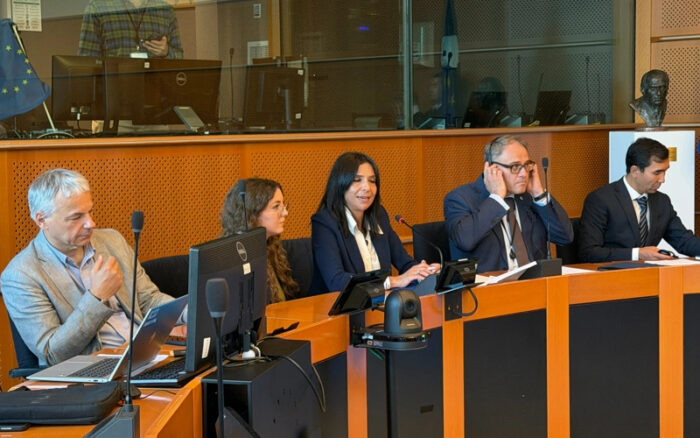
Photo credit: Arnur Rakhimbekov/Kazinform
The event brought together members of the European Parliament’s Delegation for Relations with Central Asia (DCAS) and Vassilenko to discuss the outcomes of the presidential visit and the future of Kazakhstan-EU cooperation.
Opening the briefing, DCAS Chair Giusi Princi said members of the European Parliament had closely followed Tokayev’s visit to the EU capital.
Speaking to Kazinform, Princi described the visit as historic and an important milestone in strengthening ties between Kazakhstan and Europe.
“The Delegation for Relations with Central Asia, which I have the honor to chair, has already witnessed firsthand how Kazakhstan is becoming increasingly engaged in processes aimed at promoting democracy, respect for human rights, and important constitutional reforms. Therefore, the results of the March referendum are the strongest and clearest evidence of democracy in Kazakhstan, a country that is increasingly opening up to Europe,” she said.
Vassilenko described the visit as a significant milestone in Kazakhstan-EU relations.
“It was a substantive and meaningful visit that sent a powerful political message. It confirmed that relations between Kazakhstan and the European Union are developing with growing confidence, strategic depth, and practical ambition. The main conclusion we draw from this visit is simple: Kazakhstan and the European Union are entering a more mature phase of strategic partnership. In the political sphere, the visit demonstrated the high level of trust and mutual respect that now characterizes relations between Astana and Brussels,” he said.
According to Vassilenko, Kazakhstan and the EU increasingly view each other not simply as reliable partners, but as strategic partners sharing a long-term agenda.
He highlighted growing cooperation on the Trans-Caspian International Transport Route (TITR), welcoming the EU’s increasing engagement through the Global Gateway initiative.
“As the largest economy and the largest country in Central Asia, Kazakhstan plays a crucial role in expanding the capacity of the TITR, also known as the Middle Corridor. Today, the Middle Corridor is becoming one of the most important and fastest-growing transport routes connecting Asia and Europe,” Vassilenko said.
He noted that freight volumes along the corridor have increased fivefold over the past six years to approximately 4.1-4.5 million tons annually, reflecting its rising importance for international trade and supply chains.
Vassilenko also said the visit produced tangible economic results, with the Kazakhstan-EU Business Roundtable in Brussels demonstrating how political understanding is translating into concrete business cooperation.
He underscored the growing importance of people-to-people ties, highlighting Kazakhstan’s cooperation with the EU through the Erasmus+ and Horizon Europe programs, which have expanded educational, scientific and research exchanges.
He also welcomed the successful conclusion of negotiations on visa facilitation and readmission agreements between Kazakhstan and the EU, saying they would strengthen academic, business and humanitarian contacts.
Another key outcome of the visit was the signing of the Horizontal Air Transport Agreement.
“The agreement has the potential to expand air connectivity, intensify practical exchanges, and create more opportunities for airlines and citizens on both sides. It is designed to broaden air traffic rights between the EU and Kazakhstan. Under the agreement, any EU airline will be able to operate flights between Kazakhstan and any of the 17 EU member states that already have bilateral air services agreements with Kazakhstan, instead of access being largely restricted to airlines owned and controlled by those specific countries,” he said.
Vassilenko stressed that the agreements reached in Brussels must now be translated into practical implementation with continued support from European institutions, including the European Parliament.
