
ASTANA – Kazakhstan is seeking to broaden economic cooperation with the Netherlands beyond the oil and gas sector, highlighting opportunities in agriculture, water management, logistics and infrastructure development during the Kazakhstan–Netherlands Business Council in Astana on June 23.
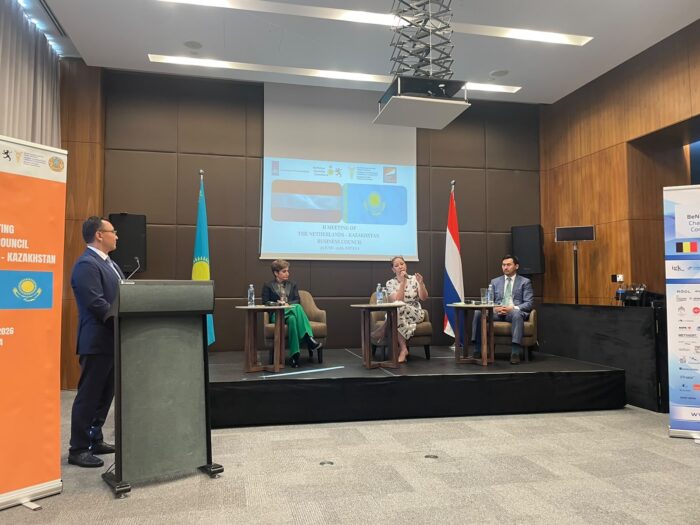
Kazakhstan’s exports to the Netherlands are dominated by crude oil, petroleum products, ferroalloys and titanium. Photo credit: Chamber of International Commerce
“The Netherlands is by far the biggest foreign direct investor in Kazakhstan. Bigger than numbers two and three, and bigger than numbers four to ten combined. That says something about the importance of Kazakhstan for the Netherlands,” said Ambassador Nicolaas Schermers of the Netherlands.
Describing Kazakhs as “land nomads” and the Dutch as “sea nomads,” Schermers noted the two countries have had limited historical interaction. Business initiatives such as the Kazakhstan–Netherlands Business Council, he said, offer an opportunity to deepen ties and build connections that did not exist in the past.
Ambassador Nicolaas Schermers. Photo credit: Chamber of International Commerce
“It is very much focused on traditional sectors – oil and gas. But nowadays, we are trying to diversify,” said the ambassador.
Schermers said Dutch companies are increasingly exploring opportunities in agriculture, water management, logistics and transport. He noted that cooperation on water management gained additional importance following the devastating floods that affected several regions of Kazakhstan in 2024.
Speaking at the meeting, Dana Kassymova, acting chairwoman of the Chamber of International Commerce, said the Netherlands remains one of Kazakhstan’s key economic partners in the European Union and has consistently ranked as the country’s largest source of foreign investment. Dutch direct investment in Kazakhstan exceeded $124 billion between 2005 and 2025, she said.
Despite these strong figures, Kassymova noted that the potential for bilateral trade and economic cooperation remains far greater than current levels suggest. Bilateral trade increased by 11% in 2025 to surpass $6 billion.
Kazakhstan’s exports to the Netherlands are dominated by crude oil, petroleum products, ferroalloys and titanium. Exports reached $6 billion in 2025, up 13% from the previous year. Imports from the Netherlands include pharmaceuticals, machinery and equipment, high-tech medical and veterinary devices, as well as agricultural products, including flowers.
More than 700 companies with Dutch participation currently operate in Kazakhstan, including major firms such as Shell, Van Oord, APM Terminals and Philips. Shell is involved in some of Kazakhstan’s largest oil and gas projects, including the Kashagan and Karachaganak fields.
According to data from the chamber, Van Oord participates in marine construction projects at the ports of Aktau and Kuryk, while APM Terminals is engaged in the development of the Trans-Caspian International Transport Route, also known as the Middle Corridor. Philips supplies medical equipment to healthcare facilities across Kazakhstan.
Raikhan Ismailova from Kazakh Invest national company highlighted the growing interest emerging in greenhouse technologies, dairy production, water management and transport infrastructure.
Ismailova spoke in detail about investment opportunities offered by Kazakhstan. She encouraged Dutch companies to look into the country’s 19 special economic zones, including the Khorgos at the border with China, Port of Aktau in western Kazakhstan, and the emerging Alatau City in the country’s southeast.
“In terms of the Alatau City, Korean firms are shaping their investment strategies over there. Chinese state construction companies are already breaking ground. We are looking for the Dutch companies to participate in projects such as smart grid, data center infrastructure, and sustainable urban design,” she said.
Officials also encouraged Dutch companies to participate in major infrastructure and logistics projects linked to Kazakhstan’s role as a transit hub between Europe and Asia. Particular attention was given to the development of the Trans-Caspian International Transport Route, which has gained strategic importance amid shifting global trade patterns.
“The Dutch companies are the large companies which have sector-specific competence, sector-specific knowledge and they have an institution, they have a whole background and acumen to develop this project and participate in the Middle Corridor project,” Ismailova said.
The council meeting comes just a week after senior Kazakh officials signed deals worth more than 160 million euros (US$182 million) with Dutch companies during the visit to Amsterdam.
